

5 cloud-based System Design interview questions I saw repeatedly as an interviewer
The cloud architecture questions that frequently appear in System Design interviews

Cloud computing has fundamentally changed how modern systems are designed, deployed, and scaled. As organizations increasingly rely on AWS, Azure, Google Cloud, and other cloud platforms, System Design interviews have evolved alongside them.
Candidates are no longer expected to design systems solely around physical servers and data centers. Instead, they are often asked to think about elasticity, managed services, multi-region deployments, fault tolerance, and cloud-native architectures.
After interviewing hundreds of engineers at Microsoft and Meta, I noticed that cloud-based System Design interview questions rarely test knowledge of a specific cloud provider. Interviewers are not usually interested in whether you know every AWS service or Azure feature.
They want to understand whether you can design scalable, reliable, and cost-effective systems that take advantage of cloud principles. Understanding the types of cloud-focused questions that appear in interviews can help you prepare far more effectively than memorizing cloud service catalogs.
Why cloud concepts have become important in System Design interviews
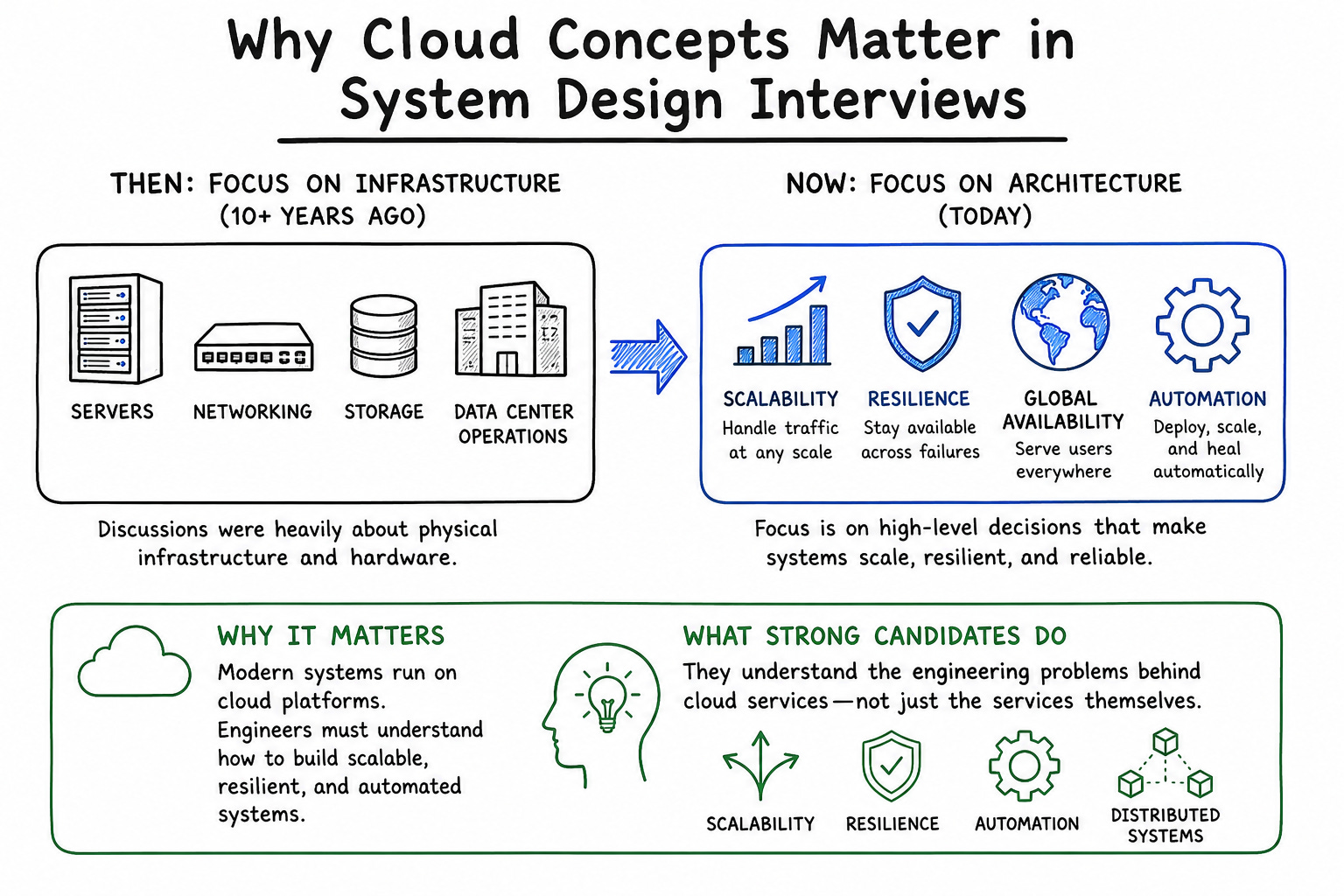
A decade ago, many System Design interview discussions focused heavily on physical infrastructure. Engineers spent significant time discussing server provisioning, hardware constraints, networking equipment, and data center operations. While these topics still matter, modern cloud platforms have abstracted much of that complexity away.
As a result, interview questions have shifted toward higher-level architectural decisions. Instead of asking how to provision servers, interviewers are more likely to ask how a system should scale automatically under unpredictable traffic. Instead of focusing on hardware failures, they may explore how applications remain available across multiple availability zones or geographic regions.
The reason cloud concepts appear so frequently is that they mirror how modern engineering teams operate. Most large-scale systems today rely on cloud infrastructure in some form. Whether a company uses AWS, Azure, Google Cloud, or a hybrid approach, engineers are expected to understand scalability, resilience, automation, and distributed system principles.
Strong candidates understand that cloud architecture is not about memorizing services. It is about understanding the engineering problems those services are designed to solve.
What interviewers are actually evaluating
One misconception candidates often have is that cloud-based System Design interviews require deep expertise in a specific cloud platform. While cloud knowledge is certainly helpful, most interviewers are evaluating broader architectural thinking rather than vendor-specific terminology.
For example, if an interviewer asks how you would design a globally distributed application, they are usually interested in concepts such as replication, failover, latency optimization, and disaster recovery. Whether you mention AWS Route 53, Azure Traffic Manager, or Google Cloud Load Balancing is often less important than understanding why global traffic distribution matters.
Similarly, when discussing scalable storage solutions, interviewers care more about your understanding of object storage, consistency models, and durability than whether you can recite specific service names. Cloud providers change rapidly, but architectural principles remain relatively stable.
Strong candidates focus on explaining requirements, constraints, and tradeoffs. They use cloud technologies as tools for solving problems rather than as evidence of memorized knowledge.
Question 1: Design a cloud-based file storage service
One of the most common cloud-based System Design interview questions involves designing a file storage platform similar to Dropbox, Google Drive, or OneDrive. This question appears frequently because it touches multiple areas of cloud architecture simultaneously.
Candidates must consider how files are uploaded, stored, replicated, and retrieved while supporting large numbers of users. The discussion often expands into topics such as object storage, metadata management, synchronization, and global content delivery.
Strong candidates typically begin by separating file metadata from file content. Metadata can be stored in databases, while large files are placed in scalable object storage systems. As traffic grows, content delivery networks can reduce latency by caching files closer to users. Replication strategies improve durability and availability while protecting against hardware failures.
Interviewers often use this question to evaluate understanding of storage scalability and cloud-native design principles because it naturally introduces discussions about durability, redundancy, and geographic distribution.
Question 2: Design a cloud-native video streaming platform
Video streaming platforms appear frequently because they combine storage, networking, scalability, and performance challenges into a single system. Designing a service similar to YouTube or Netflix requires candidates to think carefully about content ingestion, storage, processing, and delivery.
The primary challenge usually involves managing extremely large files while serving content efficiently to users around the world. Cloud-based architectures often leverage object storage systems for video content, distributed processing systems for transcoding, and content delivery networks for low-latency playback.
Interviewers frequently explore bottlenecks within the system. They may ask how uploads are processed, how videos are converted into different formats, or how content remains available during regional failures. These discussions often reveal how well candidates understand distributed workloads and cloud scalability patterns.
Strong answers focus less on specific cloud products and more on explaining why cloud-native architectures are well-suited for handling unpredictable demand and massive storage requirements.
Question 3: Design a globally distributed web application
Global applications introduce challenges that many candidates initially underestimate. Users located across different continents expect fast response times regardless of their geographic location. Achieving this requires careful architectural decisions involving replication, traffic routing, caching, and failover strategies.
Interviewers often use this question to evaluate understanding of latency and availability tradeoffs. A system serving users worldwide may require multiple deployment regions, geographic load balancing, replicated databases, and localized caching layers.
One challenge frequently discussed involves maintaining data consistency across regions. Keeping data perfectly synchronized can increase latency, while allowing eventual consistency may improve performance but introduce temporary discrepancies. This tradeoff appears frequently in distributed systems discussions.
Candidates who understand global architecture generally recognize that reducing physical distance between users and services often improves performance significantly. The discussion becomes much stronger when latency, consistency, and reliability are considered together rather than independently.
Question 4: Design a scalable cloud-based e-commerce platform
E-commerce systems remain popular interview topics because they involve multiple interacting components that must scale reliably during periods of heavy traffic. Events such as holiday sales create significant demand spikes that cloud infrastructure is particularly well-suited to handle.
Interviewers may ask how the platform processes orders, manages inventory, handles payments, and supports product searches. These discussions often expand into topics such as caching, asynchronous processing, database scaling, and fault tolerance.
One reason this question appears frequently is that it introduces realistic business constraints. Availability becomes critical because downtime directly affects revenue. Inventory consistency becomes important because overselling products creates customer issues. Scalability becomes essential because traffic patterns can change dramatically during promotions.
Strong candidates demonstrate how cloud-native architectures can handle these challenges through elasticity, redundancy, and distributed processing.
Question 5: Design a cloud-based real-time analytics platform
Analytics systems present a different set of architectural challenges because they often process enormous amounts of data continuously. Interviewers frequently use this question to evaluate understanding of streaming systems, data pipelines, and large-scale processing architectures.
A cloud-based analytics platform may ingest events from millions of users, process data in near real time, and generate reports or dashboards. This naturally introduces discussions about message queues, stream processing frameworks, distributed storage systems, and scalability concerns.
Candidates who perform well typically separate data ingestion, processing, storage, and presentation layers. They recognize that different workloads have different requirements and that cloud infrastructure enables independent scaling of these components.
The discussion often expands into reliability considerations because analytics systems frequently need to process data continuously without losing events during failures.
Common cloud architecture concepts that appear across questions
Although cloud-based interview questions vary considerably, several architectural concepts appear repeatedly because they address common scalability and reliability challenges.
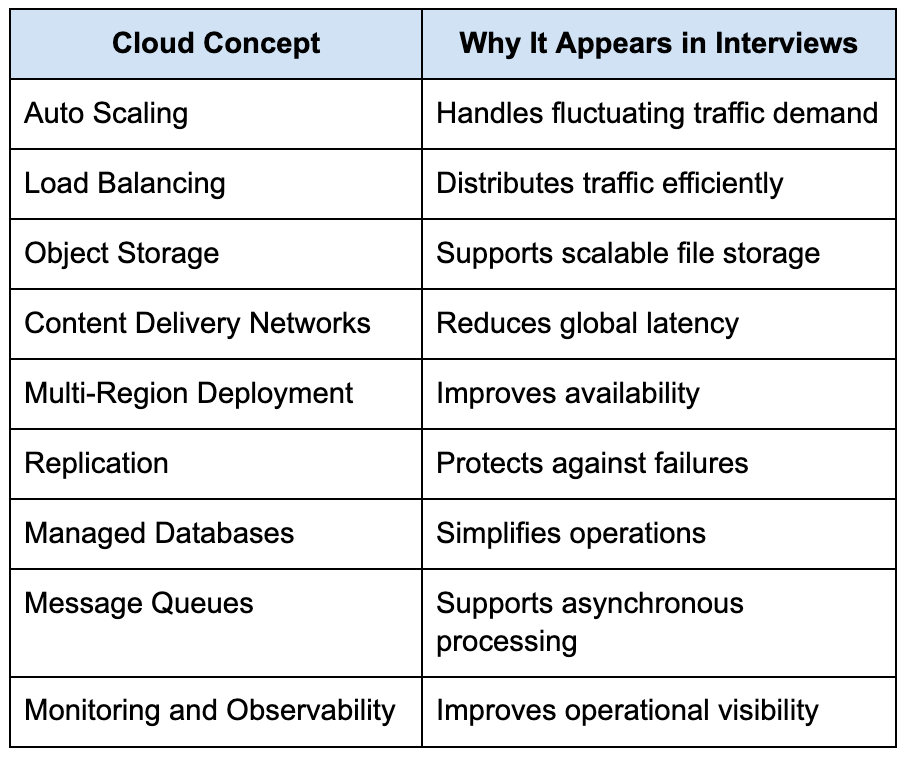
Strong candidates understand these concepts at a practical level. They know what problems each concept solves and when it should be introduced within a design.
The biggest mistake candidates make with cloud questions
One pattern I noticed repeatedly during interviews was that candidates often focused too heavily on naming cloud services. They would list products from AWS, Azure, or Google Cloud without clearly explaining why those services were necessary.
This approach rarely creates a strong interview. Interviewers are usually more interested in architectural reasoning than vendor knowledge. A candidate who explains how object storage improves scalability generally performs better than a candidate who simply mentions S3 without discussing its purpose.
The same principle applies across cloud architectures. Services are tools rather than solutions. Understanding the problem being solved is significantly more important than memorizing product catalogs. Strong candidates start with requirements, identify constraints, and then introduce cloud services as mechanisms for addressing those constraints.
The goal is to demonstrate engineering judgment rather than demonstrate familiarity with marketing terminology.
Final thoughts
Cloud-based System Design interview questions have become increasingly common because modern software systems are increasingly built on cloud infrastructure. Fortunately, preparing for these interviews does not require memorizing every service offered by AWS, Azure, or Google Cloud. The underlying principles remain consistent regardless of the platform being used.
After interviewing hundreds of engineers at Microsoft and Meta, I found that the strongest candidates focused on architecture rather than products. They understood scalability, availability, fault tolerance, latency, and operational tradeoffs. When cloud services appeared in the discussion, they were introduced because they solved specific problems rather than because they appeared on certification exams.
If you are preparing for cloud-based System Design interviews, focus on understanding the challenges modern cloud architectures address. Once you understand the problems, the solutions become much easier to recognize. Ultimately, interviewers are not evaluating whether you know the cloud. They are evaluating whether you know how to design systems that can thrive within it.