

Common mistakes in System Design interviews I’ve noticed over the years
The mistakes interviewers notice most often during System Design discussions

One of the most surprising things about System Design interviews is that candidates rarely fail because they lack technical knowledge. After interviewing hundreds of engineers at Microsoft and Meta, I found that most candidates understood databases, caching, load balancing, APIs, and distributed systems concepts reasonably well.
The difference between strong and weak interviews often came down to how that knowledge was applied. Many candidates made avoidable mistakes that prevented them from demonstrating their actual engineering ability. Some jumped into architecture before understanding the problem. Others introduced unnecessary complexity or failed to discuss tradeoffs.
In many cases, the architecture itself was not the issue. The reasoning process behind it was. Understanding the most common mistakes in System Design interviews can help you avoid the pitfalls that interviewers see repeatedly and significantly improve the quality of your design discussions.
Starting the design before understanding the problem
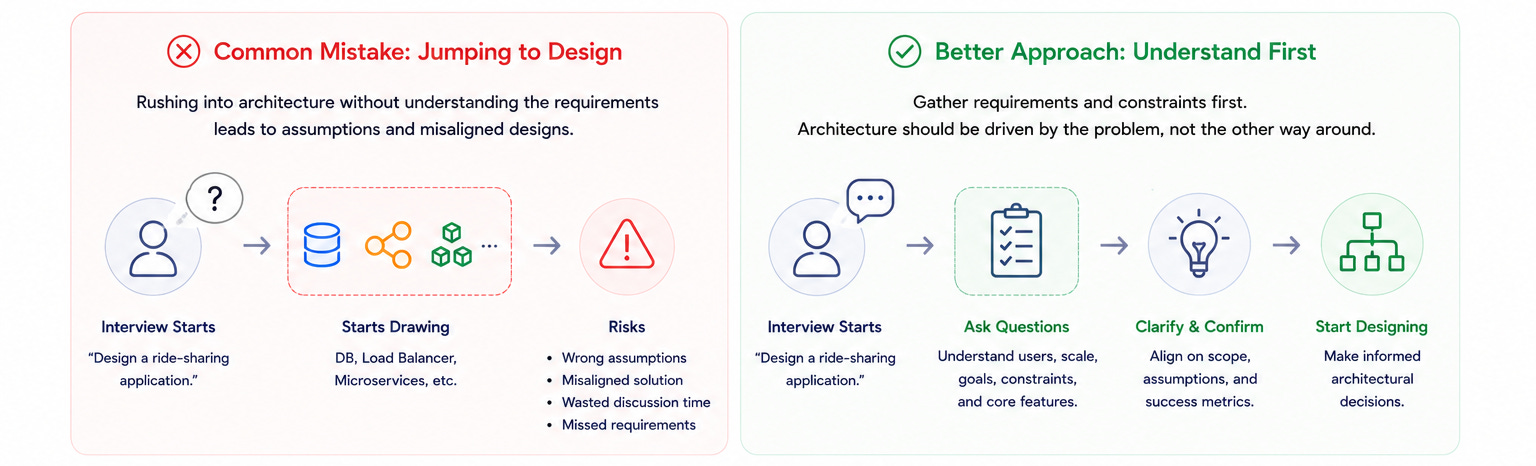
One of the most common mistakes candidates make is rushing into architecture discussions before fully understanding the requirements. Many engineers feel pressure to demonstrate technical knowledge immediately, so they start drawing databases, load balancers, and microservices within the first few minutes of the interview.
The problem with this approach is that architecture should be driven by requirements. If you do not understand the problem, every architectural decision becomes an assumption. Those assumptions may be correct, but they may also send the discussion in the wrong direction. Interviewers often provide intentionally broad prompts because they want to see whether candidates clarify requirements before proposing solutions.
Strong candidates spend time gathering information. They ask about user expectations, scale requirements, latency goals, availability targets, and core functionality. This phase may seem simple, but it often determines the quality of everything that follows. A candidate who understands the problem thoroughly will almost always design a stronger system than a candidate who immediately starts drawing diagrams.
Ignoring non-functional requirements
Many candidates focus heavily on features while giving relatively little attention to non-functional requirements in System Design interview questions. They discuss what the system does, but spend less time discussing how the system should behave under real-world conditions.
Scalability, availability, reliability, latency, durability, and security often have a greater influence on architecture than the features themselves. A messaging application serving a thousand users may require a completely different design than one serving a hundred million users, even if both applications provide identical functionality.
Interviewers frequently pay close attention to this area because non-functional requirements reveal engineering maturity. Candidates who ignore scalability or reliability concerns often produce architectures that work conceptually but fail under realistic workloads. Strong candidates treat non-functional requirements as first-class design constraints and use them to guide architectural decisions throughout the discussion.
The best System Design interviews consistently connect architecture back to performance, reliability, and operational requirements rather than focusing exclusively on functionality.
Introducing complexity too early
Another mistake I observed repeatedly was premature complexity. Candidates often assume sophisticated architectures automatically lead to stronger interviews. As a result, they introduce microservices, event-driven systems, distributed databases, and advanced scaling techniques before establishing whether those technologies are necessary.
This usually creates more problems than it solves. Complex architectures are difficult to justify when the system has not yet reached the scale that requires them. Interviewers often challenge these decisions because they want to understand whether candidates recognize the operational costs associated with complexity.
I have seen candidates propose multi-region distributed systems for applications with relatively modest traffic requirements. The architecture looked impressive, but the additional complexity delivered little practical value. Strong candidates usually start with the simplest architecture that satisfies the requirements. They then evolve the design incrementally as new constraints emerge.
This approach mirrors how successful production systems often evolve. Complexity should be introduced in response to real bottlenecks rather than hypothetical future problems.
Failing to estimate scale
Scale estimation is an area where many candidates struggle. Some skip it entirely because they view it as a separate exercise rather than an integral part of the design process. Others perform calculations but never connect those numbers back to architectural decisions.
The purpose of scale estimation is not mathematical precision. The purpose is to understand the workload the system must support. Traffic volume, storage requirements, throughput expectations, and growth projections all influence architectural choices. Without this context, it becomes difficult to justify decisions involving databases, caching, partitioning, or replication.
Strong candidates use scale estimates to identify constraints. If the system processes billions of requests per day, certain bottlenecks become more likely. If storage requirements grow rapidly, different database strategies may be necessary. Estimation creates a foundation for meaningful architectural reasoning.
Interviewers are generally less interested in exact numbers than in whether candidates understand how scale influences design decisions.
Designing without identifying bottlenecks
Many candidates introduce architectural components because they have seen them in reference solutions rather than because they solve specific problems. This often leads to designs that contain load balancers, caches, queues, and distributed databases without clear justification.
Strong System Designers think differently. They identify bottlenecks first and then introduce solutions in response to those bottlenecks. If the database becomes overloaded, caching may help. If synchronous processing limits throughput, asynchronous workflows may become valuable. If a single server cannot handle traffic growth, horizontal scaling becomes necessary.
This approach creates much stronger design discussions because every architectural component has a purpose. Interviewers generally prefer candidates who explain why a technology is needed over candidates who simply mention technologies that appear in popular architecture diagrams.
Systems evolve because constraints emerge. Understanding those constraints is often more important than understanding the technologies themselves.
Not discussing tradeoffs
One of the clearest signals of a weak System Design interview is the absence of tradeoff discussions. Some candidates present architectural decisions as if they are universally correct. They explain the benefits of their choices but rarely acknowledge the costs.
Real engineering does not work that way. Every decision involves compromise. Improving scalability often increases complexity. Increasing consistency may affect availability. Reducing latency may increase infrastructure costs. These tradeoffs exist regardless of the specific system being designed.
Interviewers frequently use tradeoff discussions to evaluate engineering judgment. Two candidates may propose similar architectures, but the candidate who understands the consequences of their decisions usually performs better. Discussing tradeoffs demonstrates that you are thinking like an engineer rather than simply assembling technologies.
Strong candidates naturally explain both the advantages and disadvantages of major architectural decisions throughout the conversation.
Focusing on technologies instead of problems
Many candidates become overly focused on technology names. They mention Kubernetes, Kafka, Redis, Cassandra, DynamoDB, RabbitMQ, and other tools because they believe familiarity with these technologies demonstrates expertise.
The problem is that technology choices matter less than the problems they solve. Interviewers generally care more about architectural reasoning than specific implementations. A candidate who explains why asynchronous processing is necessary often performs better than a candidate who simply mentions Kafka without explaining its role.
Strong engineers start with requirements and constraints. They identify the challenge, explain the solution, and then discuss technologies if appropriate. The technology becomes a consequence of the design process rather than the starting point.
This distinction is subtle but important. Interviews evaluate problem-solving ability, not product memorization.
Poor communication throughout the interview
System Design interviews are often described as technical evaluations, but communication plays a significant role in determining outcomes. Some candidates have strong technical knowledge yet struggle because their reasoning remains difficult to follow.
Interviewers need visibility into your thought process. If you make assumptions without explaining them or jump between topics without clear transitions, the discussion becomes difficult to evaluate. Strong candidates narrate their thinking continuously. They explain requirements, justify decisions, and describe tradeoffs as they work through the problem.
Communication also makes collaboration easier. Interviewers frequently introduce new constraints or ask follow-up questions. Candidates who communicate clearly adapt more effectively because the discussion feels like an engineering conversation rather than a presentation.
The strongest interviews often feel collaborative. The architecture emerges naturally because the reasoning process is visible throughout the discussion.
Forgetting reliability and failure scenarios
Many candidates design systems as if failures never occur. They focus on normal operation but spend little time discussing what happens when servers crash, databases become unavailable, or network partitions occur.
This oversight can significantly weaken an otherwise strong design. Real-world systems experience failures constantly. Reliability often becomes more important as systems scale because larger systems have more opportunities for things to go wrong.
Interviewers frequently introduce failure scenarios because they want to understand how candidates think about resilience. Questions involving replication, failover, redundancy, and disaster recovery often emerge from these discussions.
Strong candidates assume failures are inevitable. Instead of asking whether something might fail, they ask how the system behaves when failure occurs. This mindset often distinguishes experienced engineers from candidates who focus exclusively on ideal operating conditions.
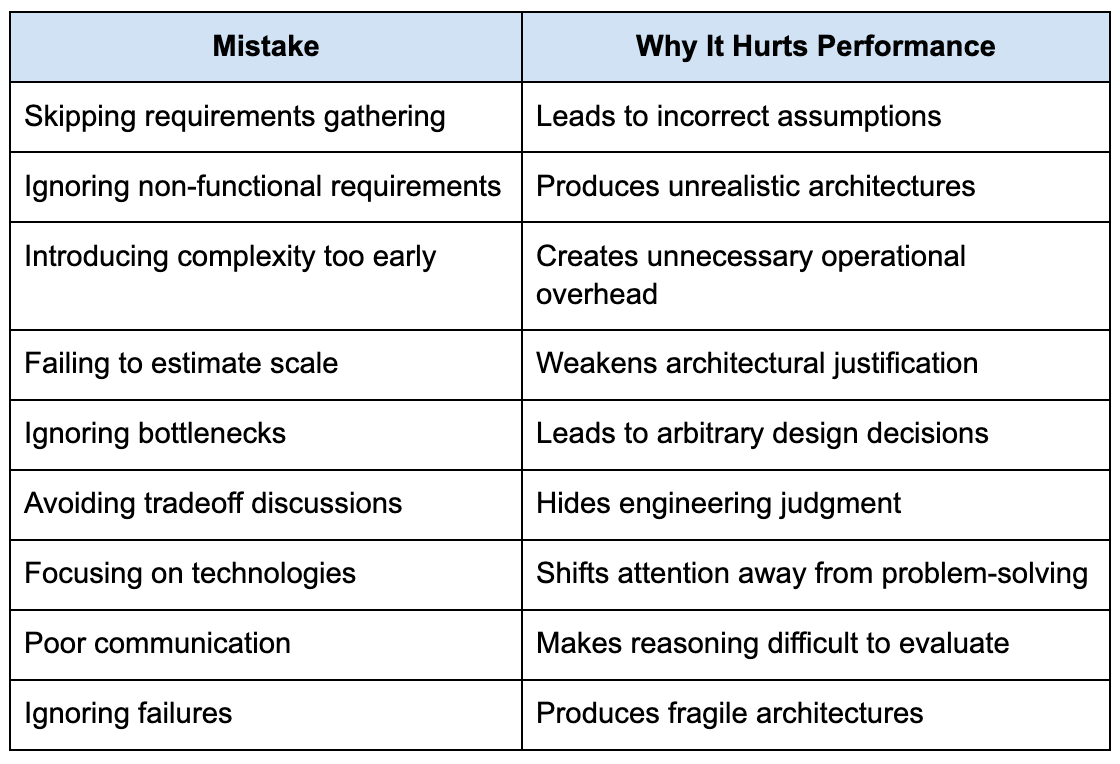
The most common mistakes at a glance
Final thoughts
The most common mistakes in System Design interviews are rarely technical deficiencies. More often, they involve process, reasoning, and communication. Candidates rush into architecture without understanding requirements, introduce complexity without justification, ignore tradeoffs, and focus on technologies instead of constraints. These mistakes prevent interviewers from seeing the engineering judgment they are trying to evaluate.
After interviewing hundreds of engineers at Microsoft and Meta, I found that the strongest candidates followed a remarkably consistent approach. They clarified requirements, estimated scale, identified bottlenecks, discussed tradeoffs, and communicated their thinking clearly throughout the discussion. Their architectures were not necessarily more sophisticated than everyone else’s. They were simply better aligned with the problem being solved.
If you want to improve your System Design interviews, focus less on memorizing architecture diagrams and more on avoiding these common mistakes. In many cases, eliminating these pitfalls will improve your performance far more than learning another distributed systems technology. Ultimately, System Design interviews are not about building perfect systems. They are about demonstrating how you think when designing systems that must operate in the real world.