

Does a System Design interview involve coding? What interviewers really want
The answer is more nuanced than most software engineers expect

If you’re preparing for System Design interviews, one question eventually comes up in nearly every study group, interview forum, and engineering discussion: Does a System Design interview involve coding?
The confusion is understandable because candidates often hear conflicting advice. Some engineers claim System Design interviews are entirely architecture-focused and never require code, while others describe interview experiences where they were asked to write APIs, database schemas, or implementation details on a whiteboard.
After interviewing candidates and helping engineers prepare for technical interviews, I have found that both perspectives contain some truth. The real answer depends on the company, the level you’re interviewing for, and what interviewers are actually trying to evaluate. Understanding that distinction can significantly improve how you prepare.
Why this question creates so much confusion
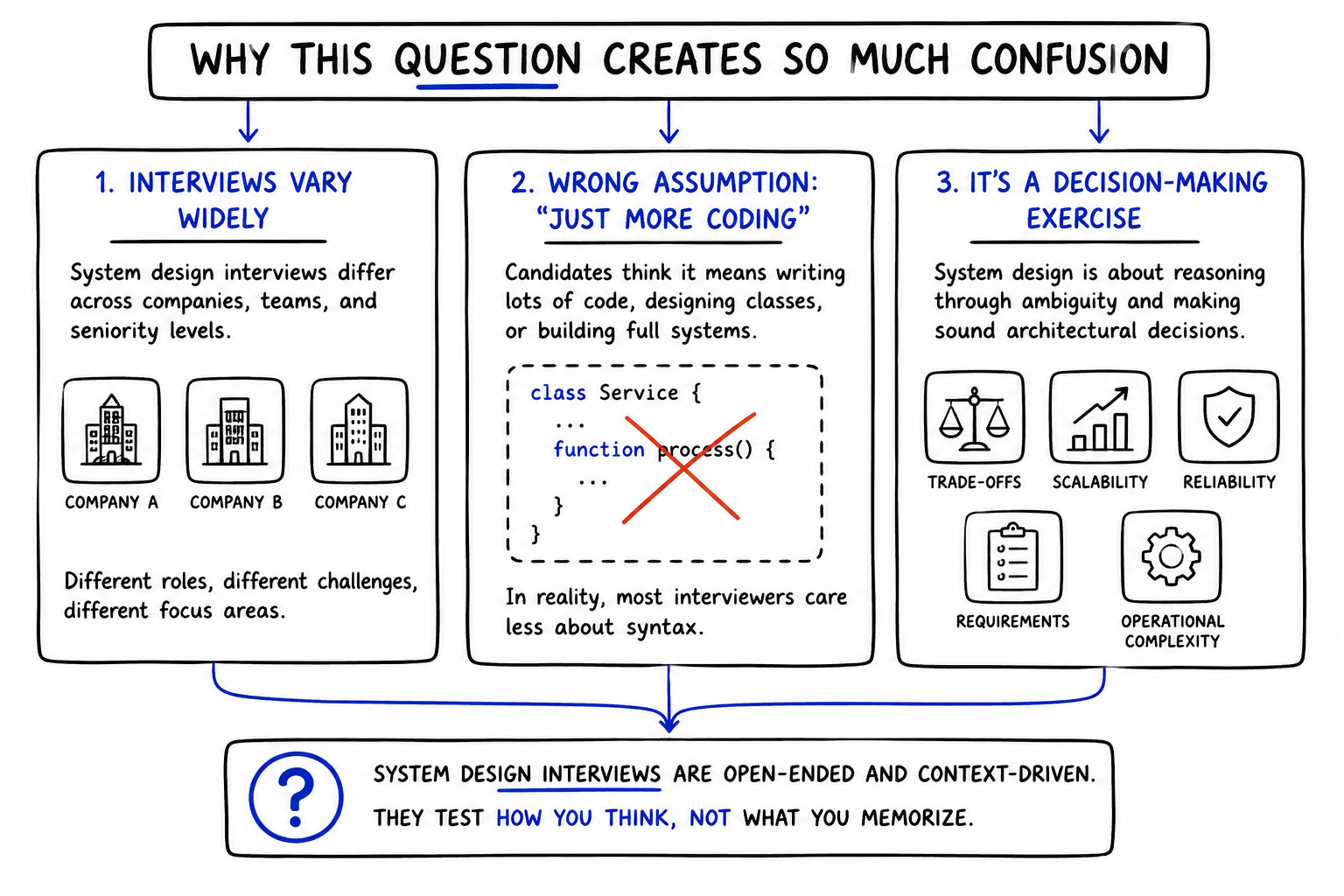
One reason candidates struggle to understand whether a System Design interview involves coding is that System Design interviews vary substantially across companies and seniority levels. Unlike coding interviews, which typically have relatively consistent expectations, System Design interviews are intentionally open-ended. Different interviewers may emphasize different aspects of software engineering depending on the role they are hiring for and the challenges their teams face.
Many candidates assume System Design interviews are simply larger versions of coding interviews. They believe the interviewer expects them to write extensive code for distributed systems, design detailed class hierarchies, or implement production-ready services during the session. In reality, most interviewers are less interested in syntax and more interested in how you reason about architectural decisions, scalability constraints, trade-offs, reliability requirements, and operational complexity.
The misunderstanding often comes from treating System Design as a coding exercise when it is fundamentally a decision-making exercise. The interviewer is typically evaluating your ability to navigate ambiguity, prioritize requirements, and design systems that can survive real-world traffic patterns rather than testing whether you remember language-specific implementation details.
What interviewers are actually evaluating
When engineers ask whether a System Design interview involves coding, they are usually trying to understand what skills will be assessed during the interview. The answer becomes much clearer when you examine the evaluation criteria behind most System Design interviews.
This distinction explains why many candidates who are exceptional programmers sometimes struggle during System Design interviews. They spend their preparation time memorizing implementation details instead of learning how to justify architectural choices.
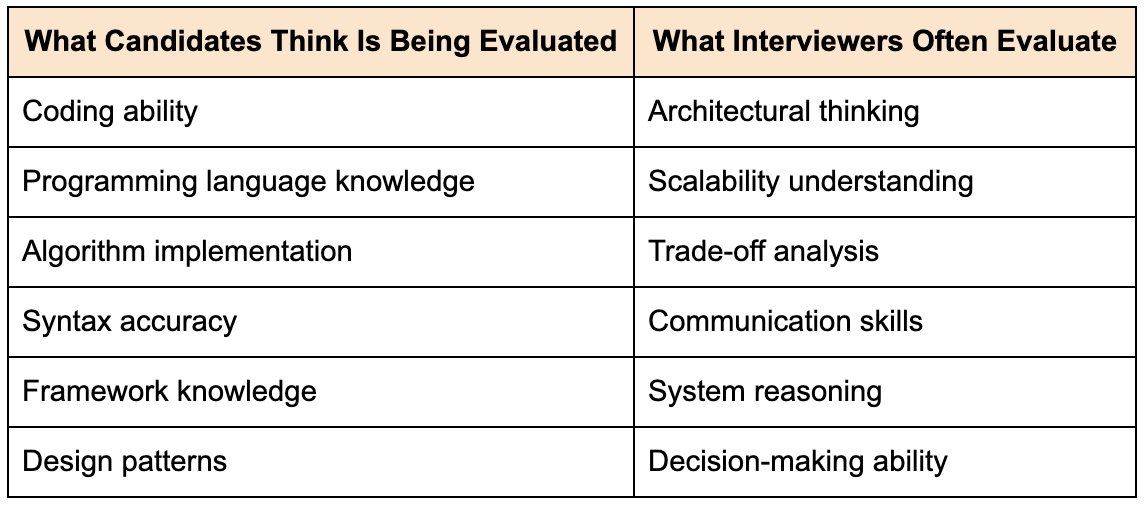
Interviewers generally assume that coding ability has already been assessed through earlier technical rounds. The System Design interview provides an opportunity to evaluate how you think about software systems at a higher level. Rather than asking whether you can implement a cache, interviewers want to know when you would use one, why you would introduce it, and what trade-offs come with that decision.
When coding does appear in a System Design interview
Although System Design interviews are not primarily coding exercises, coding occasionally appears in specific situations. Understanding these situations helps candidates prepare without overemphasizing implementation details.
For junior and mid-level roles, interviewers may ask candidates to sketch API contracts, database schemas, or service interfaces as part of the discussion. The goal is not to evaluate syntax but to understand whether the candidate can translate architectural ideas into practical implementation plans. These exercises help interviewers verify that the candidate’s proposed design can actually be built.
Consider a URL shortening service interview. The interviewer may ask how the API would look, what database tables would be required, or how URL mappings would be stored. While these tasks involve elements of coding, they are still fundamentally design discussions. The interviewer is evaluating whether the architecture connects logically to the implementation rather than checking whether every line of code compiles.
At senior levels, coding becomes even less important. Staff engineers, principal engineers, and engineering managers are generally evaluated on system thinking, organizational impact, scalability decisions, and technical leadership. Their interviews focus on architecture rather than implementation because their day-to-day responsibilities increasingly involve guiding technical direction instead of writing every component themselves.
The difference between coding interviews and System Design interviews
Many preparation mistakes happen because candidates fail to understand the difference between these two interview formats.
In a coding interview, success often comes from finding the correct algorithm and implementing it efficiently. In a System Design interview, success comes from demonstrating sound judgment while navigating uncertainty.
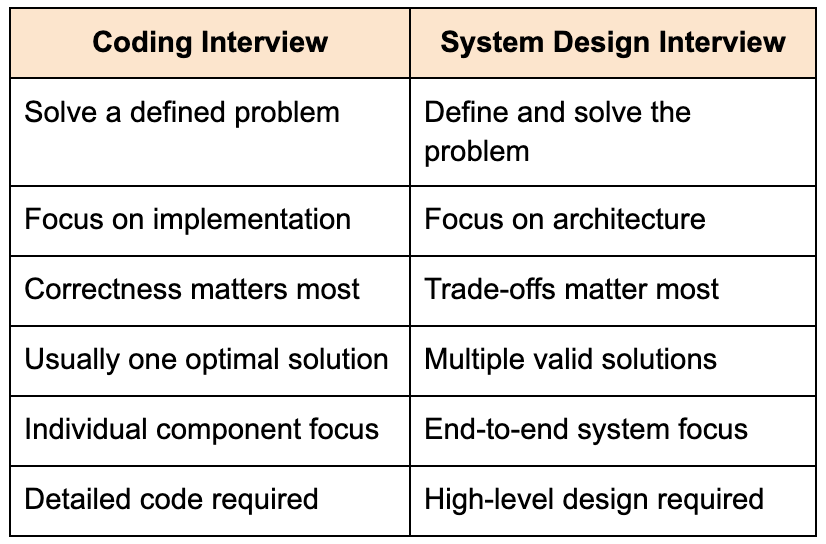
There is rarely a perfect design. Every architectural choice introduces trade-offs involving latency, reliability, complexity, cost, and scalability. Interviewers want to see whether you recognize those trade-offs and whether your decisions remain aligned with the system’s requirements.
Why candidates should still understand implementation details
The fact that a System Design interview does not primarily involve coding does not mean implementation knowledge is irrelevant. In fact, some of the strongest System Design performances come from candidates who can connect high-level architecture to realistic implementation constraints.
A common failure mode occurs when candidates design theoretically elegant systems that would be difficult or impossible to implement in practice. For example, a candidate might propose an event-driven architecture with dozens of services and asynchronous workflows without understanding the operational burden that accompanies such a design.
Strong candidates balance abstraction with practicality. They understand how databases behave under load, how caching layers affect consistency, how APIs evolve over time, and how distributed systems fail in production. That knowledge often comes from implementation experience rather than architectural theory alone.
Interviewers frequently probe implementation details not because they want code but because they want evidence that the candidate’s architectural decisions are grounded in reality.
How you should prepare if you’re wondering whether a System Design interview involves coding
The best preparation strategy is to treat coding as a supporting skill rather than the primary focus. You should be comfortable discussing APIs, data models, service boundaries, and implementation trade-offs, but the majority of your preparation should focus on architectural reasoning.
Study common System Design patterns, understand how large-scale systems operate, learn the trade-offs between different storage solutions, and practice explaining your decisions clearly. The ability to communicate architecture effectively often matters as much as the architecture itself because System Design is ultimately a collaborative activity inside engineering organizations.
The strongest candidates do not simply design systems. They explain why the system was designed that way, what alternatives were considered, what trade-offs were accepted, and how the architecture would evolve as requirements change.
Final thoughts
So, does a System Design interview involve coding? Sometimes, but not in the way most candidates imagine. Coding may appear in the form of API definitions, database schemas, service contracts, or implementation discussions, but it is rarely the primary objective of the interview. What interviewers are truly evaluating is your ability to think about systems holistically, make sound engineering decisions, communicate trade-offs, and design architectures that solve real business problems. If you prepare with that mindset, you will approach System Design interviews much more effectively than candidates who focus exclusively on implementation details.