

How I learned to crack engineering manager interviews after interviewing hundreds of candidates
What actually gets engineering manager candidates hired at top technology companies

Engineering manager interviews are often misunderstood by strong engineers because the evaluation criteria change long before most candidates realize it.
Many engineers spend weeks preparing System Design questions, revisiting distributed systems concepts, and practicing technical discussions, yet they still struggle to convert interviews into offers because the interview is no longer testing whether they can build systems. It is testing whether they can build teams, make decisions under uncertainty, and scale organizations through other people.
After spending nearly a decade at Microsoft and Meta and interviewing hundreds of candidates across different levels, I noticed a recurring pattern. The candidates who succeeded were rarely the ones with the most impressive technical achievements. They were the ones who could connect technical decisions to business outcomes, team growth, execution strategy, and organizational impact.
Why engineering manager interviews feel different from senior engineer interviews
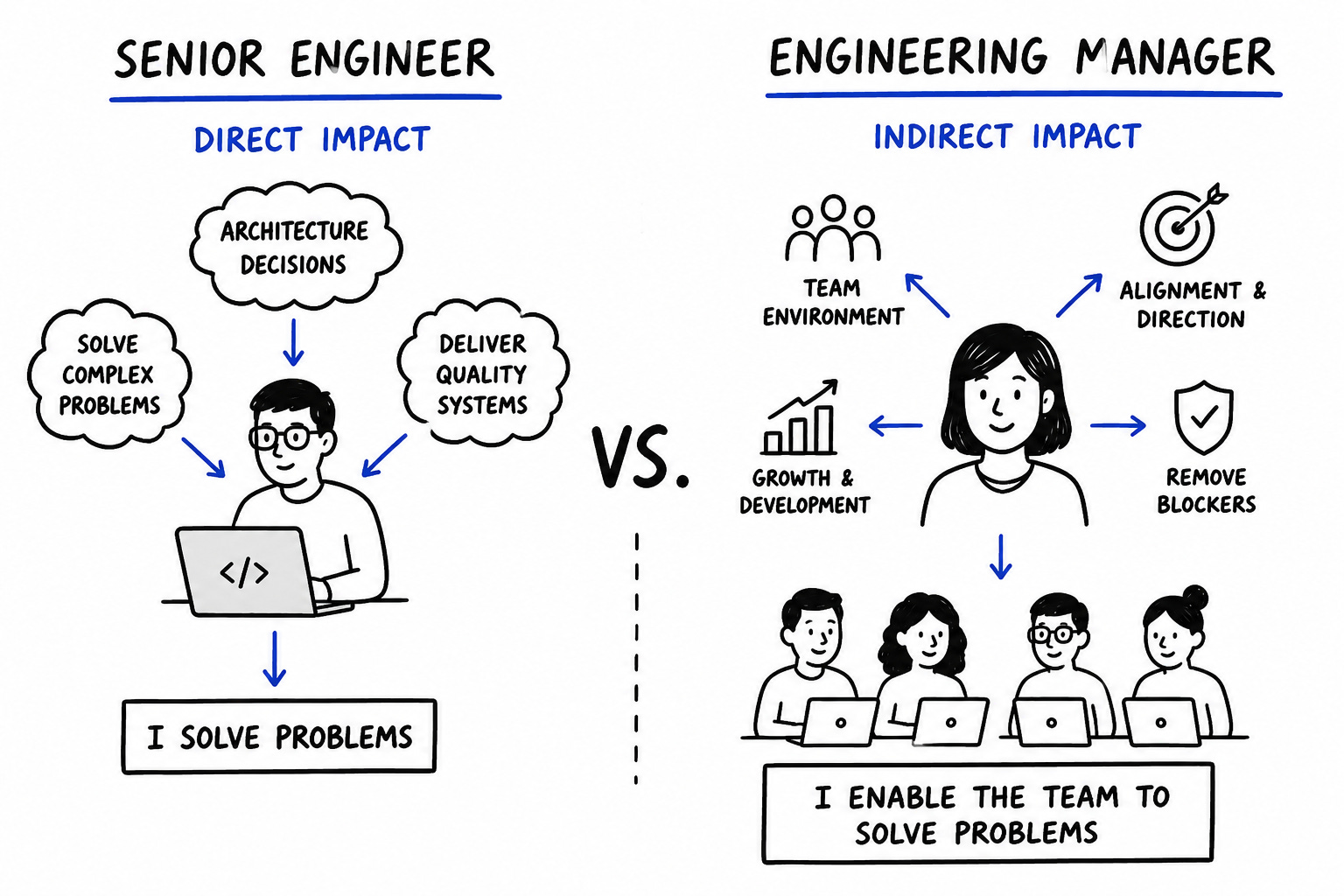
One of the biggest mistakes candidates make while preparing for engineering manager interviews is assuming they are simply senior software engineer interviews with a few leadership questions added on top. That assumption creates a preparation gap that becomes obvious within the first thirty minutes of an interview loop.
As a senior engineer, your primary responsibility is often direct technical execution. You are expected to solve difficult architectural problems, influence technical direction, and deliver high-quality systems. As an engineering manager, your effectiveness becomes increasingly indirect. Instead of evaluating how quickly you can solve a problem yourself, interviewers want to understand how you create an environment where an entire team can solve problems effectively.
The transition changes the evaluation framework completely.
This shift explains why many technically exceptional candidates struggle during engineering manager interviews. They answer every question through the lens of personal contribution rather than organizational leadership.
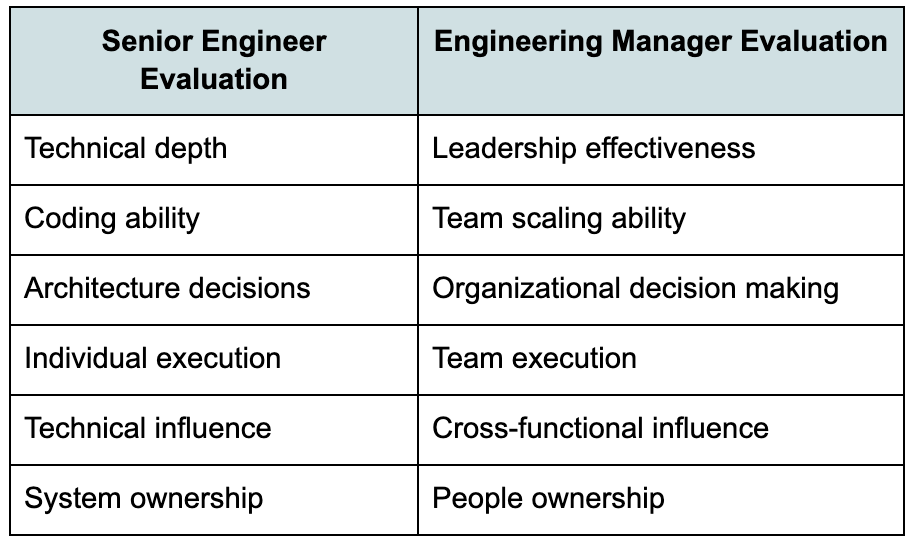
When an interviewer asks how a project succeeded, they are not looking for a detailed explanation of your caching layer implementation. They want to understand how you aligned stakeholders, managed risk, handled execution challenges, developed engineers, and ensured delivery across multiple teams.
The strongest engineering managers understand that leadership is fundamentally a scaling problem. The interview process reflects that reality.
What companies are actually evaluating
Most engineering manager interview loops appear different on the surface, but after participating in hiring processes at Microsoft, Meta, startups, and now Educative, I have found that nearly every company is evaluating the same underlying dimensions.
The terminology changes. The interview structure changes. The specific questions change.
The evaluation categories remain remarkably consistent.
Candidates often overestimate the importance of technical rounds and underestimate the importance of leadership rounds because technical preparation feels more concrete.
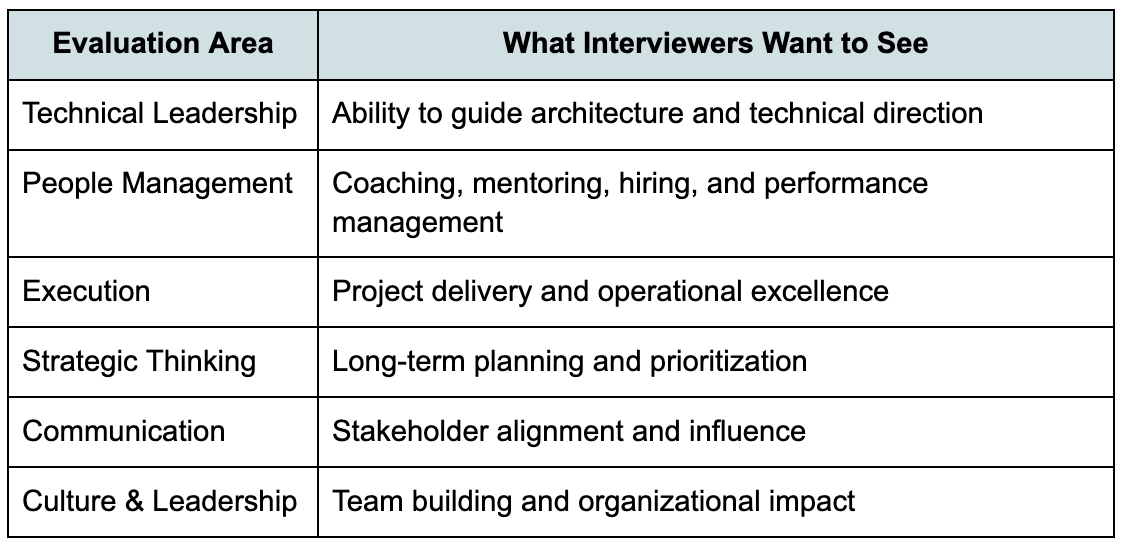
The reality is that most companies already assume you have technical competence if you reach the interview stage. What they need to validate is whether you can operate successfully in a leadership capacity.
That distinction becomes particularly important when discussing technical projects.
A candidate who explains database sharding strategies demonstrates technical knowledge.
A candidate who explains why the team chose a sharding strategy, how competing proposals were evaluated, how risks were mitigated, how stakeholders were aligned, and how engineers were mentored through implementation demonstrates engineering leadership.
The second answer is what gets people hired.
The story bank that separates strong candidates from average ones
One of the clearest patterns I observed while interviewing engineering manager candidates was the difference between prepared leadership stories and improvised leadership stories.
The strongest candidates rarely invent answers during interviews. Instead, they maintain a structured collection of experiences that can be adapted across multiple questions.
I often recommend creating a story bank before preparing anything else.
The reason this approach works is that engineering manager interviews repeatedly test similar competencies from different angles.
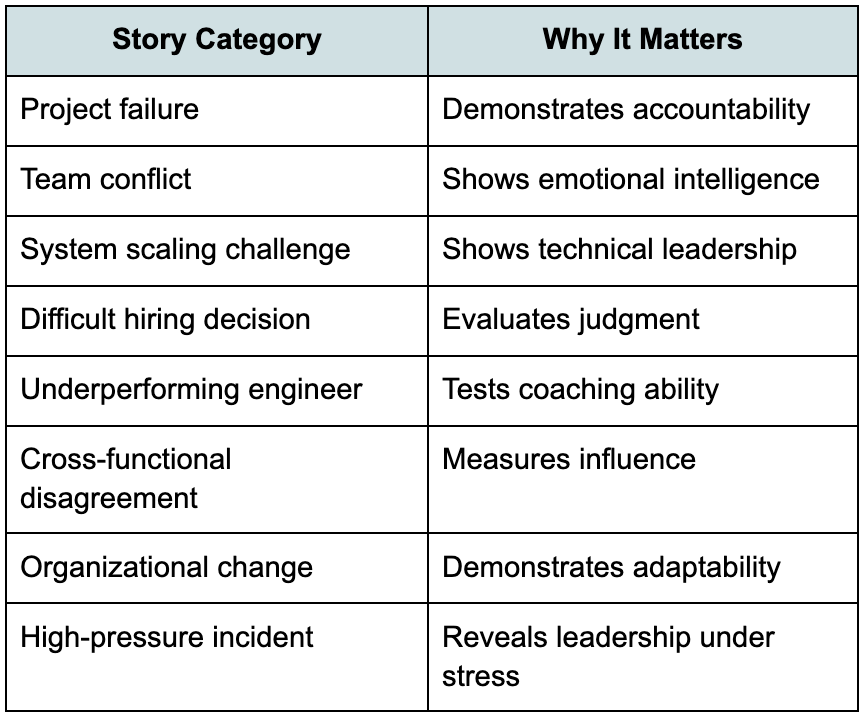
An interviewer asking about conflict resolution is often evaluating emotional intelligence.
An interviewer asking about stakeholder management is often evaluating communication skills.
An interviewer asking about project delays is often evaluating ownership and execution.
Candidates who understand the underlying competency can adapt a single experience to answer multiple questions without sounding rehearsed.
The key is depth. Most weak answers focus on events. Strong answers focus on decision-making. Interviewers care less about what happened and more about why you made the choices you did.
The technical leadership round most candidates underestimate
Many candidates preparing for engineering manager interviews assume the technical leadership round is simply a simplified version of a System Design interview.
That assumption causes significant problems.
A traditional System Design interview evaluates whether you can design a scalable system.
An engineering manager technical round evaluates whether you can lead technical discussions and make architectural decisions through teams.
The distinction sounds subtle, but it fundamentally changes how you should answer.
Consider a system that experiences latency spikes during peak traffic.
A senior engineer might focus primarily on architectural solutions, including caching strategies, load balancing improvements, database optimization, or asynchronous processing.
An engineering manager should discuss those technical solutions while also explaining how trade-offs were evaluated, how competing viewpoints were reconciled, how execution was coordinated, and how operational risk was managed.
Technical leadership requires both technical depth and organizational context.
One of the most common questions I asked candidates was not “Design a distributed messaging system.”
Instead, it was something closer to:
“Tell me about a system your team scaled and what decisions you made as a leader.”
That question reveals significantly more about a candidate.
It exposes technical understanding, communication ability, ownership, decision-making frameworks, stakeholder management, and leadership style simultaneously.
The strongest candidates understand that engineering management is not about being the smartest person in the room. It is about creating conditions where good technical decisions consistently emerge from the team.
How to answer people management questions without sounding scripted
People management questions are where many technically strong candidates lose momentum. The problem is rarely a lack of experience. The problem is a lack of reflection.
Candidates often describe events without demonstrating what they learned from those experiences.
When discussing performance management, for example, interviewers are not looking for textbook HR processes.
They want evidence that you understand how human performance actually works inside engineering organizations.
Managing underperformance rarely begins with formal performance improvement plans.
In practice, it often begins with identifying unclear expectations, communication gaps, missing support structures, or mismatched responsibilities.
Strong engineering managers understand that performance issues are usually symptoms rather than root causes.
The same principle applies to conflict resolution. Weak answers frame conflicts as interpersonal disagreements. Strong answers frame conflicts as alignment problems.
When engineers disagree about architecture, priorities, or execution strategy, the real challenge is usually establishing shared goals and creating enough context for productive decision-making.
Candidates who demonstrate this level of understanding consistently perform better because they show leadership maturity rather than procedural knowledge.
The System Design discussion that gets engineering managers hired
Engineering manager candidates often prepare System Design interviews exactly like senior engineers.
That approach leaves a lot of value on the table.
When discussing architecture, interviewers expect engineering managers to think beyond scalability and reliability.
They want to hear how technical decisions interact with organizational realities.
Consider the following dimensions.
The most effective candidates naturally connect these concepts.
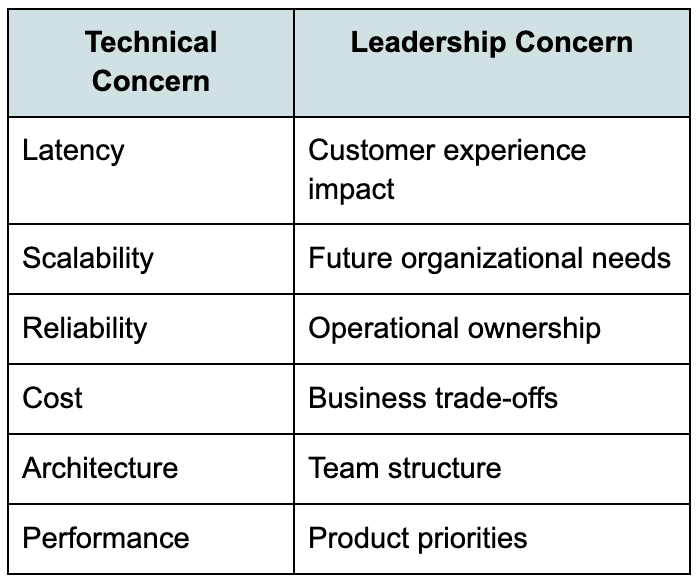
They explain not only how a system was designed but why that design aligned with broader organizational goals, but also:
They discuss migration strategies rather than idealized architectures.
They discuss operational burden rather than theoretical scalability.
They discuss engineering velocity rather than purely technical elegance.
Those perspectives signal leadership readiness.
What interviewers learn from your hiring philosophy
One of the most revealing engineering manager interview topics involves hiring.
Many candidates treat hiring discussions as secondary conversations compared to technical rounds.
In reality, hiring philosophy often becomes a strong predictor of management effectiveness.
A manager’s influence compounds through hiring decisions. A single exceptional hire can elevate an entire team. A poor hiring process can create years of organizational friction. Interviewers pay close attention to how candidates think about talent. The strongest candidates avoid simplistic descriptions of hiring.
Instead of saying they look for “smart engineers,” they discuss signal quality, structured evaluation frameworks, interview calibration, growth potential, communication skills, ownership behaviors, and cultural contribution.
More importantly, they acknowledge hiring uncertainty.
Every hiring decision involves incomplete information.
Candidates who demonstrate awareness of this reality typically appear more mature than candidates who describe hiring as a straightforward evaluation exercise.
The leadership principle most candidates forget
One lesson became increasingly clear throughout my time interviewing candidates at Microsoft and Meta.
Engineering leadership is fundamentally a trust-building exercise.
Teams follow managers they trust. Organizations promote leaders they trust. Stakeholders support decisions made by people they trust. Yet many candidates spend their entire interview demonstrating competence while forgetting to demonstrate trustworthiness.
Trust is established through consistency, accountability, transparency, and judgment.
When discussing failures, strong candidates accept responsibility.
When discussing successes, they credit teams.
When discussing uncertainty, they acknowledge trade-offs.
When discussing conflict, they demonstrate empathy.
Those behaviors create credibility. Interviewers notice them immediately. The goal is not to appear perfect. The goal is to appear dependable.
How to prepare during the final four weeks
Preparation for engineering manager interviews should be structured because the skill set being evaluated spans technical leadership, organizational leadership, communication, and execution.
The strongest preparation plans balance all four dimensions rather than focusing exclusively on System Design.
The purpose of this approach is not memorization.
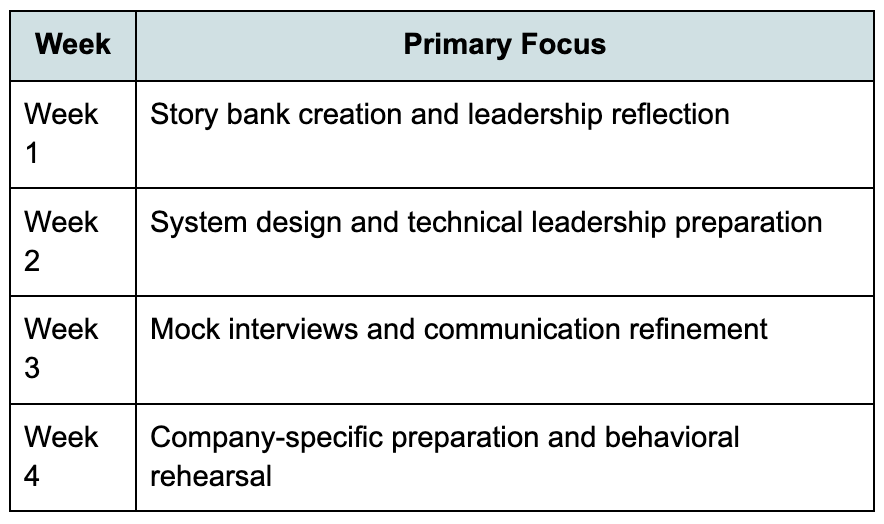
It is pattern recognition.
By the time interviews begin, you should recognize the underlying competency behind every question.
Once that happens, answering becomes significantly easier because you are no longer reacting to individual questions.
You are communicating leadership principles through relevant experiences.
The mistake that prevents many managers from getting offers
The most common mistake I see is surprisingly simple.
Candidates focus too much on proving they can manage engineers and not enough on proving they can lead organizations.
Management and leadership are related but distinct concepts. Management focuses on execution. Leadership focuses on direction. Management ensures work gets completed. Leadership ensures the right work gets completed. The highest-performing engineering managers combine both.
When interviewers evaluate candidates for senior management positions, they increasingly look for organizational thinking rather than team-level thinking.
Can this person influence multiple teams?
Can this person navigate ambiguity?
Can this person balance technical excellence against business priorities?
Can this person create alignment during uncertainty?
Those questions often determine hiring decisions more than technical performance.
Final thoughts
After interviewing hundreds of engineering manager candidates across Microsoft, Meta, and Educative, I have found that successful candidates share one defining characteristic. They understand that engineering management is not a promotion awarded for technical excellence.
It is a fundamentally different discipline that requires translating technical expertise into organizational outcomes through people, systems, and strategy. The strongest interview performances come from candidates who combine technical credibility with leadership maturity, who understand how architecture decisions affect execution, how hiring decisions affect culture, and how communication affects organizational trust.
If you approach preparation through that lens, engineering manager interviews become significantly less about memorizing answers and significantly more about demonstrating the leadership behaviors you will eventually bring to the role.