

How I would approach the Stripe System Design interview today
How to approach Stripe System Design interviews by thinking in APIs, payments, and reliability at a global scale

If you approach a Stripe System Design interview with the mindset that you are simply designing another payment system, you will get part of the way there, but you will miss the defining layer that makes Stripe fundamentally different. Stripe is not just a payments company. It is an infrastructure company that exposes payments as programmable APIs, and that distinction changes how systems are designed, scaled, and reasoned about.
In a traditional payment system, the focus is primarily on correctness, consistency, and transaction safety. Stripe shares those constraints, but it adds another dimension that is just as critical: developer experience. Every system you design in this interview is not just consumed internally; it is consumed by thousands of external developers who depend on predictable APIs, clear semantics, and reliable behavior under failure.
This introduces a new kind of pressure on System Design. It is no longer enough for the system to be correct internally. It must also be understandable and usable externally. That means error handling, idempotency, and API consistency are not implementation details; they are part of the product itself.
The nature of systems Stripe builds
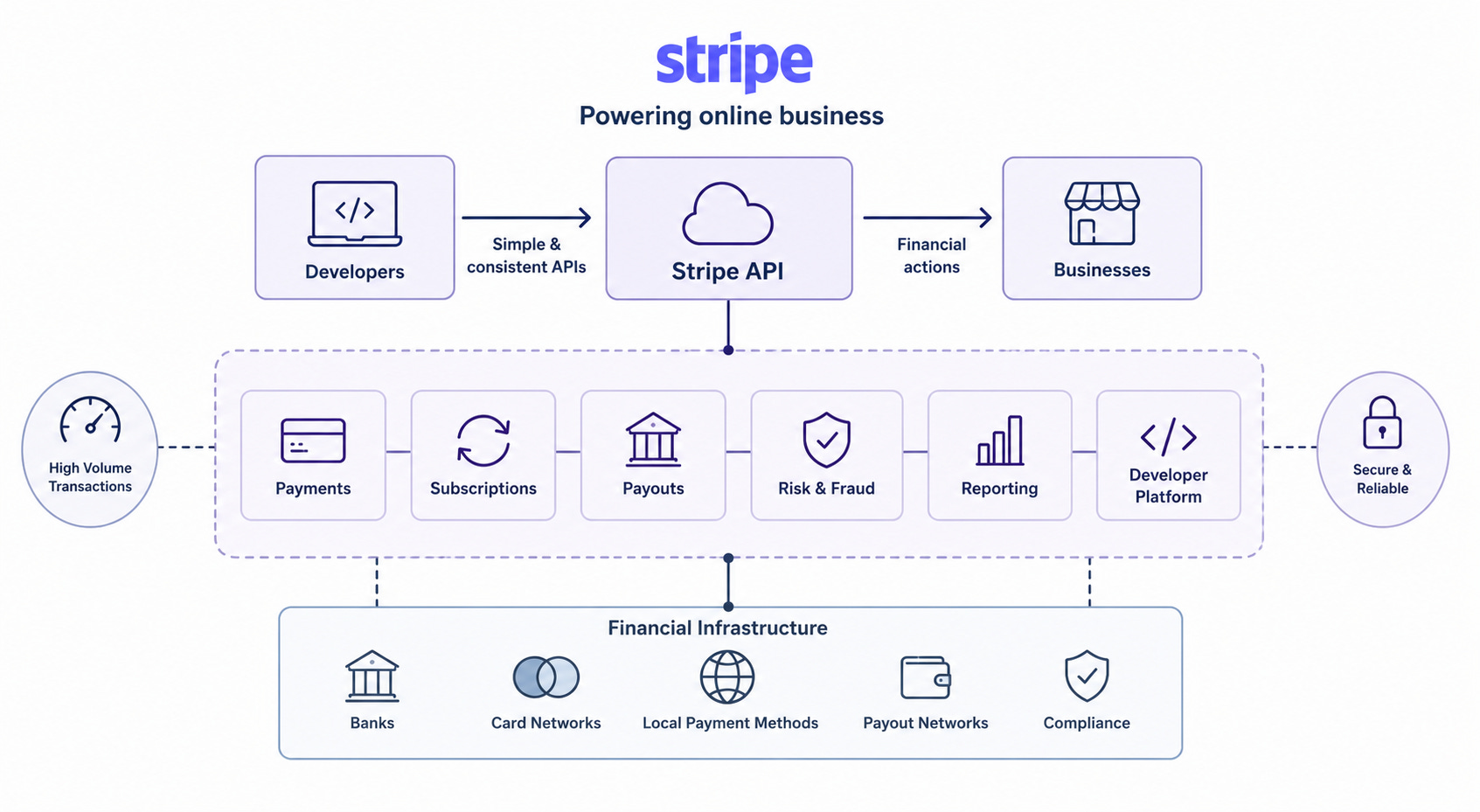
To understand what Stripe is evaluating in their System Design interview, you need to understand the type of systems they operate. Stripe builds APIs that allow businesses to accept payments, manage subscriptions, handle payouts, and interact with financial infrastructure without needing to understand the underlying complexity.
These systems sit at the intersection of payments, distributed systems, and developer platforms. They must handle high volumes of transactions, integrate with external banking networks, and provide a clean abstraction to developers.
The table below captures how Stripe-style systems differ from general payment systems:
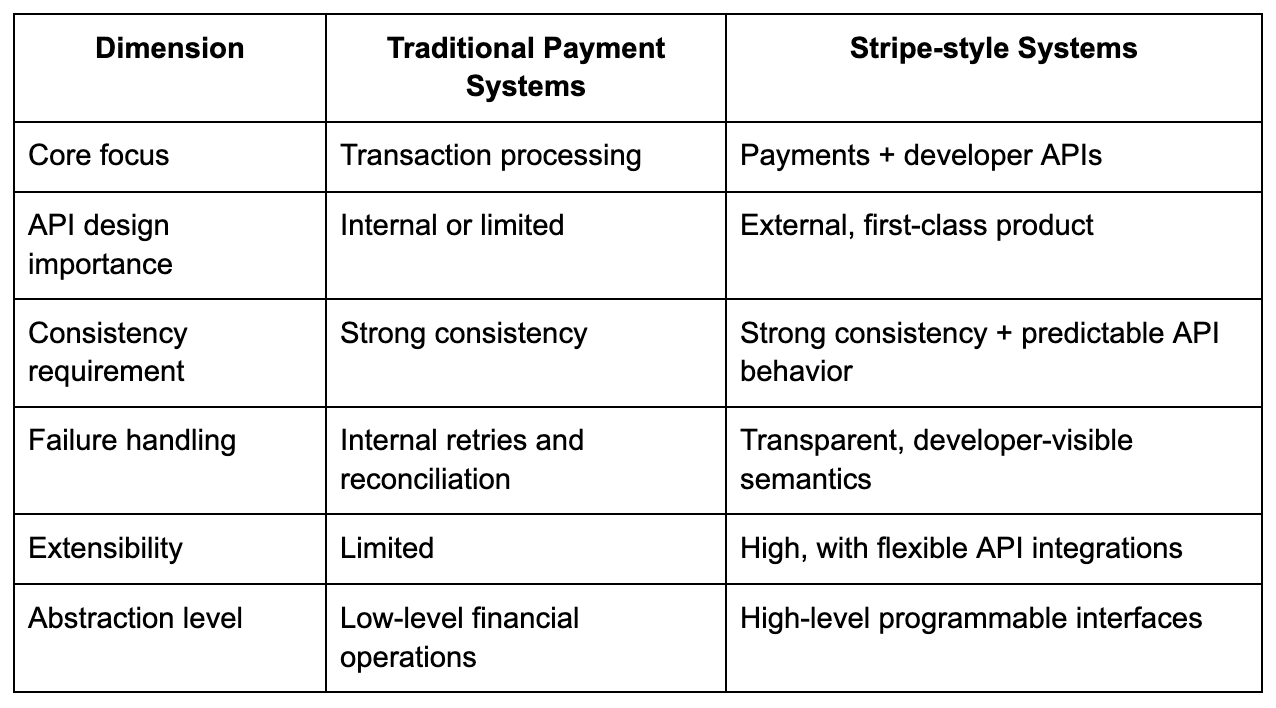
This difference matters because the interview is not just testing whether you can design a payment system, but whether you can design a system that exposes payments safely and reliably to external users.
How Stripe frames System Design problems
Stripe System Design interviews often involve problems such as designing a payment API, a subscription billing system, or a webhook delivery system. These problems may sound familiar, but the depth lies in how you handle API design, reliability, and integration with external systems.
The interviewer is not just interested in your ability to process transactions, but in how you expose those transactions through APIs. This includes how you design endpoints, handle errors, and ensure that developers can interact with the system predictably.
A strong answer begins by defining both the internal workflow and the external interface. You want to understand how developers will use the system, what guarantees they expect, and how the system behaves under failure.
A representative problem: designing a payment API
Consider a scenario where you are asked to design an API that allows developers to process payments. At a high level, the system must accept payment requests, process transactions, and return results to the client.
The table below outlines the core components of such a system:
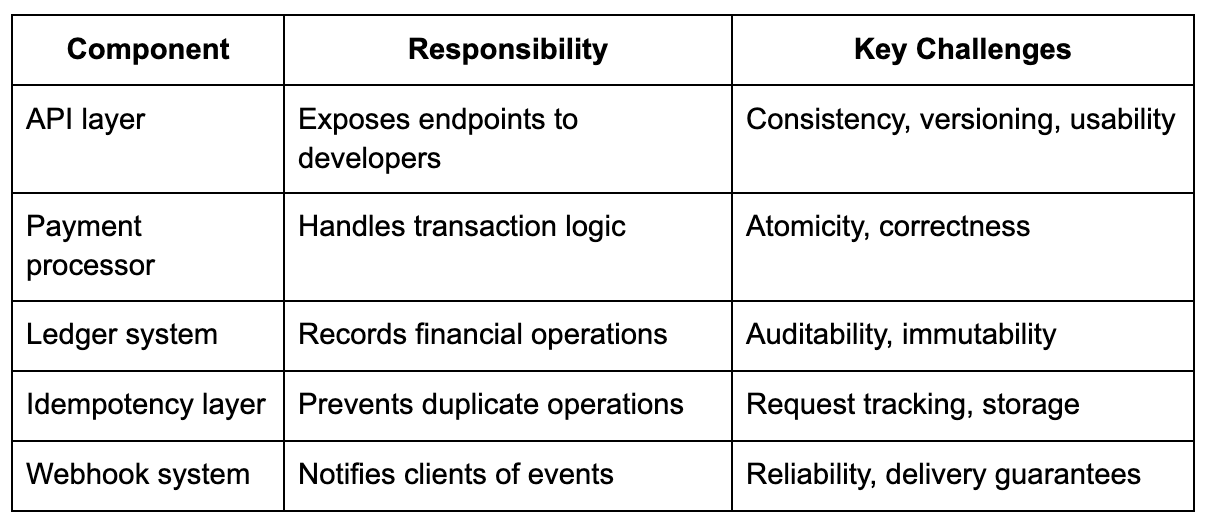
At first glance, this architecture resembles a standard payment system, but the complexity increases when you consider how developers interact with it. Every API response, error message, and retry behavior becomes part of the contract.
API design as a first-class concern
One of the defining aspects of Stripe systems is that APIs are not just interfaces; they are products. This means that API design must be treated as a first-class concern.
For example, when a payment request fails, the system must provide a clear and consistent error message that allows developers to understand what went wrong. Ambiguous errors can lead to incorrect retries or failed integrations.
Similarly, API versioning becomes critical. As the system evolves, changes must be introduced in a way that does not break existing integrations. This requires careful planning and backward compatibility.
The challenge here is that API design decisions have long-term implications. Once an API is exposed, it becomes difficult to change without impacting users.
Idempotency and retry behavior
In a Stripe-style system, idempotency is not just an internal mechanism; it is exposed to developers as part of the API. Clients are expected to include idempotency keys in their requests to ensure that retries do not result in duplicate operations.
This is particularly important because network failures are common, and clients will often retry requests when they do not receive a response. Without idempotency, these retries could lead to duplicate charges.
Designing this layer requires careful consideration. The system must store idempotency keys, associate them with requests, and ensure that repeated requests return the same result. This introduces additional storage and lookup overhead, but it is essential for correctness.
Handling asynchronous workflows
Many operations in Stripe systems are not completed immediately. For example, a payment may require external authorization from a bank, which introduces delays and uncertainty.
To handle this, Stripe uses asynchronous workflows where the initial API request returns a status, and subsequent updates are communicated through webhooks. This allows the system to remain responsive while handling long-running operations.
The table below outlines the flow:
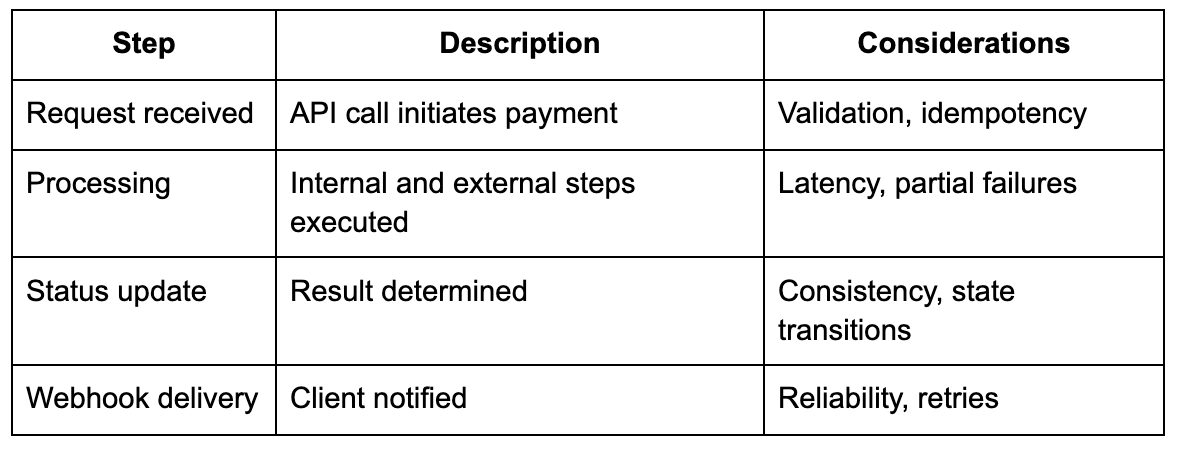
This approach introduces complexity in state management and event delivery, but it provides a flexible and scalable way to handle asynchronous operations.
Reliability and failure handling
Reliability is a core requirement for Stripe systems because failures can directly impact financial transactions and developer integrations. The system must handle failures gracefully and provide clear feedback to clients.
One of the key challenges is dealing with partial failures. For example, a payment may be processed internally but fail to notify the client due to a network issue. In such cases, the system must ensure that the client can eventually retrieve the correct state.
The table below outlines common failure scenarios and strategies:
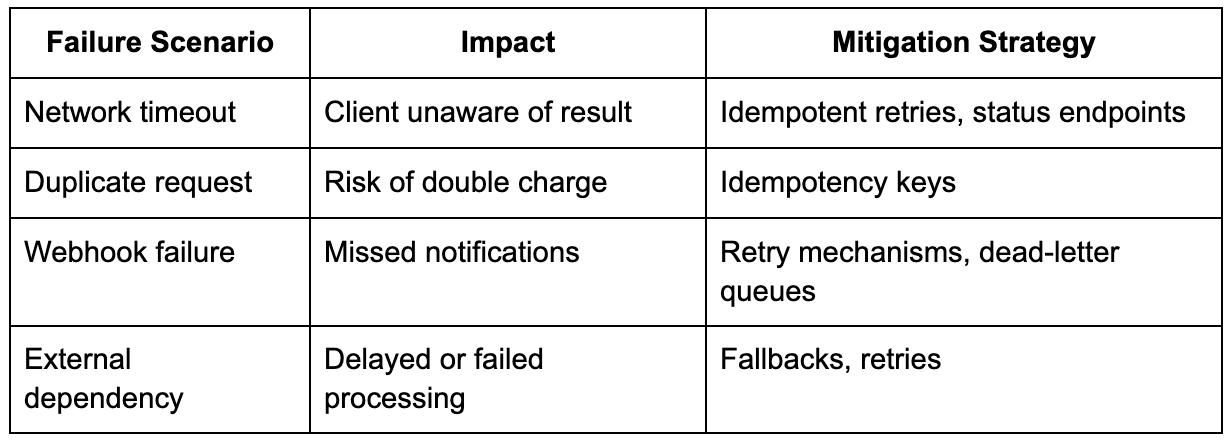
What makes these scenarios challenging is that they often involve multiple systems. A robust design must ensure that failures in one part of the system do not lead to inconsistencies elsewhere.
Ledger and financial correctness
Like all payment systems, Stripe relies on a ledger to maintain financial correctness. The ledger records all transactions as immutable entries, providing a source of truth for the system.
This design ensures that every operation can be audited and verified. It also simplifies reconciliation, as the system can compare its internal state with external records.
However, maintaining a ledger at scale introduces challenges in terms of performance and storage. The system must be designed to handle high volumes of transactions while ensuring that queries remain efficient.
Scaling Stripe systems under real constraints
Scaling a Stripe system is not just about handling more requests; it is about handling them while maintaining correctness and API reliability. This introduces unique challenges that go beyond traditional scaling strategies.
The table below outlines common bottlenecks and strategies:
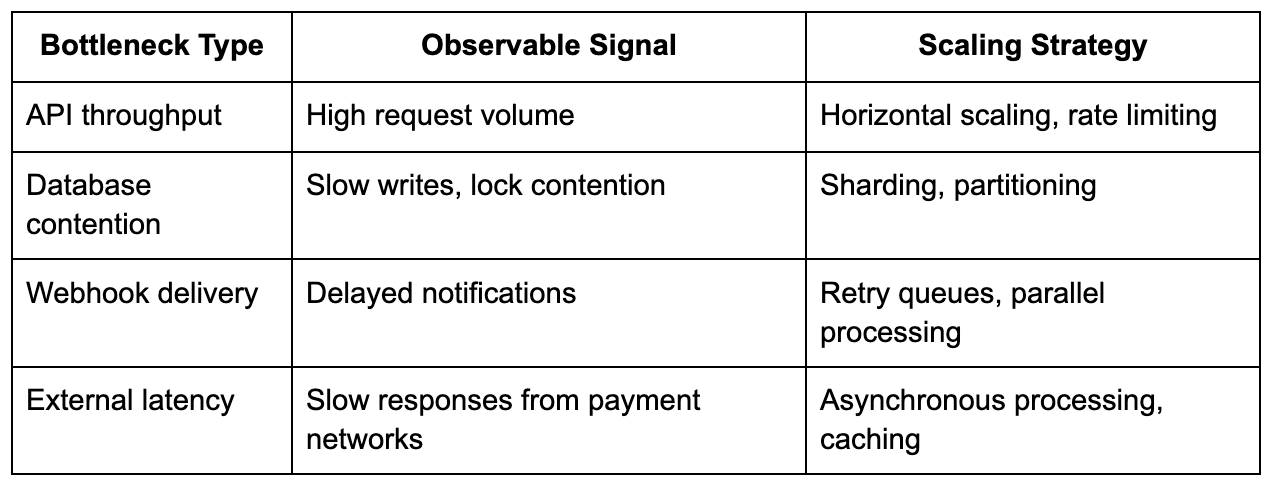
Each of these strategies must be implemented carefully to avoid compromising correctness or developer experience.
Observability and developer trust
Observability in Stripe systems is not just about internal monitoring; it is about building trust with developers. Clients need to understand what is happening in the system and be able to debug issues effectively.
This requires providing detailed logs, clear error messages, and tools for tracking requests and events. It also requires maintaining consistent behavior across different parts of the system.
Without strong observability, developers may lose trust in the platform, which can have significant business implications.
Structuring your answer in the interview
When presenting your design, it is important to structure your explanation around both the internal workflow and the external API. Start by defining the requirements and constraints, then describe how the system processes requests and how it exposes results to clients.
Instead of jumping directly into a distributed architecture, build your design incrementally. Explain how each component addresses a specific challenge and how it interacts with the rest of the system.
This approach demonstrates a clear understanding of both System Design and API design.
What Stripe is really evaluating
At its core, the Stripe System Design interview evaluates your ability to design systems that are both technically sound and developer-friendly. It is testing whether you understand how to build systems that handle financial transactions reliably while exposing them through clean and predictable APIs.
The strongest candidates are those who can reason about trade-offs, justify their decisions, and consider both internal and external perspectives.
Final perspective
Designing systems for Stripe requires a shift in mindset from internal correctness to external reliability. It requires an understanding of how APIs are used, how failures are handled, and how systems behave under real-world conditions.
If you approach the interview with this perspective, you will find that the problem becomes more coherent. Instead of trying to design the most complex system, focus on designing a system that is reliable, predictable, and aligned with the needs of developers.