

How I would prepare for a Machine Learning System Design interview at FAANG today
A practical roadmap to mastering ML System Design interviews at FAANG

I’ve seen candidates walk into ML System Design interviews with strong machine learning knowledge and still struggle within the first ten minutes. Not because they didn’t know models, but because they didn’t know how to structure a system under constraints. They would jump into talking about neural networks, embeddings, or feature stores before even clarifying what the system was supposed to do.
That’s usually where things start to fall apart.
Preparing for a Machine Learning System Design interview at FAANG is not about memorizing architectures or listing components. It’s about building a way of thinking that lets you break down ambiguous problems, define constraints, and evolve a system step by step. These interviews are less about what you know and more about how you reason.
The difference between candidates who perform well and those who don’t often comes down to preparation style. One group studies ML concepts in isolation. The other learns how to connect ML with systems, tradeoffs, and real-world behavior.
Understand what FAANG is actually evaluating
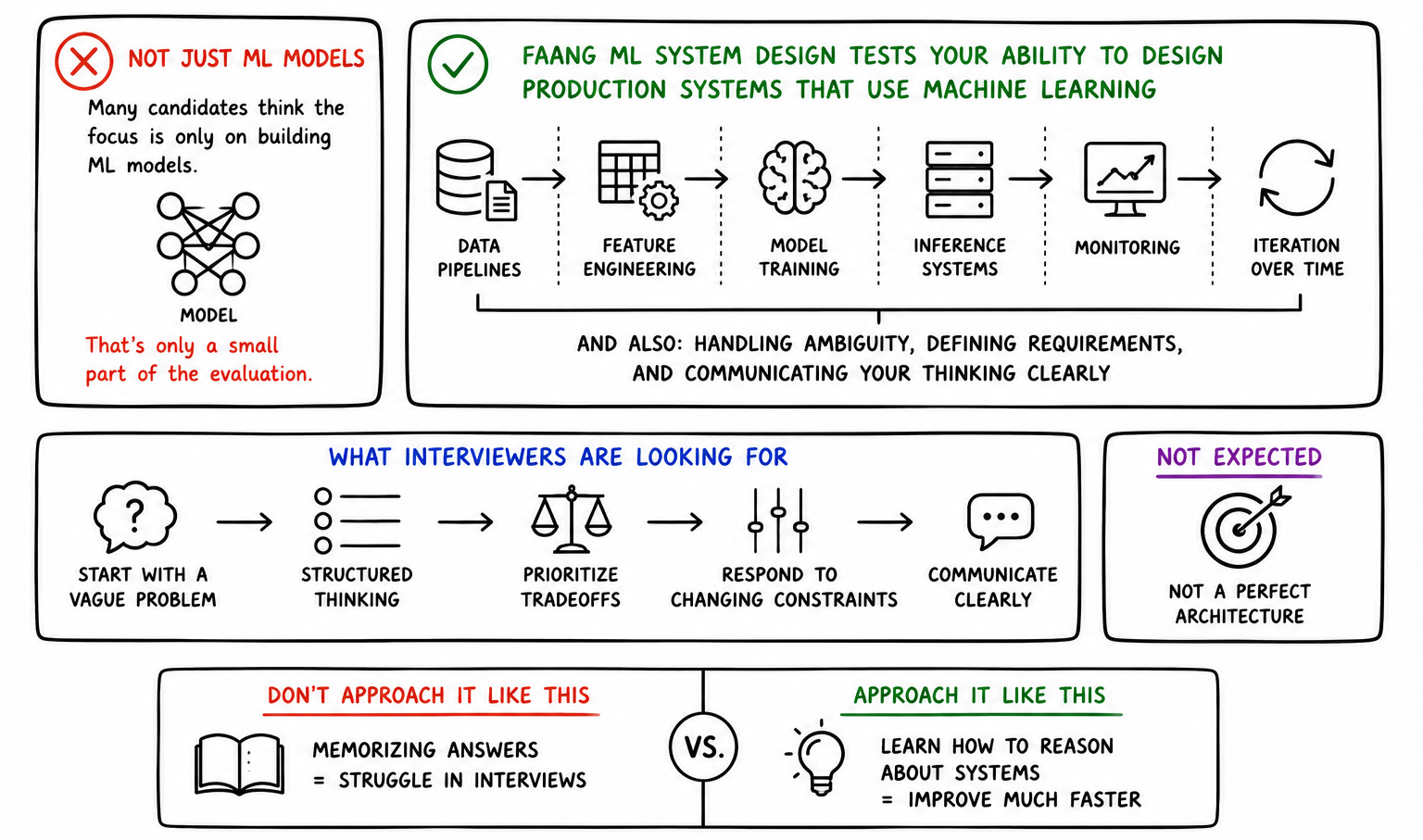
Before you start preparing, it’s important to understand what these interviews are testing. Many candidates assume the focus is on machine learning models, but that’s only a small part of the evaluation.
FAANG ML System Design interviews test your ability to design production systems that use machine learning. That includes data pipelines, feature engineering, model training, inference systems, monitoring, and iteration over time. It also includes how you handle ambiguity, define requirements, and communicate your thinking clearly.
The interviewer is not expecting a perfect architecture. They are looking for structured thinking. They want to see how you move from a vague problem to a concrete system. They want to see how you prioritize tradeoffs and how you respond when constraints change.
If you approach preparation as memorizing answers, you will struggle. If you approach it as learning how to reason about systems, you will improve much faster.
Build a strong foundation in System Design first
One of the biggest mistakes candidates make is jumping straight into ML-specific topics without a solid System Design foundation. ML System Design builds on general System Design principles, and without those, your answers will lack structure.
You need to be comfortable with concepts like scalability, latency, consistency, caching, load balancing, and distributed systems. These are not optional. They form the backbone of every ML system.
For example, when designing a recommendation system, you need to think about how requests are handled, how data is stored, how services communicate, and how the system scales under load. The ML component sits on top of that foundation.
This is why candidates who have practiced general System Design often perform better, even if their ML knowledge is not perfect. They know how to structure their answers and reason about tradeoffs.
Learn how ML changes System Design
Once you have a System Design foundation, the next step is understanding what makes ML systems different. Traditional systems process data and return deterministic results. ML systems make predictions based on learned patterns, which introduces uncertainty and variability.
This changes how you design systems.
You need to think about training pipelines, feature consistency, model versioning, and feedback loops. You need to consider how models degrade over time and how you detect and fix that. You need to balance accuracy with latency and cost.
For example, in a real-time fraud detection system, you might choose a simpler model because it meets latency requirements, even if a more complex model performs better offline. In a recommendation system, you might combine batch and real-time components to balance freshness and efficiency.
Understanding these tradeoffs is key to performing well in interviews.
Practice the most common ML System Design questions
Preparation becomes much more effective when you focus on patterns rather than isolated questions. Most ML System Design interviews revolve around a set of recurring problem types.
You will likely encounter questions about recommendation systems, fraud detection, search ranking, ad targeting, or large-scale prediction systems. Each of these has its own nuances, but they share common building blocks.
Instead of trying to memorize solutions, practice breaking these problems down into stages. Start with requirements, move to high-level design, then dive into components, and finally discuss tradeoffs and improvements.
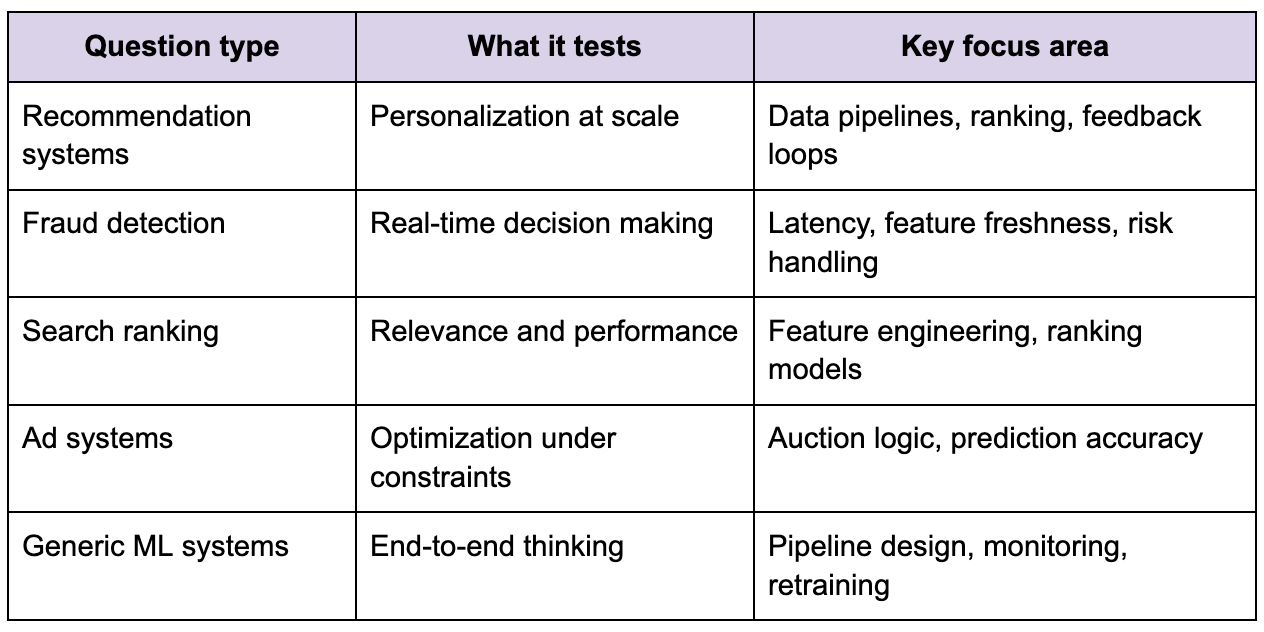
Over time, you will start to see patterns that apply across different questions.
Develop a clear answer structure
One of the most underrated parts of preparation is learning how to structure your answer. Even strong candidates struggle if they don’t present their ideas clearly.
A good structure typically starts with clarifying the problem. You define the use case, success metrics, latency requirements, and data constraints. This shows that you are not making assumptions.
Next, you outline a high-level architecture. This gives the interviewer a mental model of the system before you dive into details. Then you go deeper into specific components such as data pipelines, feature engineering, model training, and serving.
Finally, you discuss tradeoffs, scaling strategies, and potential improvements.
This structure keeps your answer organized and makes it easier for the interviewer to follow your thinking. It also gives you a framework to fall back on when you feel stuck.
Focus on tradeoffs instead of perfection
A common misconception is that there is a “correct” design for each question. In reality, there are multiple valid approaches, and the interviewer is more interested in how you evaluate them.
Every design decision involves tradeoffs. Choosing batch processing over real-time processing improves efficiency but reduces freshness. Using a complex model improves accuracy but increases latency. Caching improves speed but introduces staleness.
Your goal is to identify these tradeoffs and explain your reasoning.
For example, if you are designing a recommendation system, you might start with a batch pipeline for generating recommendations and then introduce real-time components as needed. This shows that you understand how systems evolve.
Candidates who acknowledge tradeoffs come across as more experienced because they demonstrate practical thinking rather than theoretical knowledge.
Practice thinking out loud
ML System Design interviews are as much about communication as they are about technical knowledge. You need to explain your thinking clearly and logically while solving the problem.
This is something that improves with practice. You should get used to thinking out loud, explaining your assumptions, and walking through your design step by step.
One effective way to practice is by simulating interviews with peers or recording yourself. Try to explain your design as if you were speaking to an interviewer. Pay attention to how you structure your explanation and where you get stuck.
Over time, you will become more comfortable articulating your ideas, which makes a significant difference in interviews.
Learn to handle ambiguity
FAANG interview questions are intentionally open-ended. You might be asked to design a system without detailed requirements, and it is up to you to ask the right questions.
This is not a trick. It is part of the evaluation.
Strong candidates clarify requirements before jumping into design. They ask about scale, latency, data availability, and business goals. This helps them avoid making incorrect assumptions.
For example, designing a recommendation system for a small startup is very different from designing one for a platform with millions of users. Clarifying these details allows you to tailor your design appropriately.
Handling ambiguity well shows that you can operate in real-world scenarios where requirements are often incomplete.
Build intuition through real systems
One of the best ways to prepare is by studying real-world ML systems. Look at how companies build recommendation engines, fraud detection systems, or search platforms.
You don’t need access to internal systems to do this. Many companies publish blogs, papers, and talks about their architectures. These resources provide valuable insights into how systems are designed and why certain decisions are made.
As you study these systems, focus on understanding the tradeoffs. Why did they choose a particular architecture? What problems were they solving? How did they handle scaling and reliability?
This kind of thinking helps you move beyond textbook knowledge and develop practical intuition.
Strengthen your understanding of data pipelines
ML System Design heavily depends on data pipelines. You need to understand how data is collected, processed, and transformed into features.
At a high level, you should be comfortable with batch processing, streaming systems, data storage, and feature engineering. You should understand how data flows through the system and how different components interact.
This includes understanding how to handle data quality issues, late-arriving data, and schema changes. These are real challenges that affect system reliability.
Candidates who can clearly explain data pipelines often stand out because they demonstrate a deeper understanding of how ML systems work.
Don’t ignore model serving and inference
Many candidates focus heavily on training pipelines and neglect the serving side of the system. This is a mistake because serving is often where real constraints come into play.
You need to think about how models are deployed, how predictions are generated, and how the system handles latency and scaling. This includes considerations like caching, batching, and fallback mechanisms.
For example, in a real-time system, you may need to precompute features or use simpler models to meet latency requirements. You may also need to design fallback strategies in case the model is unavailable.
Understanding these aspects shows that you are thinking about production systems rather than just experimentation.
Prepare for follow-up questions
One of the defining characteristics of FAANG interviews is the depth of follow-up questions. The interviewer will often take your design and push it further.
They might ask how your system handles scaling to millions of users, how you deal with model drift, how you monitor performance, or how you reduce latency.
Preparation should include thinking about these extensions. After designing a system, ask yourself how it would behave under different conditions. What happens if traffic increases? What happens if data changes? What happens if the model fails?
This kind of preparation helps you handle follow-ups confidently.
Time management during the interview
ML System Design interviews are time-constrained, which makes prioritization important. You need to balance breadth and depth without running out of time.
A common mistake is spending too much time on one part of the system and not covering others. A better approach is to start with a high-level design and then dive deeper into the most important components.
This ensures that you cover the entire system while still demonstrating depth where it matters.
Practicing under time constraints can help you develop this skill. Try solving design questions within a fixed time and refine your approach based on feedback.
Common mistakes to avoid
One of the most common mistakes is jumping into implementation details too early. Candidates start discussing specific models or technologies without defining the problem clearly.
Another mistake is ignoring system constraints. Designing a system without considering latency, scalability, or data availability leads to unrealistic solutions.
Overcomplicating the design is also a frequent issue. Adding unnecessary components can make the system harder to explain and maintain. Simplicity is often more effective.
Finally, many candidates fail to discuss tradeoffs. They present a single solution without acknowledging alternatives or limitations.
Final thoughts
Preparing for a Machine Learning System Design interview at FAANG is not about memorizing answers. It is about developing a way of thinking that allows you to approach complex problems systematically.
You need to understand both System Design and machine learning, and more importantly, how they interact. You need to practice structuring your answers, handling ambiguity, and communicating clearly.
The most effective preparation comes from combining theory with practice. Study real systems, solve design problems, and reflect on your approach. Over time, you will start to see patterns that make these interviews more manageable.
In the end, these interviews are not just testing your knowledge. They are testing your ability to design systems that work in real-world conditions. If you focus on building that skill, you will not only perform better in interviews but also become a stronger engineer overall.