

How I would prepare for object-oriented design interviews today
How to approach object-oriented design interviews with real engineering judgment and clarity

I have watched object-oriented design interviews confuse strong engineers for years, especially engineers who are otherwise excellent at distributed systems, backend architecture, or algorithmic problem solving. The reason is surprisingly simple.
Most candidates think the interview is evaluating whether they can memorize design patterns or produce elaborate UML diagrams quickly. In practice, strong object-oriented design interviews usually evaluate something much more fundamental: whether you can model real operational behavior cleanly without introducing unnecessary complexity.
That distinction changes everything. The strongest candidates rarely produce the biggest class hierarchies or the most sophisticated inheritance trees. Instead, they build systems that feel operationally understandable, extensible, and resilient to change. Once you start approaching object-oriented design interviews from that perspective, the conversations become far less about syntax and far more about engineering judgment.
Why object-oriented design interviews still matter
A lot of engineers dismiss object-oriented design interviews because modern backend systems increasingly rely on distributed infrastructure, event-driven architectures, and cloud-native platforms. The assumption is that class design somehow matters less now than it did years ago.
That assumption usually falls apart quickly in real production systems.
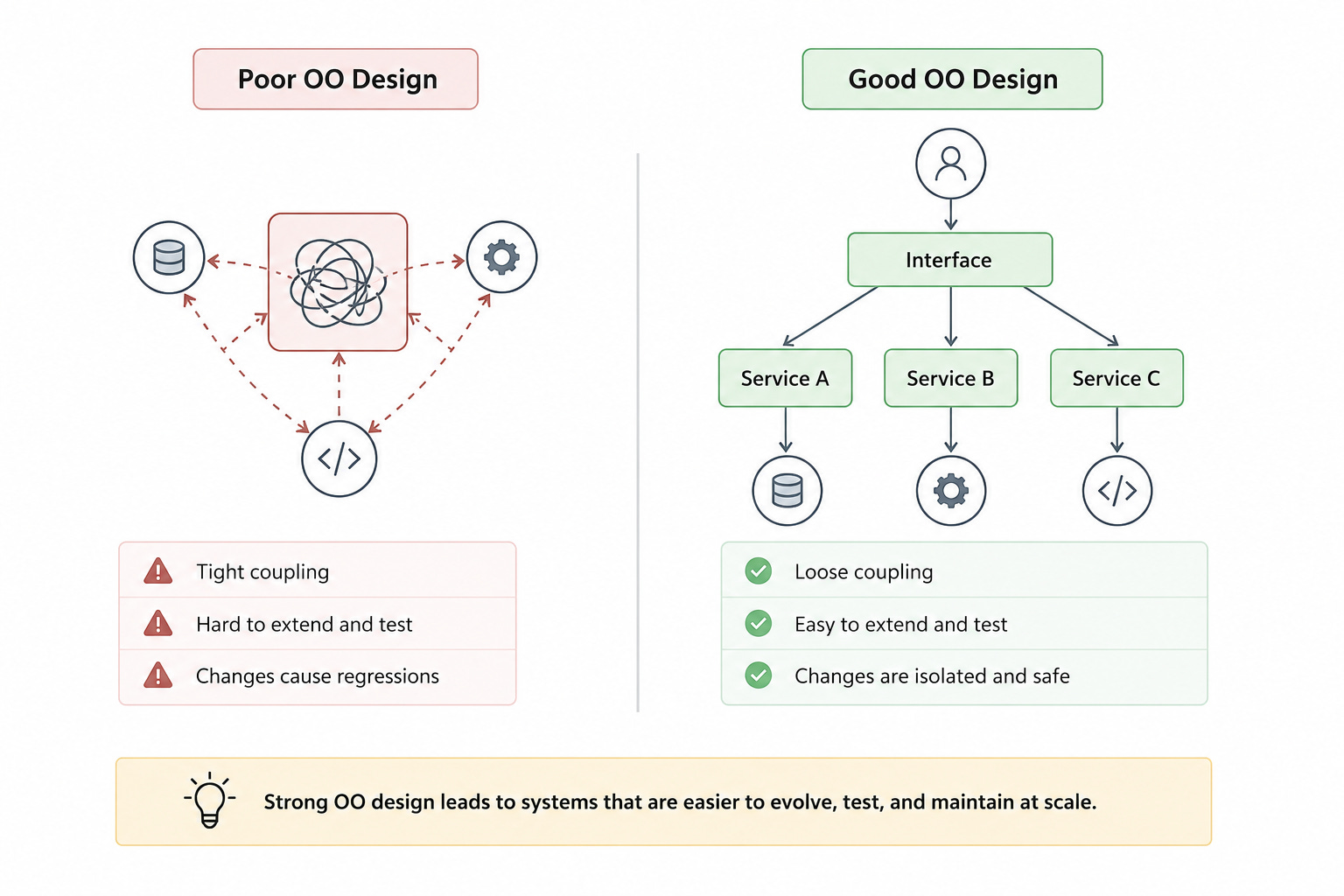
Large-scale infrastructure still depends heavily on how engineers model state, separate responsibilities, manage dependencies, and control complexity growth over time. Poor object-oriented design may not immediately crash systems the way infrastructure outages do, but it quietly creates operational drag that compounds continuously. Features become harder to extend. Testing becomes painful. Small changes introduce unexpected regressions. Teams become afraid to modify core components because dependencies are tangled unpredictably.
This is why experienced interviewers still value object-oriented design discussions. They reveal how candidates think about software structure itself.
One thing I noticed repeatedly while interviewing engineers is that weaker candidates often optimize for immediate implementation speed, while stronger candidates optimize for long-term system clarity. That difference becomes visible very quickly once the design discussion evolves beyond the happy path.
The biggest misconception candidates have
The most common misconception about object-oriented design interviews is that interviewers want extremely detailed, low-level implementations immediately.
That usually leads candidates toward overengineering.
They start introducing abstract factories, layered inheritance hierarchies, observer patterns, strategy patterns, dependency injection frameworks, and generic abstractions before even clarifying the actual behavior of the system.
The design becomes visually sophisticated but operationally confusing.
Strong interviewers usually care much more about whether the system models real behavior cleanly. They want to see whether you understand responsibility boundaries, state transitions, extensibility trade-offs, and how complexity evolves as requirements change.
This is why strong candidates usually begin by clarifying operational workflows first.
Suppose the problem is designing a parking lot, ride-sharing platform, elevator system, or online auction service. The first step is not writing classes. The first step is understanding how the system behaves operationally.
What are the core entities? Which components own state? Which operations change that state? Which parts are likely to evolve later?
Those questions matter far more initially than diagramming inheritance relationships.
Start with behavior, not classes
One of the most important shifts candidates can make is moving away from “class-first” thinking toward “behavior-first” thinking.
Most weak object-oriented designs emerge because engineers start modeling nouns immediately instead of modeling workflows.
Imagine designing an online bookstore. Many candidates immediately start creating classes like Book, User, Cart, Order, PaymentProcessor, and InventoryManager. Technically, those entities exist, but the design discussion remains shallow because the operational behavior has not been clarified.
A stronger approach starts differently.
A customer searches for books, adds items to a cart, checks out, processes payment, and receives order confirmation. Inventory updates occur after successful payment. Recommendation systems react to browsing history. Failed payments trigger rollback workflows.
Now the system has operational shape.
Once the behavior becomes clear, responsibility boundaries emerge much more naturally.
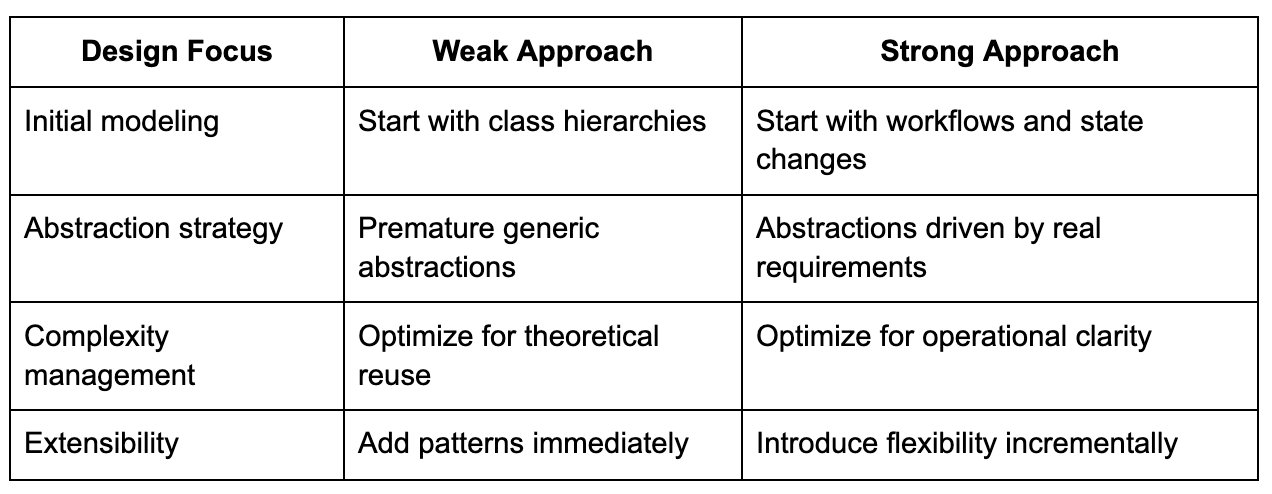
This shift matters because real software systems evolve around operational pressure, not theoretical elegance.
Good object-oriented design is really about controlling complexity
The deeper purpose of object-oriented design is not inheritance or polymorphism itself. Those are tools.
The actual goal is controlling complexity as systems evolve.
This is where many interview discussions become interesting. A design that works perfectly for today’s requirements may become extremely fragile once requirements change slightly.
Suppose you are designing a ride-sharing system. Initially, supporting one ride type seems simple. Then requirements evolve to include shared rides, premium rides, scheduled rides, and delivery workflows.
Weak designs often collapse because business logic becomes tightly coupled everywhere.
Strong designs remain adaptable because responsibilities stay isolated.
One thing experience teaches you quickly is that coupling is usually the real enemy in large systems. Excessive coupling makes changes dangerous because modifications ripple unpredictably across the codebase.
This is why strong candidates think carefully about dependency direction.
Instead of asking, “What classes should I create?” they ask, “Which components should know about each other, and which should remain isolated?”
That mindset leads to much cleaner systems.
Inheritance is often overused
One pattern I noticed repeatedly while evaluating object-oriented design interviews is that weaker candidates tend to overuse inheritance dramatically.
Inheritance feels attractive initially because it appears to reduce duplication elegantly. The problem is that deep inheritance hierarchies become operationally fragile over time.
Suppose you begin with a generic Vehicle base class. Then you introduce Car, Truck, ElectricCar, AutonomousVehicle, and DeliveryTruck subclasses. Eventually, business rules diverge. Shared assumptions stop holding consistently. Base classes become overloaded with conditional logic supporting unrelated behaviors.
Now the hierarchy becomes harder to reason about than the original duplication would have been.
This is why composition often scales better operationally.
Instead of embedding every variation into inheritance structures, strong designs isolate changing behavior into interchangeable components.
The important thing interviewers usually want to see is not whether you memorize “composition over inheritance” as a slogan. They want to see whether you understand why tightly coupled hierarchies become difficult to maintain operationally.
That distinction matters.
Encapsulation is more important than people realize
A lot of candidates define encapsulation very mechanically during interviews. They talk about private variables and getters/setters without discussing the actual operational value of encapsulation.
The real purpose of encapsulation is to protect system invariants.
Suppose an Order object exposes direct access to the internal payment state. Now, unrelated parts of the system can mutate order status unpredictably. Business rules become difficult to enforce consistently.
Strong designs instead of control state transitions carefully.
An order may transition from CREATED to PAID to SHIPPED to DELIVERED through explicit workflows. Invalid transitions become impossible or highly constrained.
That operational discipline becomes extremely valuable in large systems because uncontrolled state mutation creates debugging nightmares over time.
One thing strong engineers consistently understand is that objects are not just data containers. They are guardians of behavioral correctness.
That mindset usually leads to much better designs.
Design patterns matter less than operational reasoning
A lot of candidates prepare for object-oriented design interviews by memorizing design patterns aggressively.
Patterns are useful. Blind pattern application is not.
One thing I noticed repeatedly while interviewing engineers is that weaker candidates often force patterns into designs even when the operational problem does not require them.
The result feels artificial.
Strong candidates usually introduce patterns reactively instead of proactively. They recognize when flexibility pressure actually exists.
Suppose payment processing supports multiple providers with evolving business rules. Strategy patterns may genuinely improve extensibility there. Suppose object creation logic becomes operationally complicated because workflows vary substantially. Factory abstractions may help.
The key is that abstractions should emerge from measurable complexity rather than theoretical anticipation.
That principle mirrors large-scale systems engineering generally. Premature abstraction creates operational overhead before delivering meaningful value.
Scalability still matters in object-oriented design interviews
One misconception candidates sometimes have is that object-oriented design interviews focus only on local code structure rather than system behavior under scale.
Strong interviewers often push further.
What happens when traffic increases dramatically? How does state synchronization behave? Which components become bottlenecks? Can responsibilities scale independently? How would persistence evolve under large workloads?
This is where object-oriented design and distributed systems thinking start overlapping naturally.
Good low-level design usually creates clearer pathways toward scaling because responsibility boundaries remain understandable.
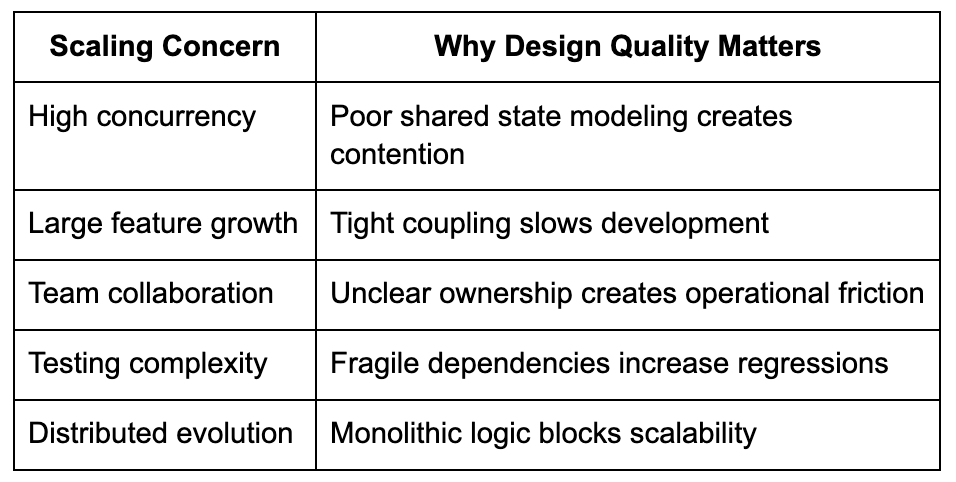
One thing years of building infrastructure teach you quickly is that operational scalability problems often begin as software design problems long before infrastructure itself becomes the bottleneck.
The strongest interviews feel collaborative
The best object-oriented design interviews rarely feel like whiteboard interrogations.
Instead, they resemble collaborative architecture discussions where requirements evolve gradually, and the candidate adapts thoughtfully.
An interviewer may suddenly introduce:
Multiple user roles
New payment methods
Reservation workflows
Failure scenarios
Audit logging requirements
Distributed synchronization challenges
The goal is usually not to break the candidate. The goal is to observe how they manage complexity growth.
Weak candidates often panic and start rewriting large portions of the design. Strong candidates evolve the system incrementally because the original responsibility boundaries were already clean.
That adaptability is often the strongest signal of all.
Simplicity is usually the hardest thing to achieve
One lesson that becomes painfully obvious after years of designing large systems is that simplicity is much harder than complexity.
Complicated architectures are easy to produce. Clean architectures require discipline.
The strongest object-oriented designs usually share several characteristics:
They model real operational behavior clearly. Responsibilities remain isolated. State transitions stay controlled. Dependencies remain understandable. Abstractions emerge only when operational pressure justifies them.
Most importantly, the design remains explainable.
One thing I consistently valued during interviews was whether candidates could explain why they introduced complexity instead of merely introducing it automatically. That reasoning matters enormously because software systems inevitably evolve, and unnecessary complexity compounds aggressively over time.
The biggest mistake candidates make during object-oriented design interviews
The most common mistake candidates make is optimizing for theoretical sophistication instead of operational clarity.
They introduce excessive abstractions too early. They overuse inheritance. They memorize patterns without understanding the trade-offs. They focus on syntax instead of system behavior.
Strong candidates usually do the opposite.
They start with workflows. They model state transitions carefully. They isolate responsibilities gradually. They keep designs simple until measurable complexity emerges.
Most importantly, they understand that object-oriented design is not really about classes at all.
It is about managing complexity in systems that evolve continuously.
How I would prepare for an object-oriented design interview today
If I were preparing for object-oriented design interviews today, I would spend far less time memorizing UML notation or design pattern catalogs and far more time studying operational system behavior.
I would practice taking simple real-world workflows and modeling them incrementally while focusing on:
Responsibility boundaries
State transitions
Dependency management
Extensibility pressure
Concurrency implications
Failure handling
Most importantly, I would practice explaining trade-offs clearly.
One thing experience teaches you after years of building systems and interviewing engineers is that strong software design is rarely about clever abstractions. The strongest systems are usually the ones that remain operationally understandable even as requirements evolve, teams grow, and scale increases.
That mindset is ultimately what strong object-oriented design interviews are trying to evaluate.
Great framing the best OOP preparation is usually less about memorizing patterns and more about learning how to make trade-offs in design. I especially like when these posts focus on clarity of responsibilities, maintainability, and judgment rather than just textbook concepts.