

How long to prepare for a System Design interview? The timeline most engineers get wrong
A realistic preparation timeline from someone who has interviewed hundreds of engineers

One of the first questions engineers ask when preparing for a System Design interview is how much time they should dedicate to preparation. Unfortunately, most answers online are either overly optimistic or unnecessarily intimidating.
Some people claim you can become interview-ready in a weekend, while others suggest spending six months studying distributed systems before scheduling interviews. After interviewing hundreds of engineers at Microsoft and Meta, I found that neither extreme reflects reality for most candidates.
The amount of time required depends heavily on your experience, your familiarity with backend systems, and the level of role you are targeting. More importantly, preparation quality matters far more than preparation length. A focused month of deliberate practice often produces better results than several months of passive studying.
Why there is no single answer
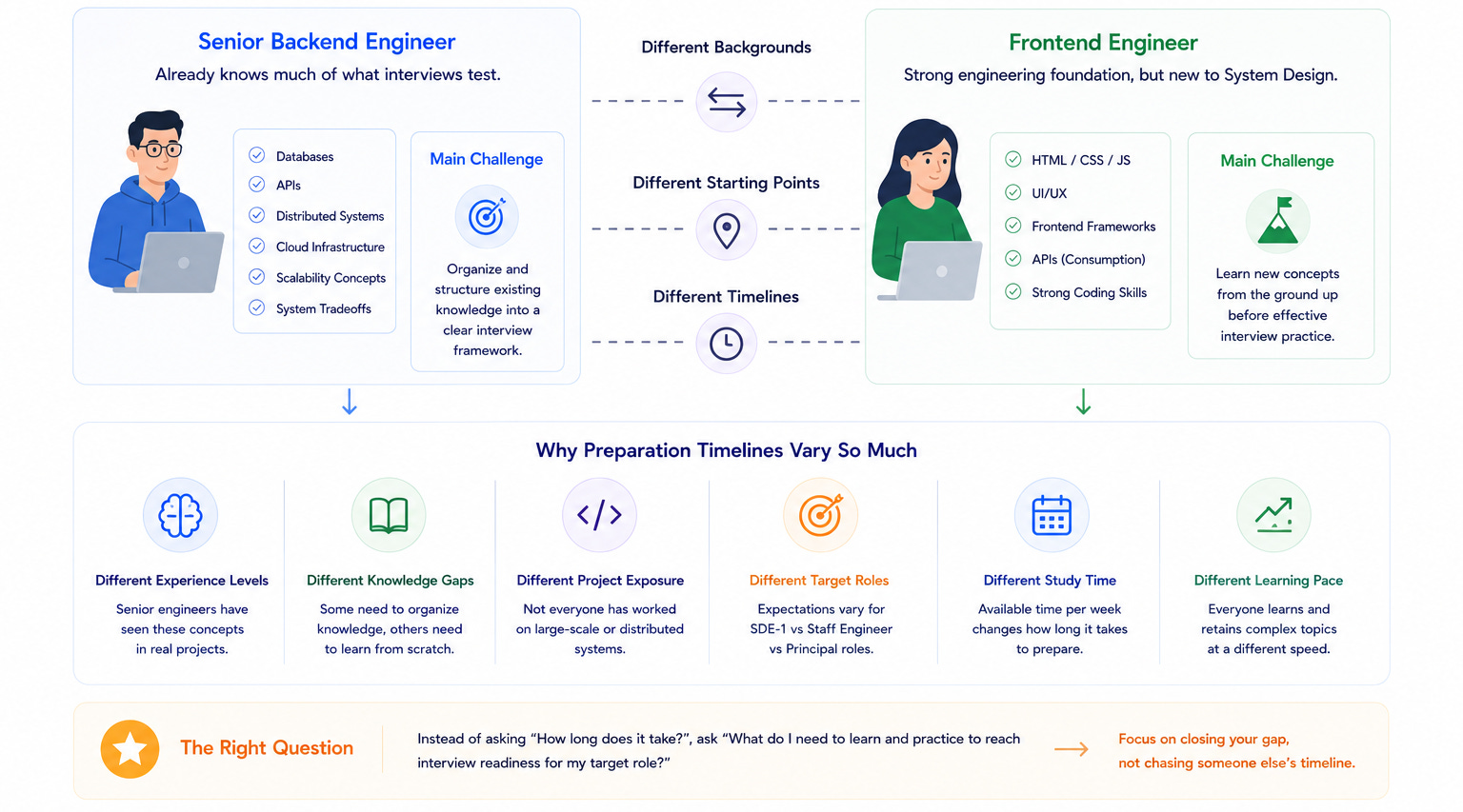
One reason candidates become frustrated when searching for preparation timelines is that everyone starts from a different place. A senior backend engineer who has spent years working with databases, APIs, distributed systems, and cloud infrastructure already possesses much of the knowledge that System Design interviews evaluate. Their challenge is often organizing that knowledge into a structured interview framework.
A frontend engineer, on the other hand, may understand software engineering exceptionally well while having limited exposure to scalability, replication, caching, partitioning, and distributed system tradeoffs. For that candidate, System Design preparation involves learning entirely new concepts before interview practice even begins.
This difference explains why preparation advice varies so dramatically online. The timeline that works for one engineer may be completely unrealistic for another. The better question is not how long preparation should take in general, but how much preparation is required to bridge the gap between your current knowledge and your target role.
What System Design interviews actually evaluate
Many engineers assume System Design interview questions are primarily testing distributed systems knowledge. While technical concepts certainly matter, interviewers are usually evaluating something broader. They want to understand how you approach open-ended engineering problems.
Strong candidates clarify requirements before proposing solutions. They estimate scale, identify bottlenecks, evaluate tradeoffs, and communicate decisions clearly. They understand that System Design is not about producing perfect architectures. It is about demonstrating structured engineering thinking.
This distinction matters because it changes how preparation should be approached. Becoming an expert in every distributed systems topic could take years. Becoming capable of handling most System Design interviews often requires much less time because interviewers are not expecting encyclopedic knowledge. They are evaluating reasoning, communication, and architectural judgment.
Candidates who understand this tend to prepare more efficiently because they focus on practical interview skills instead of attempting to master every possible technology.
How experience level affects preparation time
Experience level remains the strongest predictor of preparation requirements. Engineers who have worked on backend services often discover that many interview concepts already exist within their daily responsibilities. They may need only a few weeks to organize and refine their knowledge.
Engineers with less backend exposure usually require additional time because they must learn foundational concepts before practicing complete System Designs. This is especially true for engineers transitioning from frontend development, mobile development, or smaller-scale applications.
The table below provides a realistic preparation estimate based on common candidate profiles.
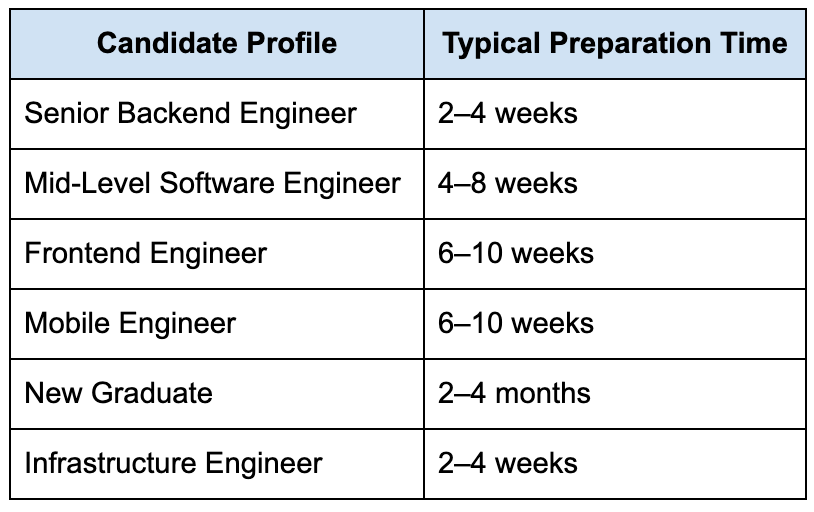
These estimates assume focused and consistent preparation. Sporadic studying often extends timelines significantly because concepts are forgotten between sessions.
The goal should not be to minimize preparation time. The goal should be developing confidence and consistency.
The first phase: building foundations
The first stage of preparation should focus on fundamentals. Many candidates skip this phase because they are eager to begin practicing famous interview questions, such as designing Instagram, YouTube, WhatsApp, or Uber.
The problem is that these systems rely on concepts that must be understood first. Topics such as load balancing, caching, databases, replication, partitioning, content delivery networks, and asynchronous processing appear repeatedly across System Design interviews. Without a solid understanding of these building blocks, larger architectures often feel confusing.
This phase is particularly important for candidates who have not worked extensively with distributed systems. Learning why these technologies exist and what problems they solve creates a foundation that makes future interview questions significantly easier.
Most candidates spend one to three weeks building this foundation, depending on their prior experience. The stronger the foundation, the more effective later preparation becomes.
The second phase: learning common design patterns
Once the fundamentals are comfortable, preparation should shift toward architectural patterns. One of the most important realizations candidates have during this phase is that many System Design questions are variations of the same underlying challenges.
Messaging systems rely on persistent communication and asynchronous processing. Social media platforms depend heavily on caching and feed generation. Streaming services require scalable storage and content delivery. E-commerce systems emphasize consistency, transactions, and inventory management.
As candidates study more examples, recurring patterns become easier to recognize. This pattern recognition is valuable because interviews rarely reward memorization. They reward the ability to identify familiar challenges within unfamiliar problems.
Engineers who understand common design patterns often perform better because they can adapt existing ideas to new scenarios rather than relying on memorized architectures.
This phase usually takes several weeks because intuition develops gradually through exposure to multiple systems.
The third phase: solving complete interview problems
Many candidates spend too much time reading and not enough time designing. This is often where preparation begins to slow down because passive learning feels productive while active practice feels difficult.
System Design interviews require candidates to create solutions under uncertainty. Reading architecture diagrams does not fully prepare you for that challenge. At some point, you must begin solving problems independently.
Choose realistic interview questions and work through them from start to finish. Clarify requirements, estimate scale, design the architecture, identify bottlenecks, and discuss tradeoffs. Resist the temptation to immediately look at reference solutions.
This process often reveals weaknesses that passive study hides. Concepts that seem clear while reading may become difficult to explain when designing a system yourself. Those moments are valuable because they identify the areas that need additional attention.
Most successful candidates spend a significant portion of their preparation time in this phase because interview performance improves fastest when actively solving problems.
Why mock interviews accelerate progress
One pattern became obvious after years of interviewing engineers. Candidates often improved more during a handful of mock interviews than during several additional weeks of studying.
The reason is simple. System Design interviews are conversations, not presentations. You must explain your reasoning, justify decisions, respond to challenges, and adapt when new requirements appear. These skills are difficult to develop through independent study alone.
Mock interviews expose communication weaknesses, unclear reasoning, and gaps in architectural understanding. They also create an environment that feels much closer to a real interview. Candidates learn how to think under pressure rather than in ideal study conditions.
For engineers approaching an actual interview date, mock interviews often provide one of the highest returns on investment because they focus directly on the skills being evaluated.
The biggest mistake candidates make
One of the most common mistakes candidates make is measuring preparation by hours consumed rather than skills developed. They watch videos, read blogs, complete courses, and study architecture diagrams while assuming progress is occurring automatically.
The problem is that consuming information does not necessarily improve interview performance. System Design interviews reward the ability to apply knowledge, not simply recognize it.
I have seen candidates spend months studying while remaining uncomfortable with basic interview discussions. I have also seen candidates improve dramatically in a few focused weeks because they prioritized active practice, tradeoff analysis, and communication.
The quality of preparation almost always matters more than the quantity. Candidates who solve problems repeatedly tend to outperform candidates who spend most of their time collecting resources.
Preparation should be measured by confidence and capability rather than hours invested.
How to know when you’re ready
One challenge with System Design preparation is determining when to stop studying and start interviewing. Unlike coding interviews, there is no clear score that indicates readiness.
A useful indicator is whether you can approach unfamiliar questions without feeling lost. You should be comfortable gathering requirements, estimating scale, creating architectures, and discussing tradeoffs, even when you have never seen the problem before.
Another sign is adaptability. Strong candidates can modify designs when interviewers introduce new constraints. They do not depend heavily on memorized solutions because they understand the reasoning behind architectural decisions.
Perhaps the strongest signal is comfort with uncertainty. Experienced engineers understand that System Design questions rarely have perfect answers. They can make reasonable decisions with incomplete information and explain those decisions confidently.
When you reach that point, additional preparation often provides diminishing returns.
A practical preparation roadmap
For many candidates, a structured roadmap provides a useful balance between learning and practice.
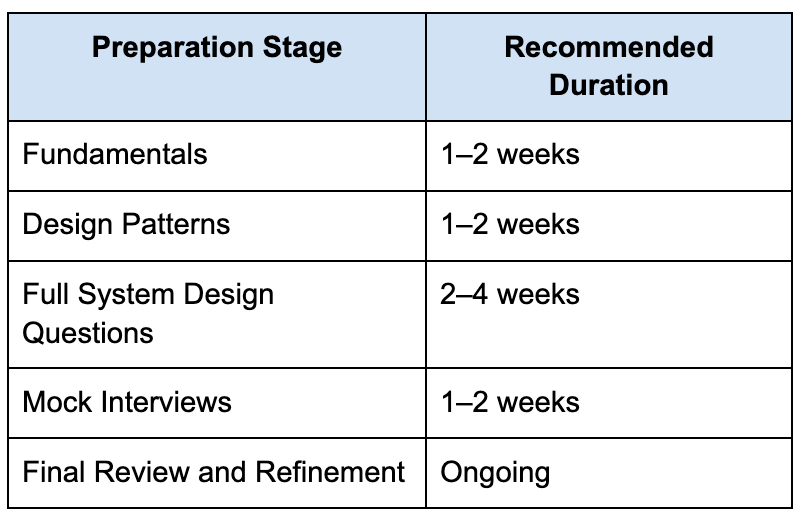
The exact timeline depends on experience level, but the progression remains effective because each stage builds naturally upon the previous one.
Candidates who follow a structured approach often develop stronger architectural intuition than those who jump randomly between topics.
Final thoughts
So, how long should you prepare for a System Design interview? For most engineers, the answer falls somewhere between four and eight weeks of focused preparation. Some experienced backend engineers may require less time, while candidates newer to distributed systems may need several months. The specific timeline matters far less than the quality of preparation.
After interviewing hundreds of engineers at Microsoft and Meta, I found that successful candidates rarely shared the same preparation schedule. What they shared was a commitment to understanding systems rather than memorizing architectures. They learned the fundamentals, practiced repeatedly, discussed tradeoffs, and developed the ability to reason through unfamiliar problems.
If you are preparing for a System Design interview, focus on building skills rather than hitting a specific timeline. A month of deliberate practice often provides more value than several months of passive studying. Ultimately, interview success comes from demonstrating how you think about systems, not how long you spent preparing for them.