


Many engineers preparing for System Design interviews spend countless hours studying architectures for YouTube, Netflix, Uber, Instagram, Amazon, and other large-scale systems. The assumption is understandable.
If interview questions often involve designing products that resemble these platforms, learning how those companies built their systems seems like a logical preparation strategy. The problem is that many candidates use real-world examples incorrectly. Instead of strengthening their answers, they turn interview discussions into memorized case studies.
After interviewing hundreds of engineers at Microsoft and Meta, I found that the strongest candidates rarely recited architecture diagrams they had studied online. Instead, they used real-world examples as evidence for architectural decisions, helping explain tradeoffs, scalability challenges, and engineering reasoning. Understanding how to use real-world examples effectively can make your design discussions significantly more convincing without making them sound scripted.
Why interviewers appreciate real-world examples
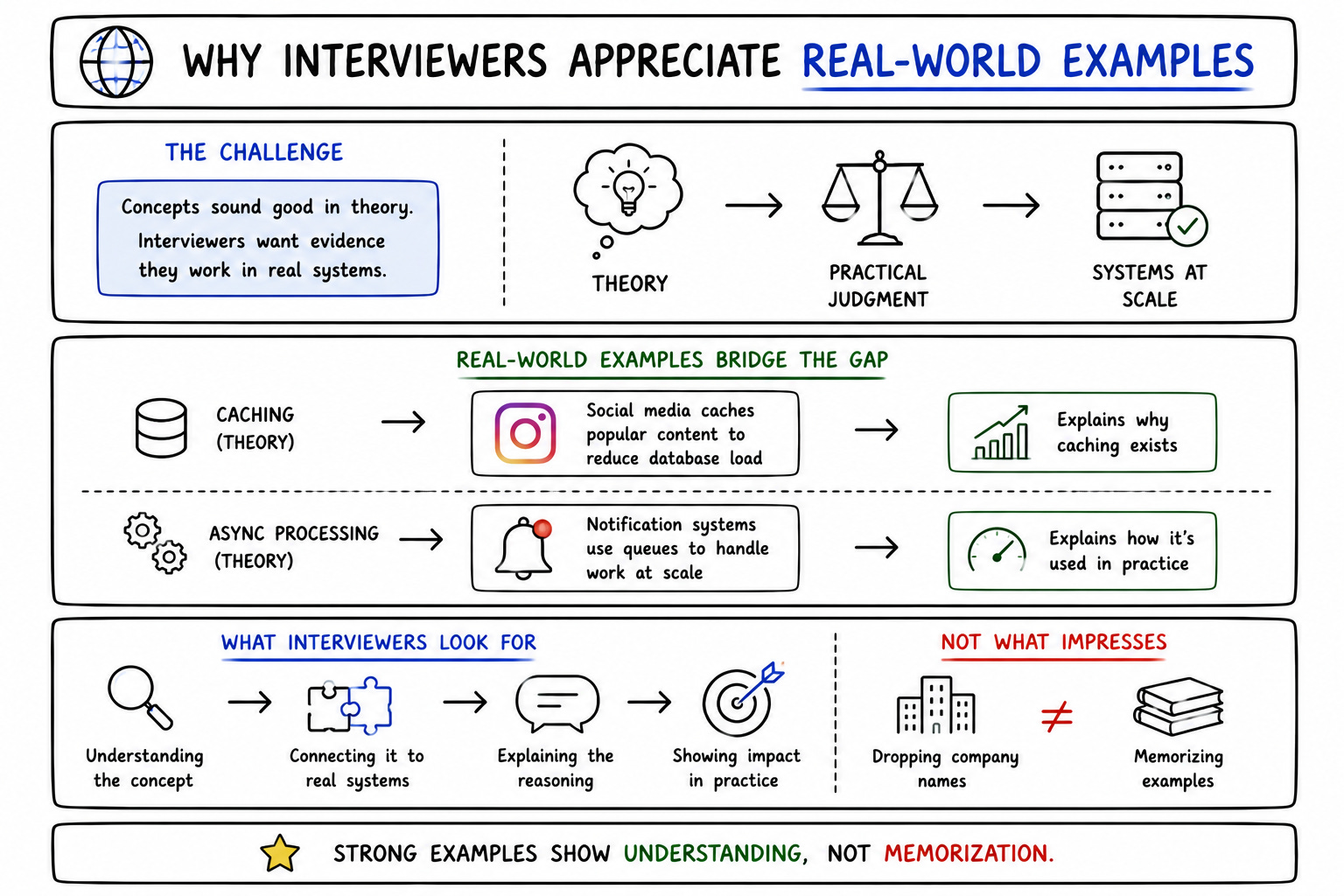
One of the challenges of System Design interviews is demonstrating practical engineering judgment. Many architectural concepts sound reasonable in theory, but interviewers often want evidence that candidates understand how those concepts apply to real systems operating at scale.
Real-world examples help bridge that gap. When candidates connect architectural decisions to systems that engineers actually use, it becomes easier to explain why a particular approach exists. Instead of discussing caching in abstract terms, a candidate might explain how social media platforms cache popular content to reduce database load. Instead of discussing asynchronous processing theoretically, they might reference how notification systems are commonly handled in large-scale applications.
The value comes from demonstrating understanding rather than demonstrating memorization. Interviewers are not impressed because a candidate mentioned Netflix or Uber. They are interested in whether the example helps explain an engineering decision. Strong examples show that the candidate understands how architectural concepts appear in production environments and why those concepts matter.
Why memorized architectures often hurt candidates
One pattern I noticed repeatedly is that answers to System Design interview questions involved candidates who had clearly studied popular System Design examples extensively. They could explain how YouTube stored videos, how Twitter generated timelines, or how Uber matched drivers and riders. Initially, this often sounded impressive.
The problems usually appeared when the interviewer changed the requirements. Because the candidate’s knowledge was tied to a specific architecture, adapting became difficult. The discussion shifted from engineering reasoning to architecture recall. Instead of designing a system, the candidate was attempting to remember details from a reference solution.
Strong candidates approached examples differently. They focused on patterns rather than architectures. They understood why YouTube uses content delivery networks, why Instagram relies heavily on caching, or why Amazon embraces distributed systems. Because they understood the underlying reasoning, they could adapt those ideas to completely different problems.
Real-world examples should support your design process, not replace it. The interview is evaluating your ability to solve unfamiliar problems, not your ability to memorize existing solutions.
Use examples to justify decisions, not introduce them
One of the most effective ways to incorporate real-world examples is after you have already explained your reasoning. Start with the problem, discuss the requirements, identify the constraint, and explain the solution. Once that reasoning is clear, a real-world example can reinforce the decision.
Imagine you are discussing a caching strategy for a content-heavy platform. Rather than beginning with “Netflix uses caching,” explain why database reads may become a bottleneck as traffic grows. Discuss how caching reduces latency and decreases pressure on storage systems. Once that reasoning is established, you can mention that streaming platforms and social media companies use similar approaches because they face the same challenges at scale.
This approach demonstrates independent thinking. The architectural decision exists because the problem requires it, not because another company implemented it. The example simply provides additional context and credibility. Interviewers generally respond much more positively when examples support reasoning rather than replace it.
The best real-world examples for scalability discussions
Scalability is one of the most common topics in System Design interviews, which makes it one of the easiest areas to incorporate real-world examples. Many well-known technology companies have publicly discussed how their systems evolved as traffic increased.
Social media platforms provide useful examples because they process enormous amounts of user-generated content. Streaming services offer insights into content distribution and bandwidth optimization. E-commerce platforms demonstrate challenges involving inventory management, recommendation systems, and global traffic patterns.
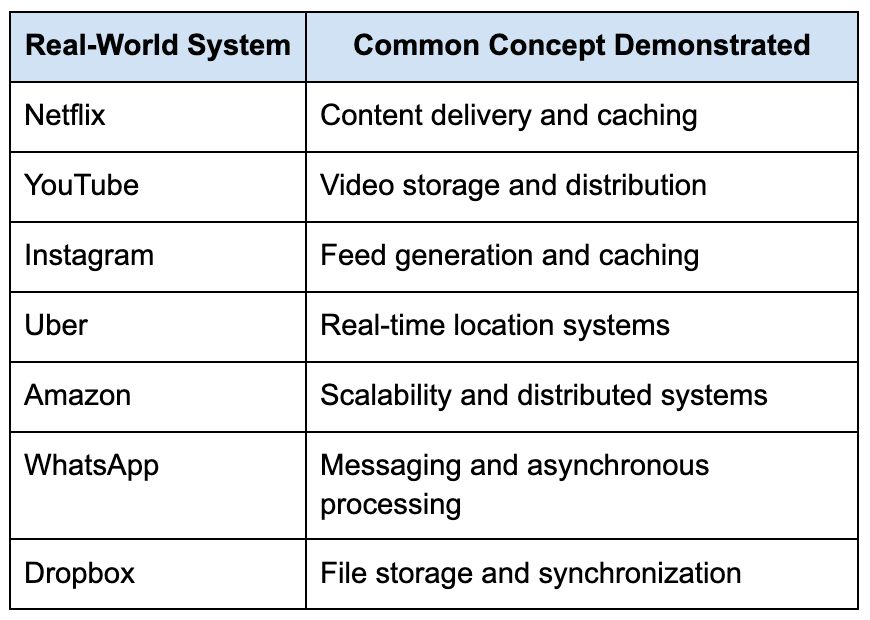
The key is understanding the engineering challenge behind the example. Interviewers care far more about the concept being demonstrated than the company itself.
Use examples to explain tradeoffs
One area where real-world examples become particularly valuable is tradeoff discussions. Many architectural decisions involve balancing competing priorities such as consistency, availability, performance, and cost. Real systems often provide useful illustrations of how those tradeoffs play out in practice.
For example, social media platforms often prioritize availability and responsiveness over strict consistency because temporary inconsistencies rarely create serious business problems. Financial applications frequently make different decisions because consistency becomes much more important when handling money.
These examples help transform abstract tradeoffs into concrete engineering discussions. Instead of describing consistency models in theoretical terms, candidates can explain how different industries make different choices depending on user expectations and business requirements.
Strong candidates use examples to demonstrate that tradeoffs are not academic concepts. They are practical decisions that affect how real systems behave in production.
The difference between examples and comparisons
Many candidates unintentionally turn real-world examples into comparisons. This often weakens the discussion because the interview shifts toward analyzing another company’s architecture instead of solving the problem at hand.
A comparison focuses on how a company built a system. An example focuses on why a particular architectural decision makes sense. This distinction may seem subtle, but it changes the entire conversation.
Suppose you are designing a ride-sharing platform. A comparison might involve describing Uber’s architecture in detail. An example might involve referencing how real-time location updates create unique scalability requirements that influence architectural decisions. The second approach keeps the discussion centered on the problem while using industry experience to reinforce the reasoning.
Interviewers generally prefer examples because they reveal engineering judgment. Comparisons often reveal memorization.
How experienced candidates use examples differently
One thing I noticed while interviewing senior engineers was that they used real-world examples very differently from less experienced candidates. Junior engineers often referenced examples to demonstrate knowledge. Senior engineers used examples to explain reasoning.
When discussing a design decision, experienced candidates would frequently mention challenges they had encountered directly in previous projects or products. The examples felt natural because they emerged from practical experience rather than interview preparation materials.
Even if you do not have experience working on massive distributed systems, you can adopt a similar mindset. Focus on understanding why architectural patterns exist and what problems they solve. When you reference a well-known system, connect the example directly to the engineering challenge being discussed.
This approach makes examples feel authentic rather than rehearsed. The discussion becomes about engineering principles rather than company architectures.
When not to use real-world examples
Although real-world examples can strengthen an interview, they are not always necessary. Some candidates try to include references in every answer because they believe it demonstrates expertise. In practice, excessive examples can become distracting.
If an example does not help explain a decision, it probably does not belong in the discussion. Interviewers are already familiar with popular systems such as Netflix, Uber, and YouTube. Repeatedly mentioning them without adding meaningful insight rarely improves the conversation.
Examples should appear when they clarify a concept, reinforce a tradeoff, or provide context for an architectural decision. They should never become the primary focus of the interview. The goal is designing a system, not delivering a case study presentation.
Strong candidates remain focused on the problem in front of them and use examples only when they genuinely improve understanding.
Building a library of useful examples
One effective preparation strategy is creating a small collection of examples that illustrate common System Design concepts. Instead of memorizing complete architectures, focus on understanding how a handful of well-known systems address specific challenges.
You do not need dozens of examples. A few strong examples can cover a surprising number of interview topics. Understanding how Netflix handles content delivery can help with caching discussions. Understanding how WhatsApp manages messaging can support conversations about asynchronous processing. Understanding how Dropbox stores files can reinforce storage and synchronization discussions.
The goal is not to become an expert on these platforms. The goal is to develop a set of practical references that help explain architectural reasoning when relevant. This approach is significantly more flexible than memorizing complete designs because the concepts can be applied across many different interview questions.
Final thoughts
Real-world examples can be powerful tools in System Design interviews when used correctly. They help connect architectural concepts to practical engineering challenges, reinforce tradeoff discussions, and demonstrate that you understand how systems operate beyond textbook diagrams. However, their value comes from supporting your reasoning rather than replacing it.
After interviewing hundreds of engineers at Microsoft and Meta, I found that the strongest candidates rarely relied on memorized architectures. Instead, they used examples strategically to explain decisions and provide context. Their discussions remained focused on requirements, constraints, bottlenecks, and tradeoffs. The examples simply made those discussions stronger.
If you want to improve your System Design interviews, spend less time memorizing architecture diagrams and more time understanding why successful systems are designed the way they are. Once you understand the reasoning behind real-world examples, you can apply those lessons to almost any interview question. That ability to transfer knowledge from one problem to another is ultimately what strong System Designers do every day.