

I’ve interviewed hundreds of engineers: Is one month enough for System Design interviews?
A realistic roadmap for becoming System Design interview-ready in 30 days

One of the most common questions I hear from engineers preparing for interviews is whether one month is enough for System Design interviews. The question usually appears when an interview date is approaching, and the candidate starts comparing their preparation against the advice they find online.
Some people claim they studied for six months before feeling comfortable. Others insist they became interview-ready within a few weeks. After nearly a decade at Microsoft and Meta, where I interviewed hundreds of engineers and participated in architecture reviews for systems serving millions of users, I learned that neither timeline tells the whole story.
The amount of time available matters, but the quality of preparation matters far more. One month can be enough for many candidates, but only if they focus on learning how to reason about systems instead of trying to memorize every architecture diagram they encounter.
Why the question itself is misleading
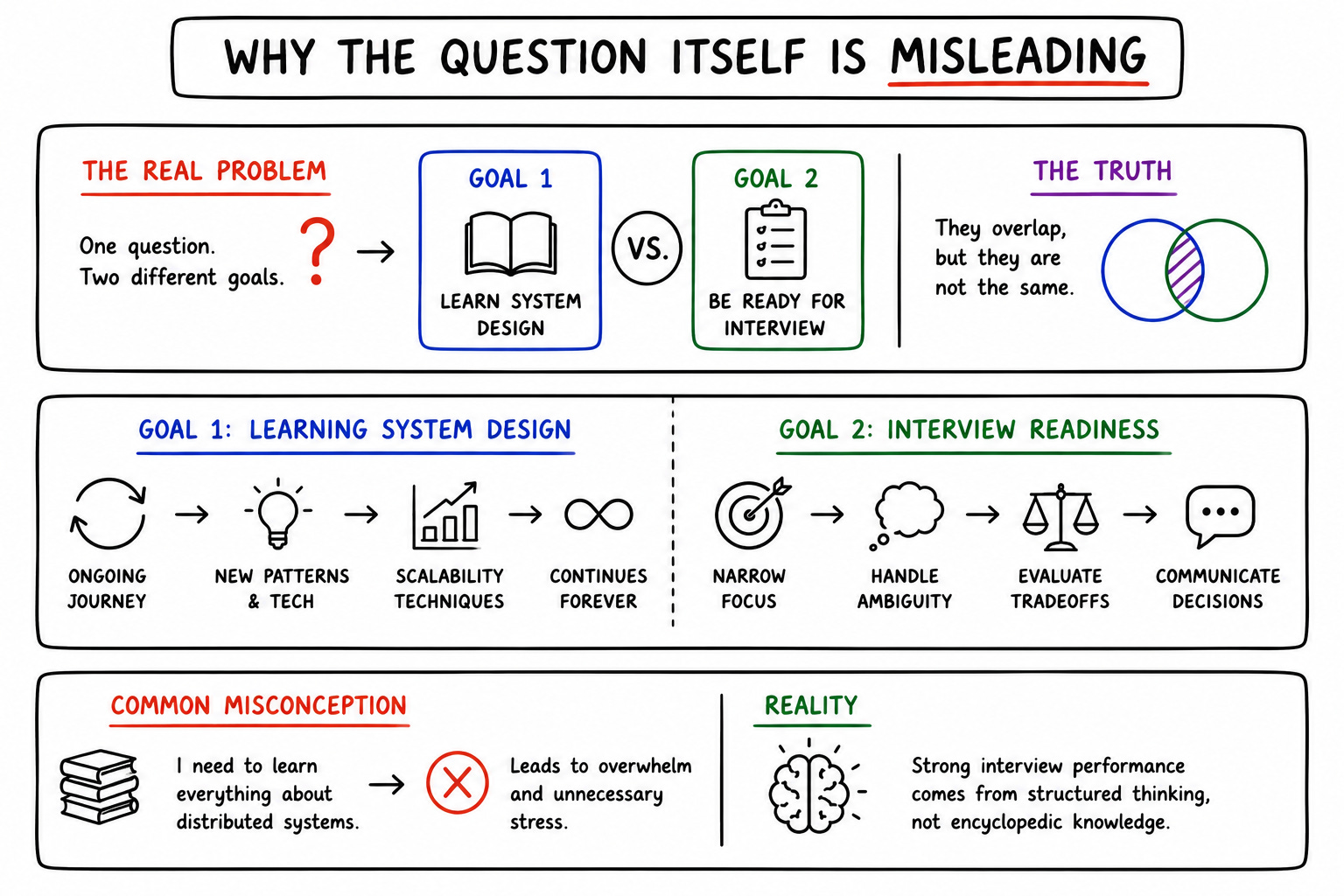
When engineers ask whether one month is enough, they are usually combining two different goals into a single question. The first goal is learning System Design as a discipline. The second goal is becoming ready for a System Design interview. These goals overlap, but they are not the same thing, and confusing them often creates unnecessary stress during preparation.
Learning System Design is a long-term process that continues throughout your career. Even experienced staff and principal engineers constantly learn new architectural patterns, infrastructure technologies, and scalability techniques. Interview readiness, however, is much narrower. Interviewers are not evaluating whether you could independently design the next version of Netflix or Azure. They are trying to understand how you approach ambiguity, identify constraints, evaluate tradeoffs, and communicate technical decisions. Many candidates spend weeks consuming information because they believe success requires mastering every distributed systems concept. In reality, strong interview performance usually comes from structured thinking rather than encyclopedic knowledge.
What I noticed after interviewing hundreds of engineers
After conducting interviews at Microsoft and Meta, I began noticing a pattern that repeated itself surprisingly often. Candidates frequently assumed that System Design interview questions rewarded technical complexity. Because of that assumption, they spent enormous amounts of time studying advanced concepts and looking for opportunities to showcase sophisticated architectures during the interview.
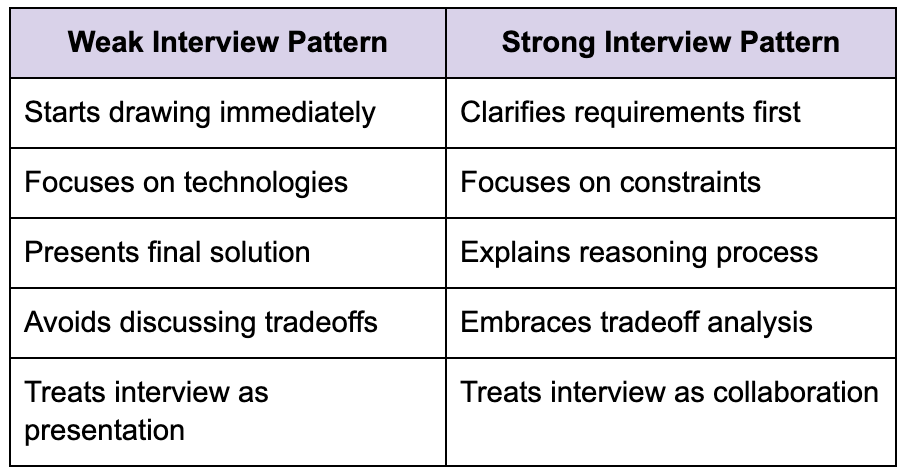
The strongest candidates approached the problem differently. They rarely rushed into discussing sharding strategies, consensus protocols, or multi-region deployments. Instead, they spent time understanding the problem before proposing solutions. They clarified requirements, established assumptions, and identified constraints before introducing architectural components. Their solutions were often simpler than those proposed by weaker candidates, but every decision had a clear justification. The difference was not technical intelligence. It was discipline. Strong candidates understood that interviewers care more about how decisions are made than how complicated a design appears on a whiteboard.
What interviewers are actually evaluating
Many candidates enter System Design interviews believing they are being tested on architecture. In reality, they are being tested on engineering judgment. The architecture simply provides a vehicle through which that judgment becomes visible. This distinction is important because it changes how you should approach preparation.
When interviewers evaluate a design discussion, they are paying attention to how requirements are gathered, how assumptions are validated, and how tradeoffs are handled throughout the conversation. A candidate who proposes a reasonable architecture and explains their reasoning clearly will often outperform a candidate who proposes a more sophisticated solution but struggles to justify it. Strong interviews feel less like presentations and more like collaborative engineering discussions. Interviewers want to understand how you think when the answer is not obvious, because that mirrors the type of decision-making that occurs in real engineering environments.
Can one month actually be enough?
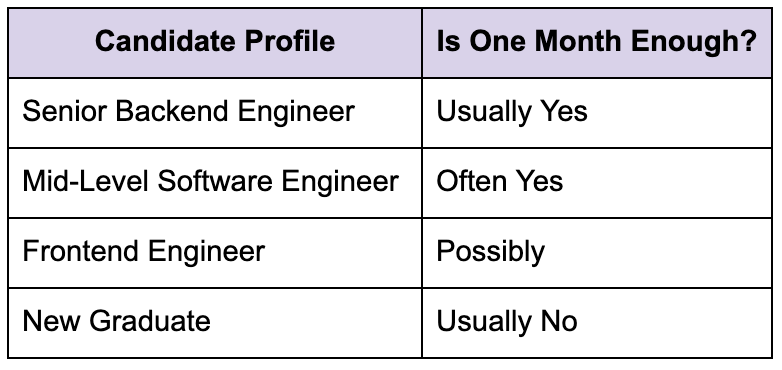
The honest answer is yes, but only under specific conditions. The biggest variable is not the number of days available. The biggest variable is your starting point. An engineer who has spent several years building backend services already possesses many of the mental models required for System Design interviews. Someone with limited exposure to production systems may need more time because they are building those models from scratch.
This difference explains why preparation advice often feels contradictory. Both perspectives can be true depending on the candidate’s background. A senior backend engineer may need only a few weeks of focused practice to become interview-ready. A new graduate may need several months to develop sufficient familiarity with distributed systems concepts. The goal is not to compare yourself against someone else’s timeline. The goal is to understand where you currently stand and build a preparation plan that closes the most important gaps.
What you should learn during those 30 days
The most effective month-long preparation plans focus on depth rather than breadth. Candidates who try to learn everything often end up retaining very little because they spread their attention across too many topics. A focused approach generally produces much better results because it allows concepts to connect naturally.
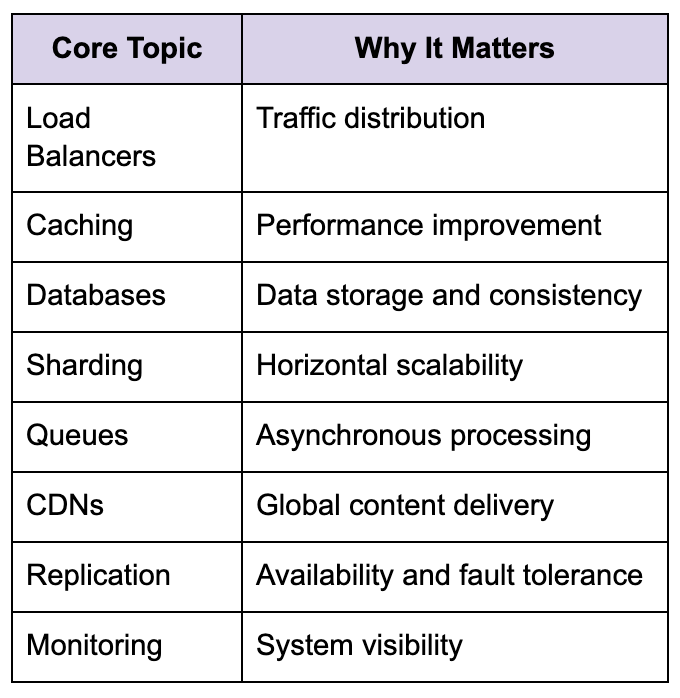
Rather than memorizing architectures for dozens of systems, concentrate on understanding the components that appear repeatedly across large-scale applications. Learn why load balancers exist, how caching reduces latency, why databases become bottlenecks, and when asynchronous processing makes sense. Once these fundamentals become familiar, more complex architectures start feeling intuitive rather than overwhelming. Many interview questions ultimately revolve around combining a relatively small set of building blocks to solve different business problems.
A realistic 30-day preparation plan
One of the biggest mistakes candidates make is treating all thirty days the same. Effective preparation is usually sequential. The first week should look very different from the final week because the skills you need early in the process are not the same skills you need immediately before the interview.
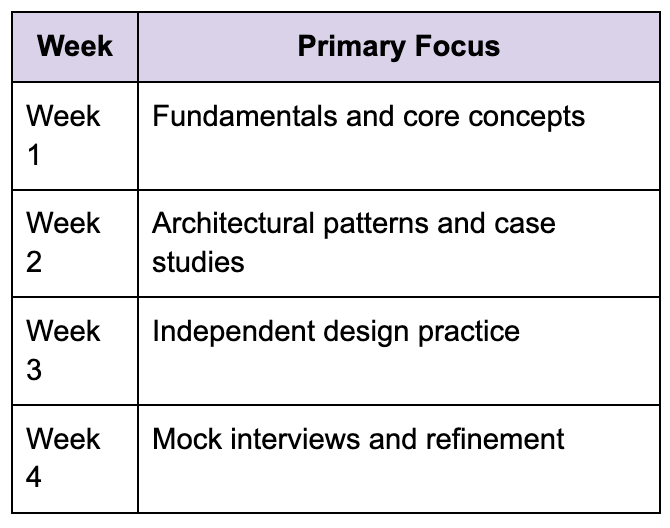
The first week should focus almost entirely on fundamentals. Spend time understanding how load balancers, databases, caches, queues, and CDNs work. The goal is not memorization. The goal is understanding why these components exist and what problems they solve. During the second week, start studying complete System Designs and identifying recurring patterns. As you analyze systems such as YouTube, Instagram, Uber, or Dropbox, you will begin noticing that many seemingly different architectures rely on the same underlying building blocks.
The third week should emphasize active practice. Instead of consuming solutions, start designing systems yourself. Work through prompts independently before reviewing reference solutions. The final week should focus heavily on mock interviews because communication quality often determines interview performance more than technical depth.
Why mock interviews matter more than most candidates realize
One lesson I learned repeatedly while interviewing engineers is that understanding a concept and explaining a concept are completely different skills. Many candidates discover this only after their first mock interview. While studying alone, it is easy to convince yourself that you understand a system because the architecture makes sense when reading it on a screen. The challenge appears when you need to explain that same architecture aloud while answering follow-up questions in real time.
Mock interviews expose weaknesses that passive studying often hides. They reveal gaps in your requirements gathering process, unclear explanations, unrealistic assumptions, and weak transitions between architectural components. More importantly, they teach you how to organize your thoughts under pressure. System Design interviews rarely reward perfect solutions. They reward structured thinking and clear communication.
Some candidates spend twenty hours reading System Design content and only one hour practicing interviews. In many cases, those priorities should be reversed. Once you understand the fundamentals, the fastest improvements often come from repeatedly discussing designs, receiving feedback, and refining your communication style. Interview performance improves when architectural reasoning becomes conversational rather than rehearsed.
How to know when you’re actually ready
One challenge with System Design preparation is that readiness can feel difficult to measure. Unlike coding interviews, there is no collection of test cases that confirms your solution works. Many candidates continue studying because they are waiting for a moment when they suddenly feel completely prepared. In practice, that moment rarely arrives.
A better approach is to look for behavioral indicators. You are probably closer to interview-ready than you think if you can take an unfamiliar prompt and structure a discussion without immediately feeling overwhelmed. You should be comfortable clarifying requirements, estimating scale, identifying bottlenecks, and discussing tradeoffs between different architectural choices. You should also be capable of adapting your design when new constraints are introduced midway through the conversation.
Perhaps the strongest signal is confidence in uncertainty. Experienced engineers understand that System Design problems rarely have perfect answers. They know that every decision introduces tradeoffs. Candidates who become comfortable operating within that ambiguity tend to perform significantly better than candidates searching for the single correct architecture. Interviewers are not evaluating certainty. They are evaluating judgment.
What one month cannot do
Although one month can be enough for many candidates, it is important to establish realistic expectations. Thirty days will not transform a junior engineer into a staff-level architect. It will not replace years of experience operating distributed systems, responding to production incidents, or making long-term architectural decisions at scale.
What thirty days can do is help you build the skills necessary to participate effectively in a System Design discussion. It can teach you how to reason about scalability, reliability, latency, consistency, and operational tradeoffs. It can help you recognize common patterns and understand why they appear across different systems. Most importantly, it can teach you how to communicate those ideas clearly during an interview.
This distinction matters because unrealistic expectations often create unnecessary frustration. The goal is not mastery. The goal is to demonstrate that you can think like an engineer when faced with an open-ended problem. For most interview processes, that level of preparation is far more important than becoming an expert in every corner of distributed systems.
The difference between passing and standing out
There is an important distinction between becoming interview-ready and becoming a standout candidate. Many engineers can reach the point where they are capable of passing a System Design interview within a month. Standing out among a group of strong candidates usually requires something more than technical competence.
The candidates who consistently impressed me were able to connect technical decisions back to business goals. They understood that System Design is not just about scaling infrastructure. It is about building systems that solve problems while balancing reliability, cost, performance, maintainability, and team velocity. Their discussions felt grounded in real engineering experience because every design decision reflected an understanding of practical tradeoffs.
This is why experienced engineers often have an advantage. They have seen production systems evolve over time. They understand how technical decisions affect development teams, operational complexity, and long-term maintenance. While a month may be enough to become interview-ready, developing that broader engineering judgment is something that happens gradually throughout your career.
Final thoughts
After interviewing hundreds of engineers at Microsoft and Meta, I have become skeptical of preparation timelines measured purely in months. Some candidates spend six months accumulating information but never develop the ability to structure a design discussion. Others make remarkable progress within a few focused weeks because they spend their time practicing the skills that interviews actually evaluate.
So, is one month enough for System Design interviews? For many engineers, the answer is yes. Not because thirty days is enough to master System Design, but because thirty days is enough to build a strong foundation, develop a repeatable framework for approaching problems, and improve the communication skills that interviewers care about most.
The candidates who perform best are rarely the ones who know the most. They are usually the ones who understand how to navigate uncertainty, justify tradeoffs, and communicate their thinking clearly. If your preparation focuses on those skills rather than on collecting endless amounts of information, one month can be enough to walk into a System Design interview with confidence and perform at a high level.