

System Design primer: learning to think in constraints, not just components
A complete System Design primer to help you think in constraints, trade-offs, and real-world scalable architectures

If you approach System Design as a collection of patterns, components, and diagrams to memorize, you will likely find that your understanding breaks down the moment you encounter a problem that does not fit a familiar template. This is a common experience because System Design is not fundamentally about knowing which database or cache to use. It is about understanding how systems behave under constraints, how those constraints interact, and how trade-offs shape the architecture.
Most beginner explanations reduce System Design to a set of building blocks such as load balancers, databases, caches, and queues. While these components are important, focusing on them too early leads to a shallow understanding. Real System Design begins with identifying constraints, understanding failure modes, and reasoning about how the system evolves over time.
The goal of this primer is not to give you a checklist. It is to help you build a mental model that allows you to approach any System Design problem with clarity and confidence.
What System Design actually is
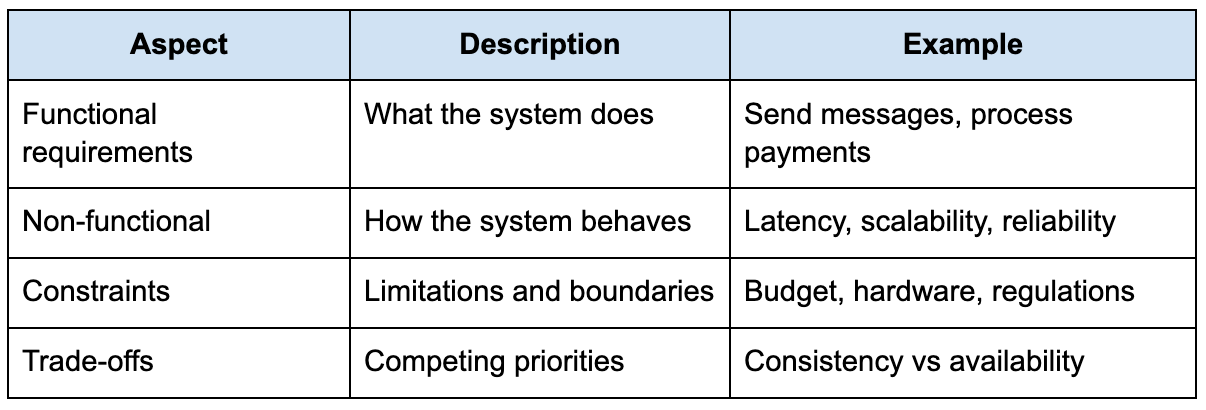
System Design is the discipline of building systems that meet functional and non-functional requirements under real-world constraints. Functional requirements define what the system should do, while non-functional requirements define how the system should behave under conditions such as scale, latency, and failure.
At its core, System Design is about managing trade-offs. Every design decision has a cost, and optimizing for one dimension often comes at the expense of another. The challenge is to choose trade-offs that align with the system’s goals.
The table below summarizes key aspects of System Design:
Understanding these dimensions is the first step toward designing systems that are not just correct but resilient and scalable.
Thinking in constraints
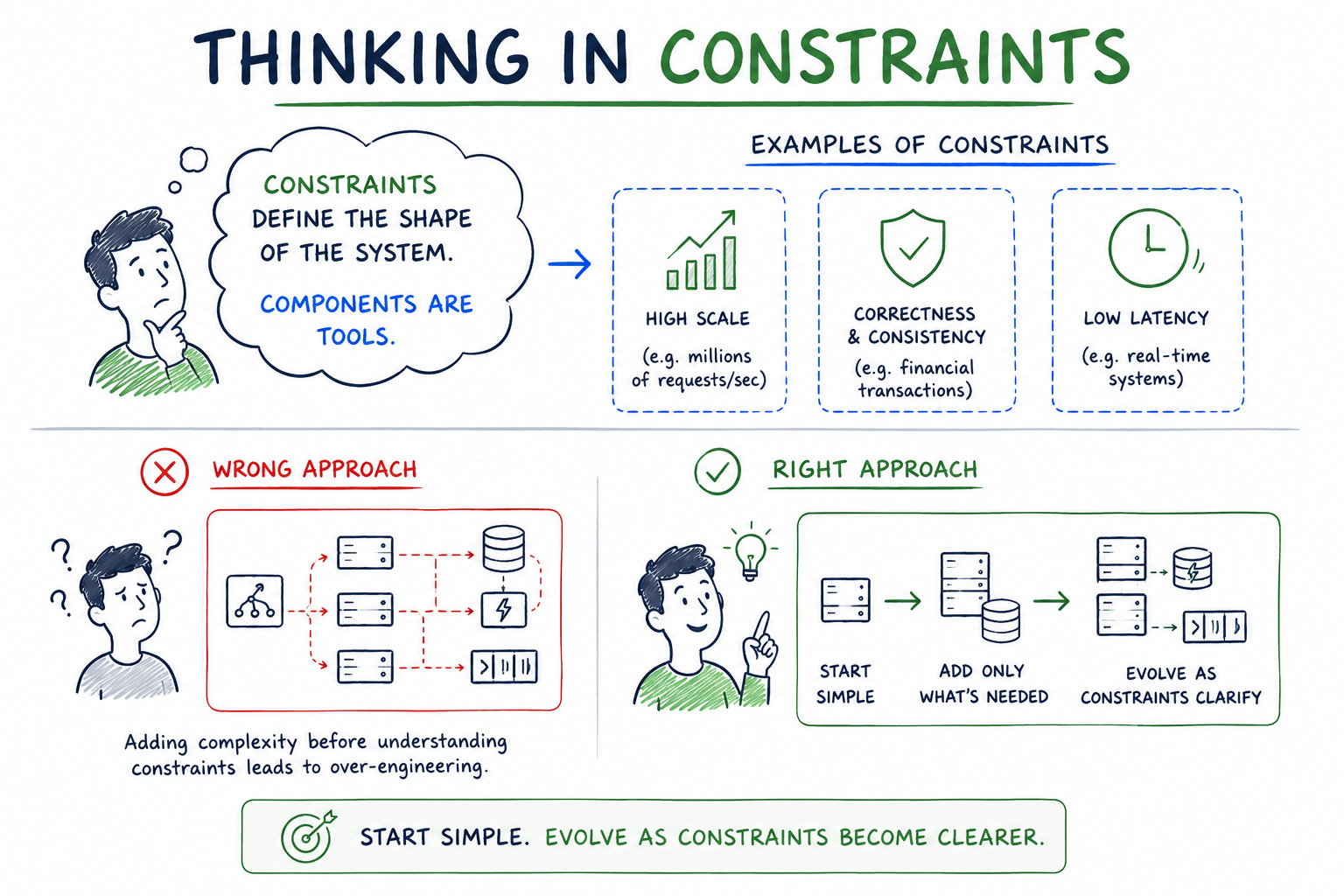
One of the most important shifts in System Design is learning to think in constraints rather than components. Constraints define the shape of the system. Components are simply tools used to satisfy those constraints.
For example, if a system must handle millions of requests per second, scalability becomes a primary constraint. If a system must process financial transactions, correctness and consistency become dominant constraints. If a system must operate in real time, latency becomes critical.
The mistake many beginners make is introducing complexity before understanding constraints. They design distributed systems when a single-node solution would suffice, or they introduce caching without identifying actual bottlenecks.
A better approach is to start simple and evolve the system as constraints become clearer. This helps when answering System Design interview questions.
The building blocks of modern systems
While System Design is not about memorizing components, understanding the role of common building blocks is essential. These components are the tools you use to address specific challenges.
The table below outlines common components and their purposes:
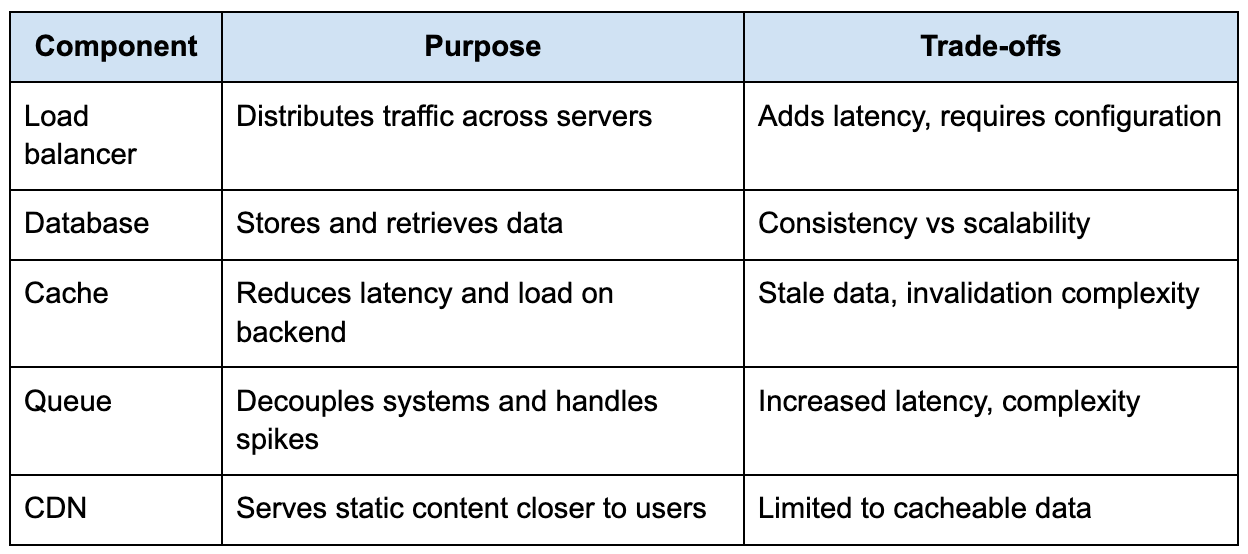
Each of these components solves a specific problem, but none of them is universally necessary. The key is to use them only when justified by constraints.
Scaling systems: from single node to distributed
Scaling is one of the fundamentals of System Design, but it is often misunderstood. Scaling is not about adding more machines by default. It is about addressing bottlenecks that prevent the system from meeting its requirements.
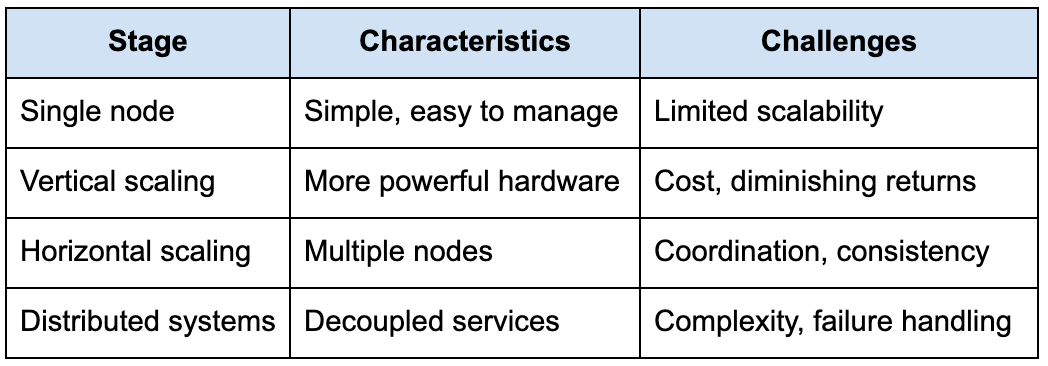
Systems typically evolve through stages. They start as simple, single-node systems and gradually become distributed as load increases.
The progression often looks like this:
The key insight is that distribution introduces complexity. It should be a response to real constraints, not a default choice.
Latency and throughput: understanding performance
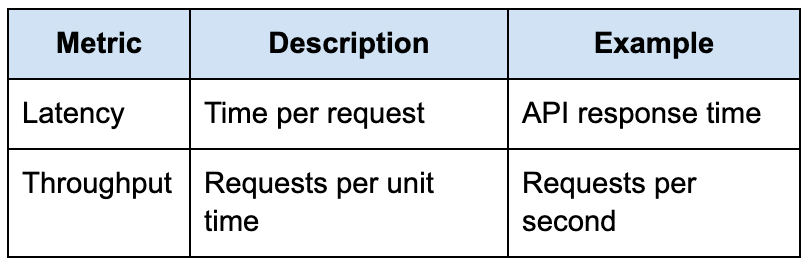
Performance in System Design is often discussed in terms of latency and throughput. Latency refers to how long it takes to process a request, while throughput refers to how many requests can be handled over time.
These metrics are related but not identical. Improving one does not always improve the other.
The table below illustrates the difference:
In many systems, tail latency is more important than average latency. A system may have low average latency but still perform poorly if a small percentage of requests take significantly longer.
Understanding these nuances is critical for designing systems that perform well under load.
Consistency and availability: the fundamental trade-off
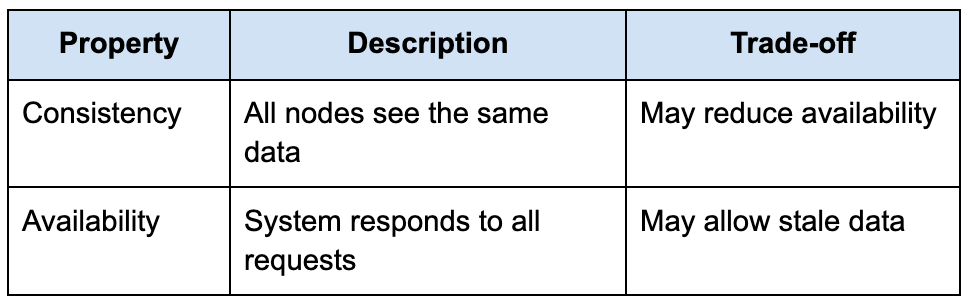
One of the most important trade-offs in distributed systems is between consistency and availability. This trade-off is often discussed in the context of the CAP theorem, which states that a system can only guarantee two out of three properties: consistency, availability, and partition tolerance.
In practice, partition tolerance is non-negotiable in distributed systems, which means the trade-off is between consistency and availability.
The table below illustrates this trade-off:
Different systems make different choices based on their requirements. Financial systems prioritize consistency, while social media systems often prioritize availability.
Data modeling and storage
Data is at the core of most systems, and how you model and store it has a significant impact on performance and scalability. Choosing the right database depends on access patterns, consistency requirements, and scale.
The table below compares common database types:
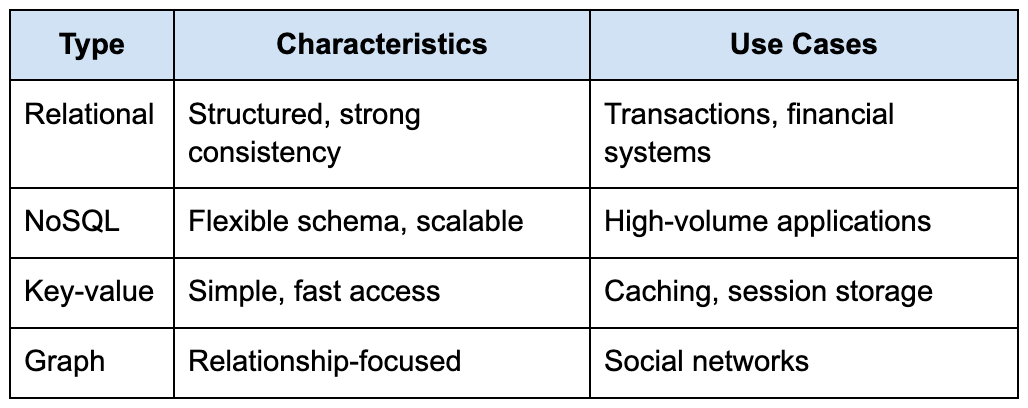
The key is to align the data model with how the system uses the data. A mismatch between the data model and access patterns can lead to inefficiencies.
Caching: improving performance with trade-offs
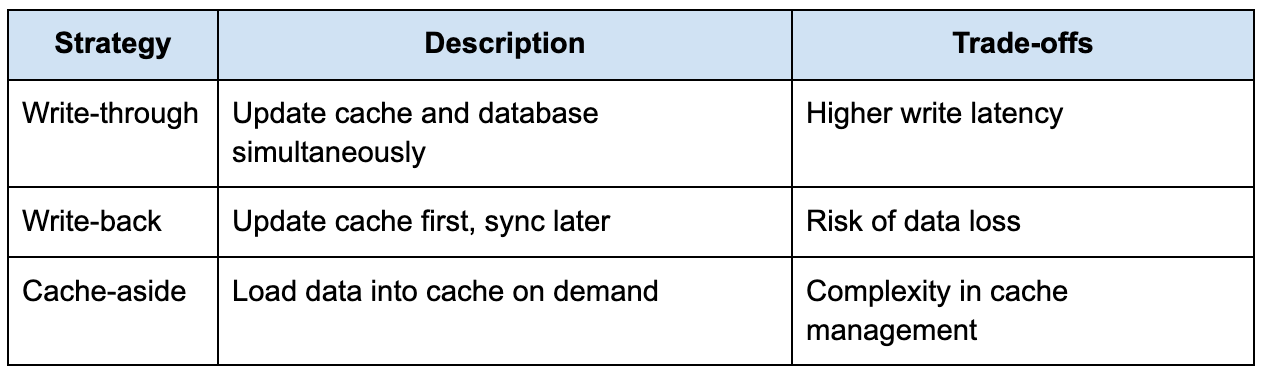
Caching is one of the most effective ways to improve performance, but it introduces its own challenges. By storing frequently accessed data in memory, caching reduces latency and load on backend systems.
However, caches can become stale, and managing cache invalidation is one of the hardest problems in System Design.
The table below outlines common caching strategies:
Choosing the right strategy depends on the system’s requirements for consistency and performance.
Asynchronous systems and queues
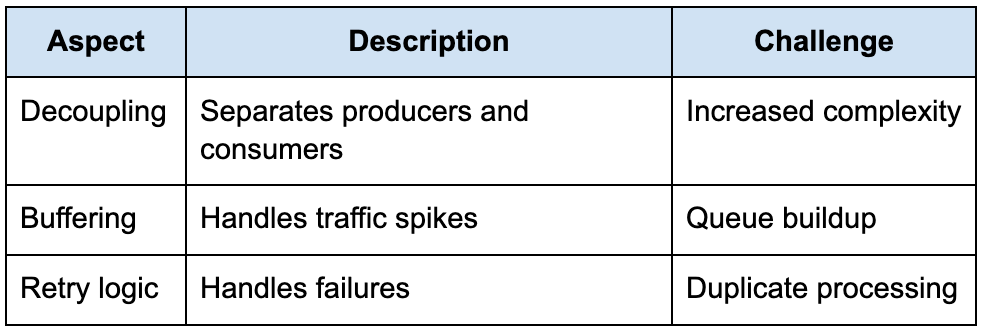
Asynchronous processing is a key technique for building scalable systems. By decoupling components, queues allow systems to handle spikes in traffic and process tasks independently.
However, asynchronous systems introduce complexity in terms of ordering, retries, and failure handling.
The table below highlights key aspects:
Understanding when to use asynchronous processing is critical for building resilient systems.
Reliability and fault tolerance
Reliability is a core requirement for most systems, and it involves designing systems that continue to function correctly in the presence of failures.
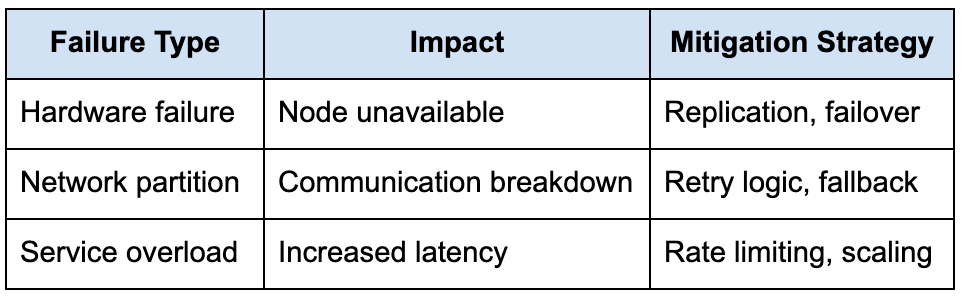
Failures can occur at multiple levels, including hardware, network, and software. A robust system must anticipate these failures and include mechanisms to handle them.
Common techniques include redundancy, retries, and circuit breakers.
The table below outlines common failure scenarios:
Reliability is not achieved by avoiding failures but by handling them effectively.
Observability: understanding system behavior
Observability is essential for understanding how a system behaves in production. It involves collecting and analyzing data to diagnose issues and improve performance.
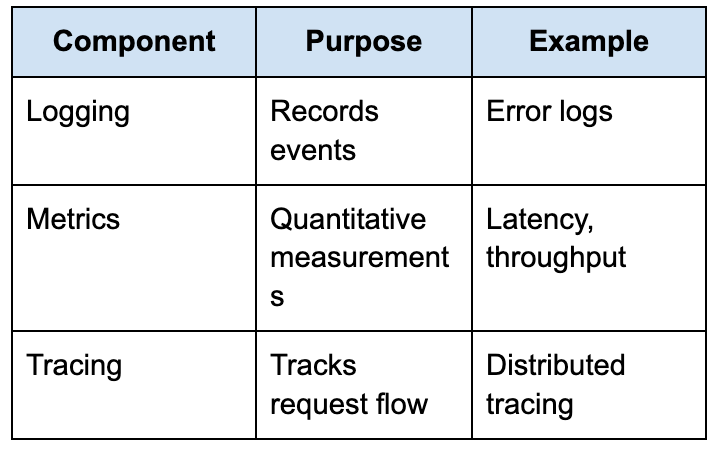
Key aspects of observability include logging, metrics, and tracing.
The table below summarizes these components:
Without observability, debugging becomes guesswork, especially in distributed systems.
Security and data protection
Security is an essential aspect of System Design, particularly for systems that handle sensitive data. This includes protecting data at rest and in transit, managing access control, and ensuring compliance with regulations.
Security considerations often influence architectural decisions, such as encryption, authentication mechanisms, and data isolation.
Designing for evolution
One of the most overlooked aspects of System Design is how systems evolve over time. Systems are rarely static. Requirements change, traffic grows, and new features are added.
A good design anticipates change and allows for gradual evolution. This involves modular architecture, clear interfaces, and backward compatibility.
The goal is to build systems that can adapt without requiring complete rewrites.
Structuring your approach to System Design
When approaching a System Design problem, it is helpful to follow a structured process. Start by understanding the requirements, then define constraints, and finally design the system incrementally.
Instead of jumping directly into architecture diagrams, focus on building a clear narrative that explains how the system works and why it is designed that way.
Final perspective
System Design is not about memorizing patterns or drawing complex diagrams. It is about understanding how systems behave under constraints and making informed decisions about trade-offs.
If you focus on constraints, think critically about trade-offs, and build systems incrementally, you will develop the ability to design systems that are not only scalable but also reliable and adaptable.
The goal of this primer is not to give you all the answers, but to give you the tools to think through problems effectively. Once you develop that mindset, System Design becomes less intimidating and more intuitive.