

The best System Design interview prep strategy I’ve seen actually work
A realistic and technical roadmap for mastering modern System Design interviews

Most engineers preparing for System Design interviews spend too much time collecting resources and not enough time learning how systems actually behave under scale.
They watch architecture videos at 2x speed, memorize diagrams for YouTube and Twitter clones, and consume endless “top 20 System Design questions” lists without developing the operational intuition needed to reason through bottlenecks confidently during live interviews.
The problem is not effort. Most candidates work incredibly hard. The problem is that System Design interviews reward engineering judgment rather than memorization. After interviewing hundreds of candidates at Microsoft, Meta, and Educative, I noticed that the strongest engineers rarely relied on polished templates. They understood constraints deeply enough to evolve systems calmly, explain trade-offs clearly, and adapt when requirements changed unexpectedly during the conversation.
Why most System Design interview prep advice feels shallow
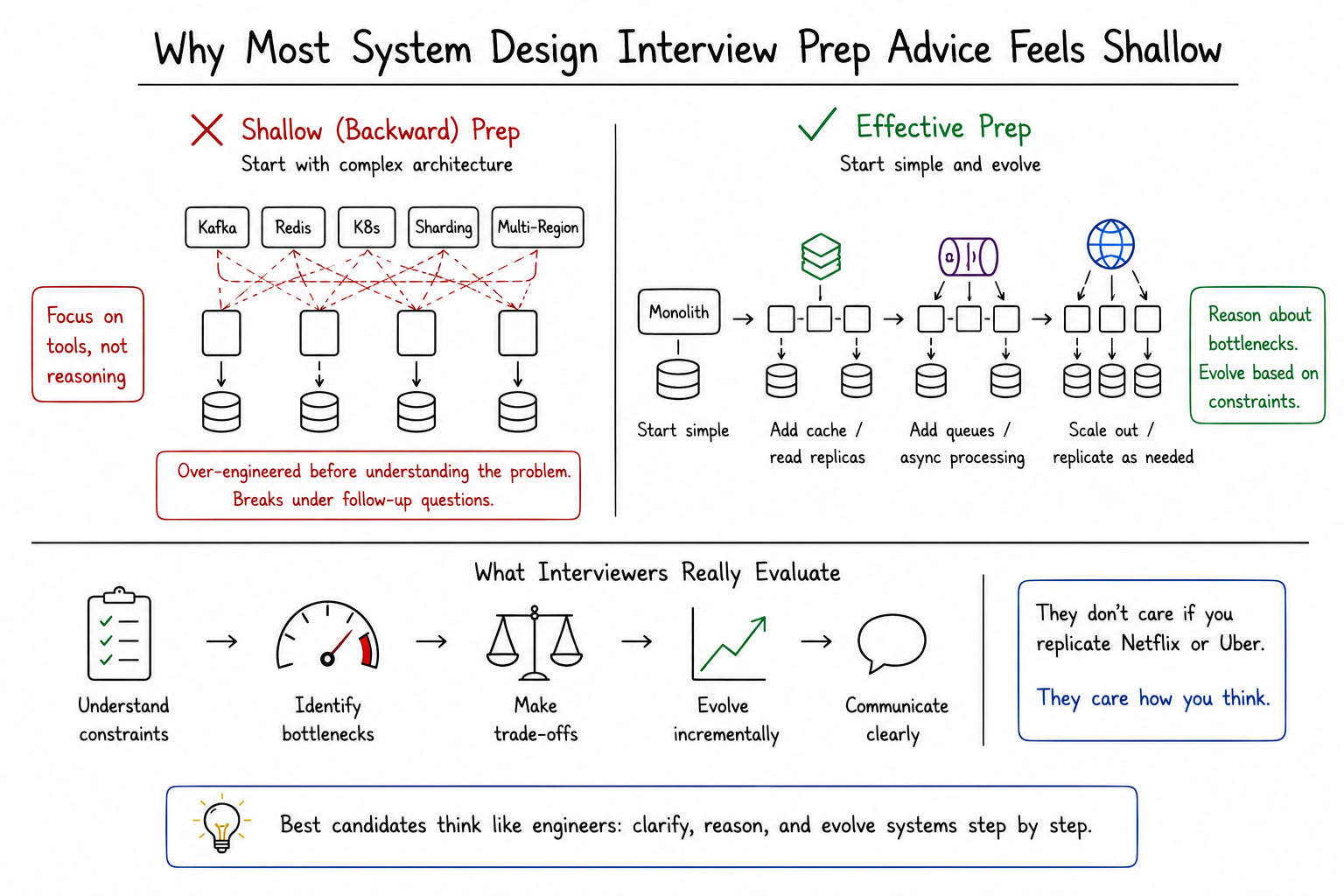
One reason System Design interview preparation feels overwhelming is that the internet tends to teach architecture backward. Many resources begin by showing highly distributed “internet-scale” systems without explaining the operational pressures that forced those architectures to evolve over time.
As a result, engineers often develop a distorted view of scalability. They assume strong System Design answers require introducing Kafka, Redis, Kubernetes, sharding, global replication, and event-driven workflows immediately, even when the problem itself does not justify that complexity. This creates a dangerous habit where candidates optimize for sounding architectural rather than reasoning like engineers.
The reality is that experienced interviewers are usually evaluating whether you can identify bottlenecks logically and evolve systems incrementally as constraints emerge. They are not checking whether you can reproduce the exact internal architecture used at Netflix or Uber.
That distinction matters because many weak interviews collapse for the same reason. Candidates jump directly into advanced distributed systems discussions before clarifying traffic assumptions, consistency requirements, storage constraints, or latency goals. Once follow-up questions begin exposing gaps in reasoning, the architecture starts feeling performative instead of practical.
The strongest candidates almost always begin simpler than expected.
What interviewers are actually testing in System Design interviews
Most engineers assume System Design interview questions are architecture quizzes. In practice, they are much closer to collaborative engineering discussions about trade-offs, operational constraints, and scalability evolution.
Interviewers want to understand how you think under ambiguity. They want to see whether you can clarify requirements, estimate scale reasonably, identify bottlenecks methodically, and evolve a system without introducing unnecessary complexity too early.
The following table captures the areas most experienced interviewers evaluate during System Design interviews.
One thing that becomes obvious after conducting hundreds of interviews is that System Design interviews are rarely about final diagrams. They are about the reasoning process behind the architecture.
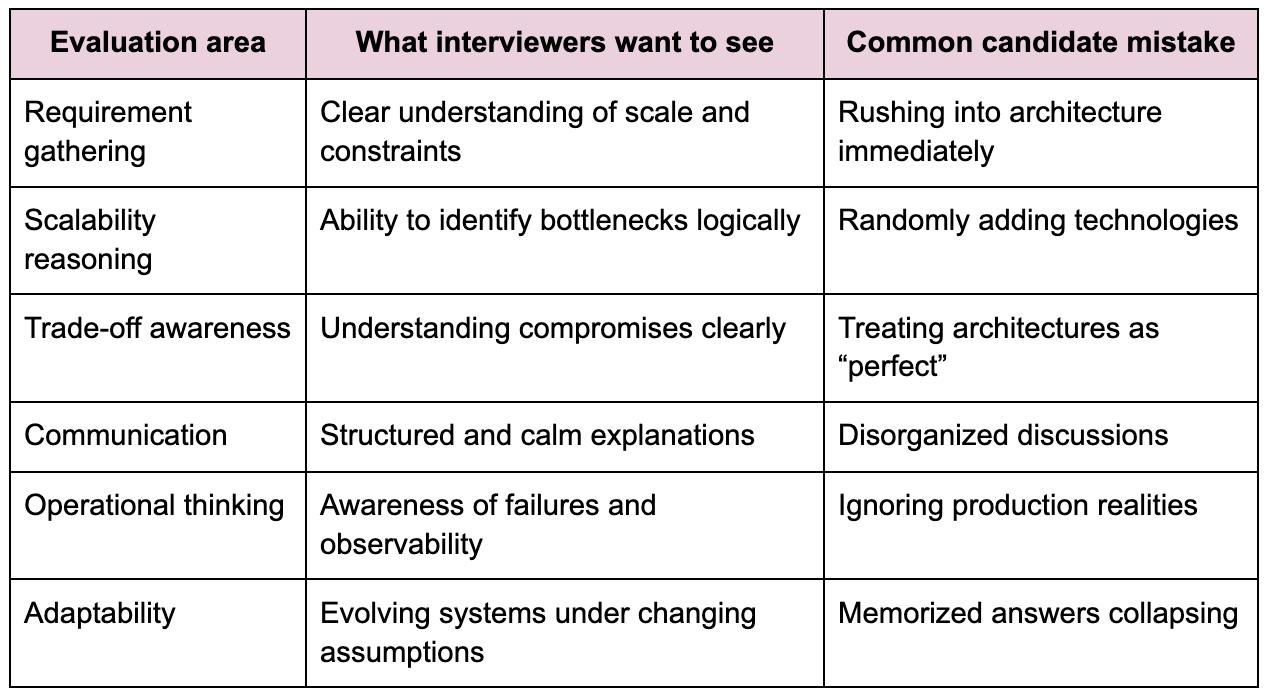
A candidate who starts with a clean monolithic baseline, identifies measurable constraints, and evolves the system incrementally will usually outperform someone presenting an over-engineered distributed architecture with weak justification.
This is because real systems evolve under pressure rather than appearing fully distributed on day one.
The best System Design interview prep starts with fundamentals
One of the biggest mistakes engineers make during preparation is jumping directly into distributed systems before understanding the lower-level mechanics that distributed systems are trying to solve.
Before studying microservices or event-driven systems, you should understand how requests actually move through systems. Learn how DNS resolution works, how TCP connections behave under latency, how reverse proxies distribute traffic, how databases respond under concurrency pressure, and how caching changes performance characteristics.
Without those foundations, architecture discussions become collections of disconnected technologies instead of engineering decisions tied to measurable constraints.
The strongest System Design candidates usually have excellent intuition around request flow and resource contention because they understand what happens underneath the abstractions.
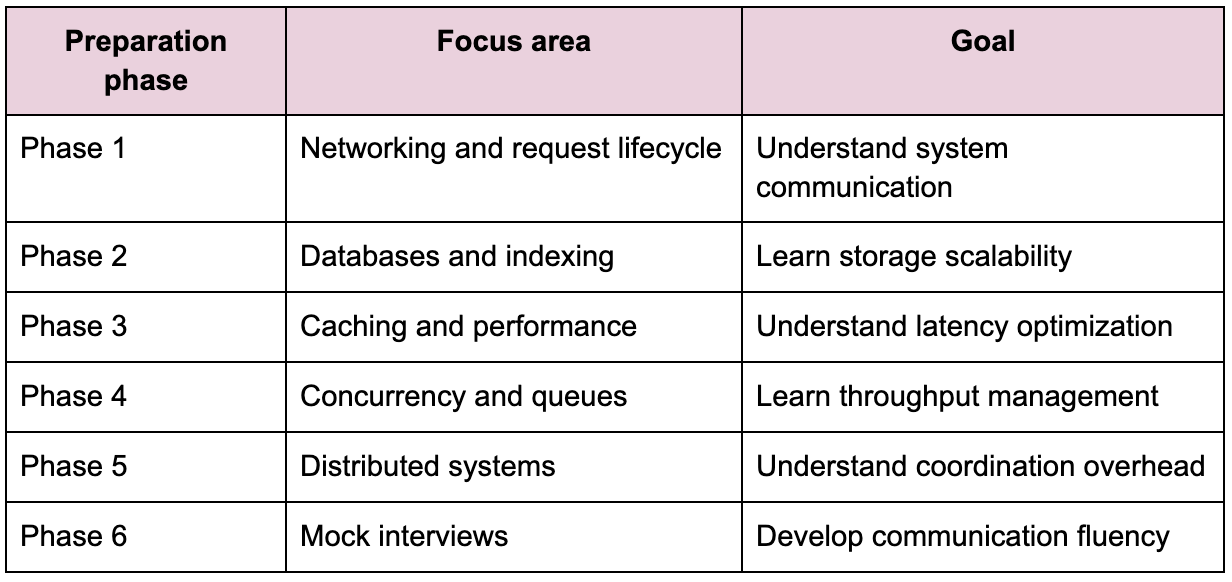
The progression below reflects the learning sequence I generally recommend.
This sequence matters because System Design maturity develops incrementally. You cannot reason effectively about distributed architectures until you understand why centralized systems eventually fail under load.
Learn to think in bottlenecks instead of technologies
One of the clearest differences between average candidates and strong candidates is how they frame System Design discussions mentally.
Weak candidates tend to think in terms of technology. Strong candidates think in bottlenecks.
For example, suppose an application experiences increasing latency under traffic spikes. An inexperienced engineer might immediately recommend introducing Kafka, Redis, or additional microservices because those technologies sound scalable. A stronger engineer first asks what resource is actually saturating.
Is the database becoming CPU-bound? Are connection pools exhausted? Is network latency amplifying tail latency? Are synchronous requests blocking expensive downstream calls? Is memory pressure increasing garbage collection pauses?
Those questions matter because scalability work is fundamentally about managing constrained resources.
Once you begin thinking this way, architecture becomes dramatically easier to reason about during interviews.
The table below summarizes several common bottlenecks and their corresponding mitigation strategies.
The important thing to understand is that every scalability improvement introduces trade-offs.
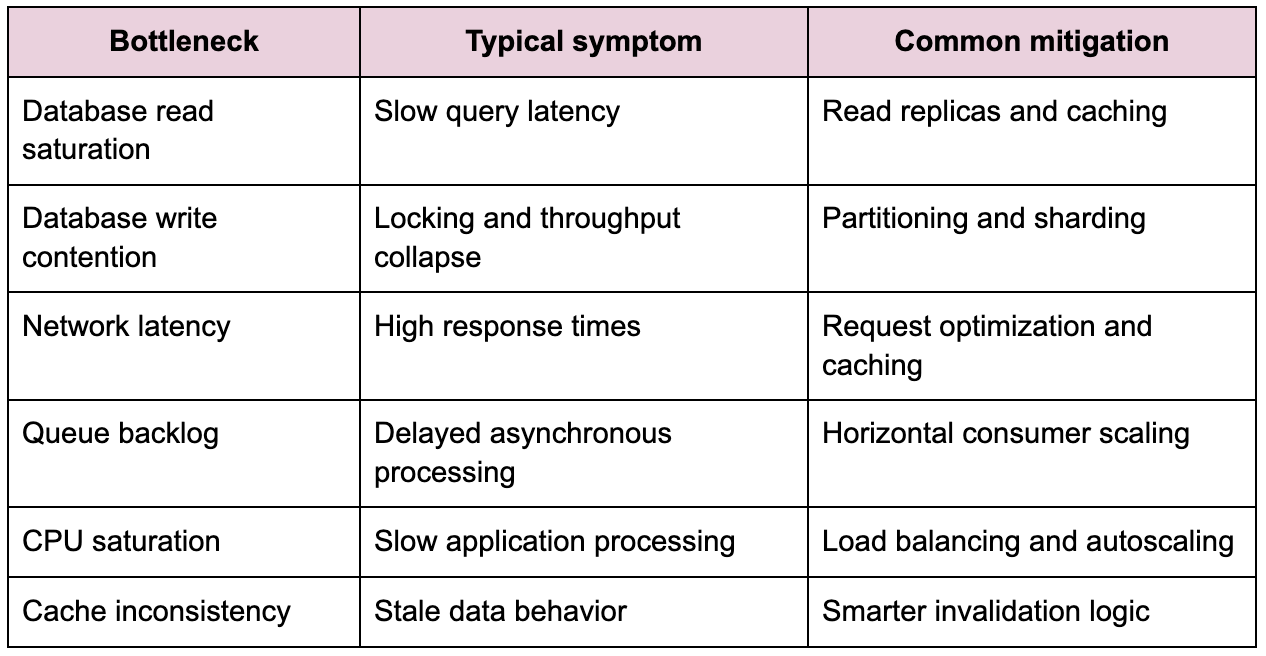
Caching improves performance but complicates invalidation. Replication improves availability but weakens consistency guarantees. Microservices improve deployment independence but increase operational overhead.
Interviewers care deeply about whether you recognize those trade-offs naturally.
Why passive studying rarely works
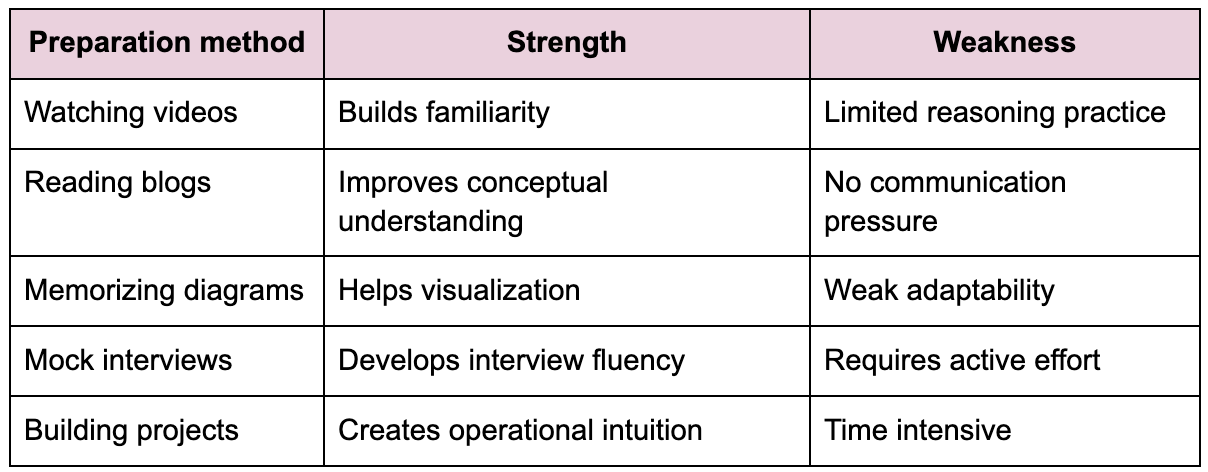
One of the biggest problems with modern System Design interview prep is that too much of it is passive.
Engineers watch videos, read architecture blogs, and skim diagrams repeatedly without actively practicing structured reasoning under pressure. The issue with passive studying is that System Design interviews are conversational. They require you to organize thoughts clearly while adapting dynamically when requirements change.
This is why many engineers who “know the concepts” still struggle during actual interviews.
Mock interviews expose weaknesses that passive studying hides. They reveal whether your explanations are coherent, whether your assumptions are reasonable, whether your scaling estimates make sense, and whether you can defend architectural trade-offs confidently when challenged.
At Meta, I often saw candidates whose knowledge looked impressive superficially but collapsed once follow-up questions introduced operational complexity. They knew terminology but lacked architectural intuition.
That intuition only develops through active practice.
The difference between passive learning and active preparation becomes obvious quickly.
If I had limited preparation time, I would prioritize mock interviews much earlier than most candidates do.
The best System Design prep mirrors how real systems evolve
One reason many interview answers feel unrealistic is that candidates attempt to design final-stage architectures immediately rather than evolving systems progressively.
Real production systems rarely begin as globally distributed architectures with complex asynchronous workflows and dozens of independent services. They evolve gradually as measurable scaling constraints emerge over time.
Strong System Design interview prep should reflect that reality.
For example, imagine designing a notification system. At a small scale, synchronous notifications triggered directly from the application server may work perfectly well. As traffic increases, response latency may become problematic because notification delivery blocks user-facing requests. A queue emerges to decouple workloads asynchronously. Eventually notification fan-out creates throughput pressure requiring consumer scaling and retry handling.
The architecture evolves because operational pressure evolves.
Interviewers want to see whether you understand that progression.
One of the most common mistakes I see is candidates introducing multi-region replication, aggressive sharding, and distributed queues before proving why the simpler architecture fails first.
That approach signals memorization rather than engineering judgment.
Study real-world engineering systems strategically
One of the best ways to improve System Design intuition is reading production engineering blogs from large technology companies.
However, the goal should not be memorizing their architectures mechanically.
The real value comes from understanding why those architectures changed under pressure.
Netflix engineering posts often focus heavily on resiliency because their workloads demand high availability during regional failures. Uber engineering blogs frequently discuss event-driven coordination because real-time distributed communication becomes critical for their platform. Meta engineering articles emphasize observability and efficiency because infrastructure visibility becomes essential at an enormous scale.
When you study systems through the lens of constraints, architecture starts making sense organically.
This also helps you recognize recurring patterns during interviews. Large-scale systems repeatedly encounter similar operational problems involving throughput limits, consistency trade-offs, resource contention, retry amplification, and latency management.
Understanding those patterns gives your interview discussions far more depth than memorized diagrams ever will.
Why communication quality matters more than most engineers realize
One thing many candidates underestimate is how heavily communication quality influences interview outcomes.
System Design interviews are collaborative engineering discussions, not silent whiteboard exercises. Even technically solid architectures can perform poorly when explanations feel disorganized, reactive, or difficult to follow.
Strong candidates narrate their reasoning clearly. They explain assumptions early, identify constraints methodically, and evolve architectures logically. The interviewer rarely needs to “extract” information because the discussion flows naturally.
Weak candidates often jump unpredictably between technologies without connecting decisions back to requirements or bottlenecks.
Communication quality usually reflects thinking quality.
This is another reason mock interviews matter so much. Repetition improves structure, pacing, and clarity in ways passive studying cannot replicate.
Build systems yourself if you want deeper intuition
One of the fastest ways to accelerate System Design interview prep is to build small systems personally.
You do not need to build internet-scale infrastructure. The goal is to expose yourself to operational behavior directly.
Build a URL shortener with rate limiting. Build a WebSocket chat application. Build a notification pipeline using queues and retries. Build a file upload service with chunked processing and asynchronous storage workflows.
Once you build these systems yourself, architectural concepts stop feeling theoretical.
You begin understanding why retry storms become dangerous during partial outages. You experience cache invalidation complexity firsthand. You see how queue depth increases under traffic spikes. You learn why observability becomes essential once debugging distributed systems becomes painful.
That implementation experience creates architectural intuition much faster than passive studying alone.
The best resources for System Design interview prep
One mistake engineers make is trying to consume every System Design resource available online simultaneously. That usually creates a fragmented understanding instead of depth.
I generally recommend combining structured learning material with real-world engineering content and active mock interview practice.
The strongest preparation usually comes from three categories of resources working together.
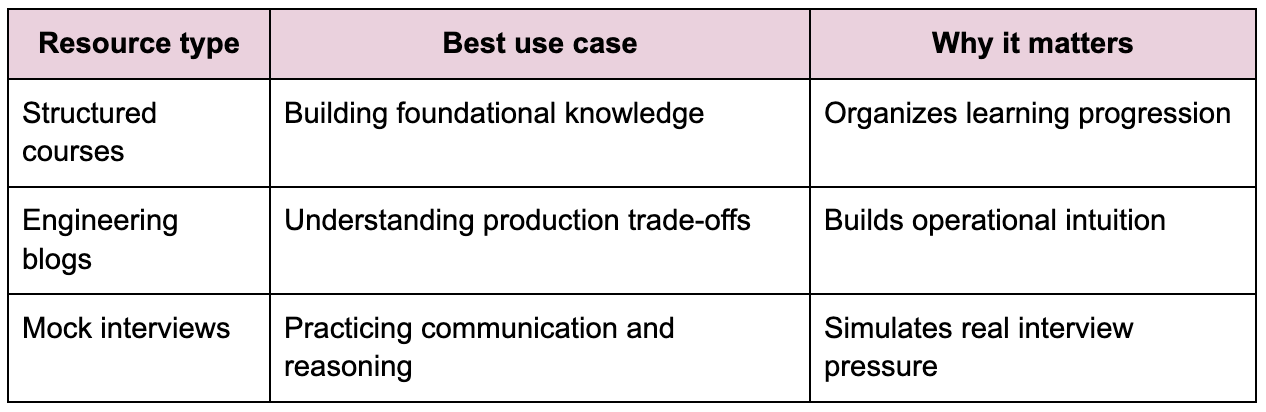
Courses such as Grokking Modern System Design Interview provide structured frameworks for learning scalability concepts incrementally. Engineering blogs from Netflix, Uber, Meta, and Amazon expose you to real production trade-offs. Mock interviews convert passive knowledge into interview fluency.
The combination matters more than any individual resource alone.
What I would do if I had 30 days to prepare
If I had only one month to prepare for System Design interviews again, I would focus aggressively on fundamentals, repetition, and structured communication rather than trying to memorize massive amounts of content.
I would begin by strengthening networking, databases, caching, concurrency, and distributed systems fundamentals because those concepts underpin nearly every interview conversation. Then I would repeatedly practice a smaller set of systems deeply rather than skimming dozens superficially.
I would study systems such as chat applications, URL shorteners, search engines, feed generation systems, file storage platforms, and notification pipelines until discussing them felt natural under pressure.
Most importantly, I would prioritize mock interviews heavily because communication quality becomes one of the biggest differentiators during real interviews.
The goal would not be memorizing architectures.
The goal would be to develop engineering judgment.
The strongest candidates think like production engineers
After interviewing hundreds of candidates at Microsoft, Meta, and Educative, one pattern became incredibly consistent.
Strong candidates think like engineers operating real systems. Weak candidates think like students taking architecture exams.
Strong engineers prioritize simplicity initially. They care about observability. They think about operational overhead. They evolve systems incrementally under pressure. They understand that every distributed boundary increases coordination complexity.
Weak candidates often optimize for sounding sophisticated instead of sounding practical.
Real production systems reward clarity far more than unnecessary complexity.
That same principle applies during interviews.
System Design interview prep should feel like engineering, not memorization
Most System Design interview advice online focuses too heavily on templates and not enough on reasoning.
The best preparation strategy is not collecting hundreds of architecture diagrams. It is developing the ability to reason through bottlenecks calmly, evolve systems incrementally, and explain trade-offs clearly under pressure.
Real systems evolve gradually as constraints emerge. Your preparation process should mirror that same progression.
If you focus on understanding request flow, scalability behavior, database constraints, operational bottlenecks, and communication clarity, System Design interviews stop feeling mysterious. Architecture discussions become grounded in engineering logic instead of memorized patterns.
That is usually the point where candidates finally start performing confidently during interviews, rather than trying to imitate internet-scale systems they do not yet fully understand.