

The framework I used for approaching System Design problems
A practical framework for breaking down complex System Design questions

One of the biggest misconceptions about System Design interviews is that success comes from knowing the right architecture. Candidates spend weeks memorizing designs for Instagram, YouTube, Uber, and Twitter because they assume interviewers are looking for specific solutions.
After interviewing hundreds of engineers at Microsoft and Meta, I can confidently say that interviewers care far less about the final architecture than most candidates realize. What they are actually evaluating is how you approach a System Design problem when the answer is not obvious. The strongest candidates rarely begin with diagrams or technologies.
They start by understanding the problem, identifying constraints, and making thoughtful decisions as new information emerges. That approach works not only in interviews but also in real engineering environments where requirements are rarely complete, and tradeoffs are unavoidable.
Why most candidates struggle with System Design questions
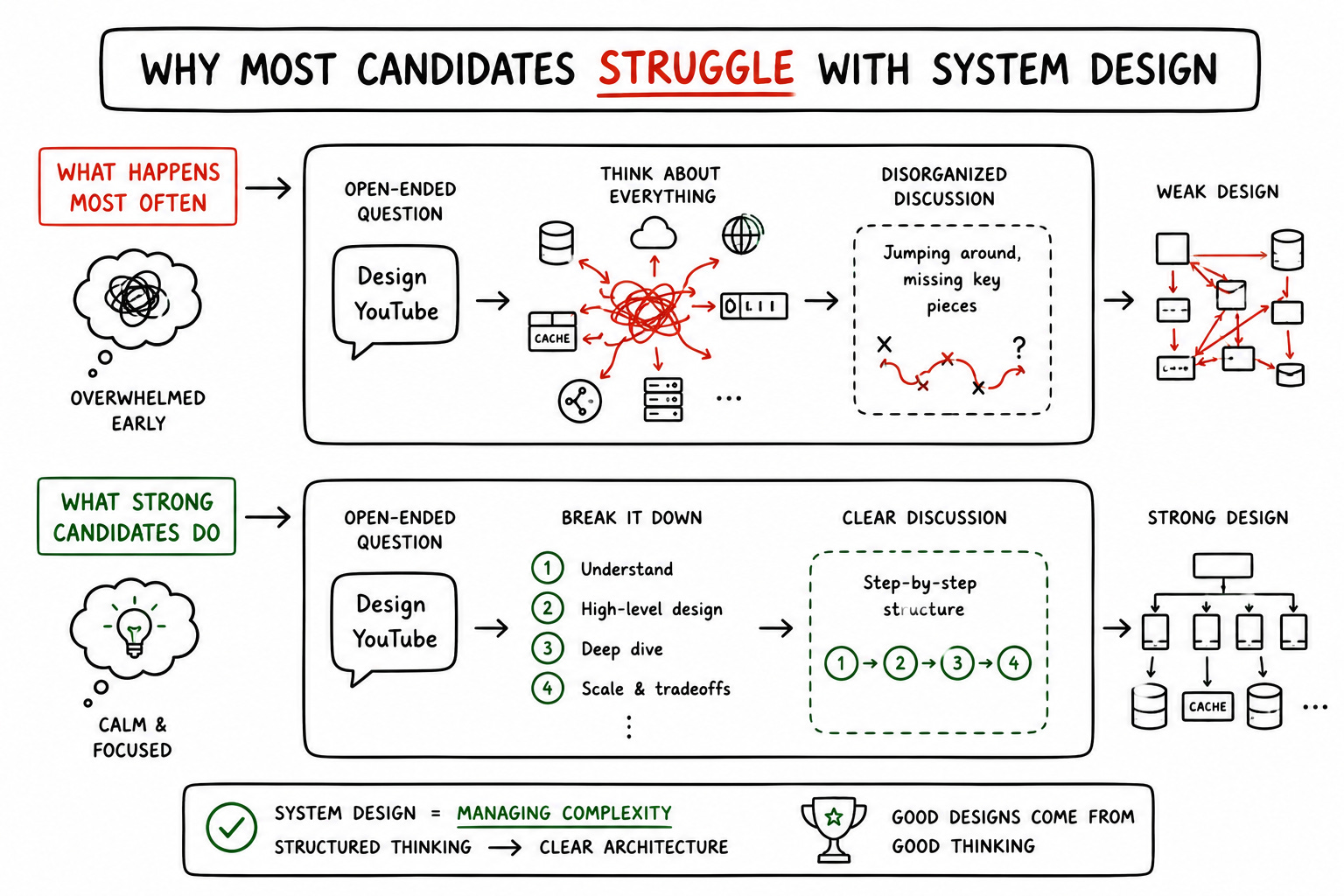
The challenge with System Design questions is not usually a lack of technical knowledge. Most engineers preparing for interviews already understand databases, APIs, caching, load balancing, and other common architectural concepts. The difficulty comes from figuring out where to begin when faced with an open-ended question that could potentially have dozens of reasonable solutions.
I often watched candidates become overwhelmed within the first few minutes of an interview. The interviewer would ask them to design a service such as YouTube or a ride-sharing platform, and they would immediately start thinking about every scaling challenge they had ever studied. Instead of simplifying the problem, they attempted to solve everything simultaneously. As a result, the discussion quickly became disorganized.
Strong candidates approached the situation differently. They understood that a System Design interview is fundamentally an exercise in managing complexity. Rather than trying to solve every problem at once, they broke the problem into smaller pieces and addressed each one systematically. Their designs were easier to follow because their thought process was easier to follow. The architecture was simply a reflection of structured reasoning.
Start by understanding the problem before designing anything
One of the most common mistakes candidates make is drawing architecture diagrams before they fully understand the requirements. This usually happens because engineers feel pressure to demonstrate technical knowledge immediately. Unfortunately, starting too early often creates more problems than it solves.
In real engineering environments, architects rarely begin implementation discussions before understanding what the business is trying to achieve. The same principle applies to System Design interviews. Before discussing databases, caches, or microservices, spend time clarifying the problem itself. Ask what features are required, who the users are, and what scale the system needs to support.
A simple example illustrates why this matters. Designing an internal employee messaging system is fundamentally different from designing WhatsApp. The core functionality may appear similar, but the scale, reliability requirements, and performance expectations are completely different. Without understanding these constraints, every architectural decision becomes speculation.
Strong System Designers understand that requirements drive architecture. If you skip requirements gathering, you are making decisions without understanding the problem you are trying to solve.
Separate functional and non-functional requirements
Once the problem is understood, the next step is separating functional requirements from non-functional requirements. This distinction provides structure and prevents important considerations from being overlooked later in the discussion.
Functional requirements describe what the system must do. These are the features users interact with directly. For a social media platform, functional requirements might include posting content, viewing feeds, liking posts, and following users. These requirements define the capabilities of the system.
Non-functional requirements describe how the system should behave. They include considerations such as scalability, availability, latency, reliability, consistency, and security. These requirements often have a larger impact on architecture than the features themselves because they determine how the system must perform under real-world conditions.
The strongest candidates use non-functional requirements to guide architectural decisions throughout the interview. Instead of introducing technologies because they are familiar, they introduce technologies because specific requirements justify them. This creates a much more logical and convincing design process.
Estimate scale before discussing architecture
Many System Design mistakes happen because candidates start designing without understanding scale. Architecture decisions that make sense for ten thousand users may become completely inappropriate for one hundred million users. Before introducing major components, spend time estimating traffic, storage requirements, and growth expectations.
Interviewers are usually less interested in precise calculations than they are in your ability to reason about scale. They want to see whether you understand how system requirements influence architectural choices. Even rough estimates can provide valuable context for later decisions.
Consider a video-sharing platform. If the system serves millions of daily users uploading large media files, storage and bandwidth immediately become critical concerns. If the platform only supports internal company training videos, those concerns may be significantly less important. The scale influences nearly every architectural decision that follows.
Strong candidates use estimation as a tool for identifying constraints. Rather than treating calculations as a separate exercise, they use them to understand which parts of the system are likely to become bottlenecks.
Build a simple high-level design first
One mistake I frequently observed was candidates introducing too much complexity too early. They would discuss sharding strategies, replication topologies, and caching layers before establishing a basic architecture. This often made the discussion difficult to follow because the foundation was never clearly defined.
A better approach is starting with the simplest design that satisfies the requirements. Begin by identifying the major components and the interactions between them. At this stage, the goal is clarity rather than optimization.
For many systems, a high-level design consists of users, APIs, application servers, databases, and supporting infrastructure. This simple structure creates a framework that can be expanded later. It also allows the interviewer to understand your thought process before the discussion becomes more detailed.
Experienced engineers understand that architecture evolves incrementally. The first version of a design does not need to solve every future problem. It simply needs to provide a clear foundation for discussing scalability and reliability improvements later.
Identify bottlenecks before solving them
One lesson I learned repeatedly while working on large-scale systems is that engineers often optimize the wrong thing. The same pattern appears frequently during interviews. Candidates introduce complex scalability solutions before identifying whether scalability is actually a problem.
Strong System Designers focus on bottlenecks. They examine the architecture and ask where pressure is likely to emerge as traffic increases. Sometimes the bottleneck is the database. Sometimes it is storage. Sometimes it is network bandwidth or application throughput. The important part is understanding why a particular component becomes a constraint.
This approach creates a much more natural design discussion because every optimization has a clear purpose. Instead of adding caches because caches are common, you add them because database reads have become a bottleneck. Instead of introducing queues because they appear in reference architectures, you introduce them because asynchronous processing improves throughput and resilience.
Architecture should evolve in response to measurable constraints. Even in interviews, the strongest designs feel like responses to specific problems rather than collections of technologies.
Discuss tradeoffs throughout the conversation
One characteristic shared by strong System Design interviews is continuous discussion of tradeoffs. Architecture is rarely about choosing perfect solutions because perfect solutions usually do not exist. Most engineering decisions involve balancing competing priorities.
A common example involves consistency and availability. Increasing consistency may reduce availability during certain failure scenarios. Improving performance may increase operational complexity. Reducing infrastructure costs may impact latency. These tradeoffs exist regardless of the specific system being designed.
Interviewers often learn more from tradeoff discussions than from the architecture itself. The goal is not demonstrating that you know the correct answer. The goal is demonstrating that you understand the consequences of your decisions. Engineers who openly discuss tradeoffs tend to appear more experienced because they acknowledge the realities of building production systems.
The best System Design discussions feel less like presentations and more like engineering conversations. Tradeoffs naturally emerge because every architectural decision introduces benefits and costs.
Dive deeper into the most important components
Once the high-level architecture is established, interviewers usually select specific areas for deeper discussion. This is where candidates have an opportunity to demonstrate technical depth while maintaining the structure established earlier.
The key is focusing on components that matter most to the problem. For a social media platform, feed generation might deserve additional attention. For a messaging application, message delivery and storage may become the primary focus. For a video platform, content storage and distribution are often critical areas.
Strong candidates avoid attempting to discuss every component equally. Instead, they identify the areas most likely to influence scalability, performance, or reliability and invest their time there. This mirrors how real engineering teams operate. Not every part of a system deserves the same level of scrutiny.
Depth becomes much easier once the overall architecture is clear because every detailed discussion remains connected to the broader system.
Treat the interview as a collaborative discussion
One of the most effective mindset shifts candidates can make is treating the interview as a collaborative design session rather than an exam. Many engineers become overly focused on finding the perfect answer and forget that System Design interviews are conversations.
Interviewers frequently introduce new constraints, ask follow-up questions, and challenge assumptions. These interactions are not attempts to break your design. They are opportunities to demonstrate adaptability. Real-world systems evolve constantly, and interviewers want to understand how you respond when requirements change.
Candidates who remain collaborative often perform better because they communicate naturally. They explain their reasoning, ask clarifying questions, and adapt their solutions as new information becomes available. The discussion feels closer to an architecture review than a technical assessment.
This collaborative mindset also reduces pressure. The objective is not perfection. The objective is demonstrating how you think through complex engineering problems.
Final thoughts
Learning how to approach a System Design problem is more valuable than memorizing any individual architecture. Technologies change, infrastructure evolves, and new design patterns emerge every year. The ability to reason through ambiguity, identify constraints, and make thoughtful tradeoffs remains valuable regardless of how the industry changes.
The strongest candidates I interviewed at Microsoft and Meta were not necessarily the ones who knew the most technologies. They were the ones who approached problems methodically. They clarified requirements, estimated scale, built simple architectures, identified bottlenecks, and discussed tradeoffs throughout the conversation. Their designs felt structured because their thinking was structured.
If you focus on developing that framework instead of collecting architecture diagrams, you will not only perform better in interviews but also become a stronger engineer. System Design is ultimately the discipline of making good decisions when the answer is not obvious, and that skill extends far beyond any single interview.