

The System Design interview practice routine I recommend after 100+ interviews
A practical System Design interview practice roadmap for engineers targeting senior roles

Most engineers approach System Design interview practice far too late in their preparation journey. They spend months grinding LeetCode problems, optimizing dynamic programming solutions, and memorizing graph algorithms, only to realize a few weeks before interviews that they still cannot confidently explain how to design a scalable notification service or why one database architecture might outperform another under heavy concurrency.
The issue is rarely intelligence or technical capability. The issue is that System Design requires a completely different type of engineering thinking than algorithmic problem-solving. It rewards architectural reasoning, operational awareness, and the ability to make calm trade-offs under uncertainty.
After interviewing hundreds of engineers at Microsoft, Meta, and Educative, I’ve noticed that the candidates who perform best are rarely the ones with the fanciest architectures. They are the engineers who understand systems deeply enough to evolve them realistically under pressure.
Why System Design interview practice feels difficult for most engineers
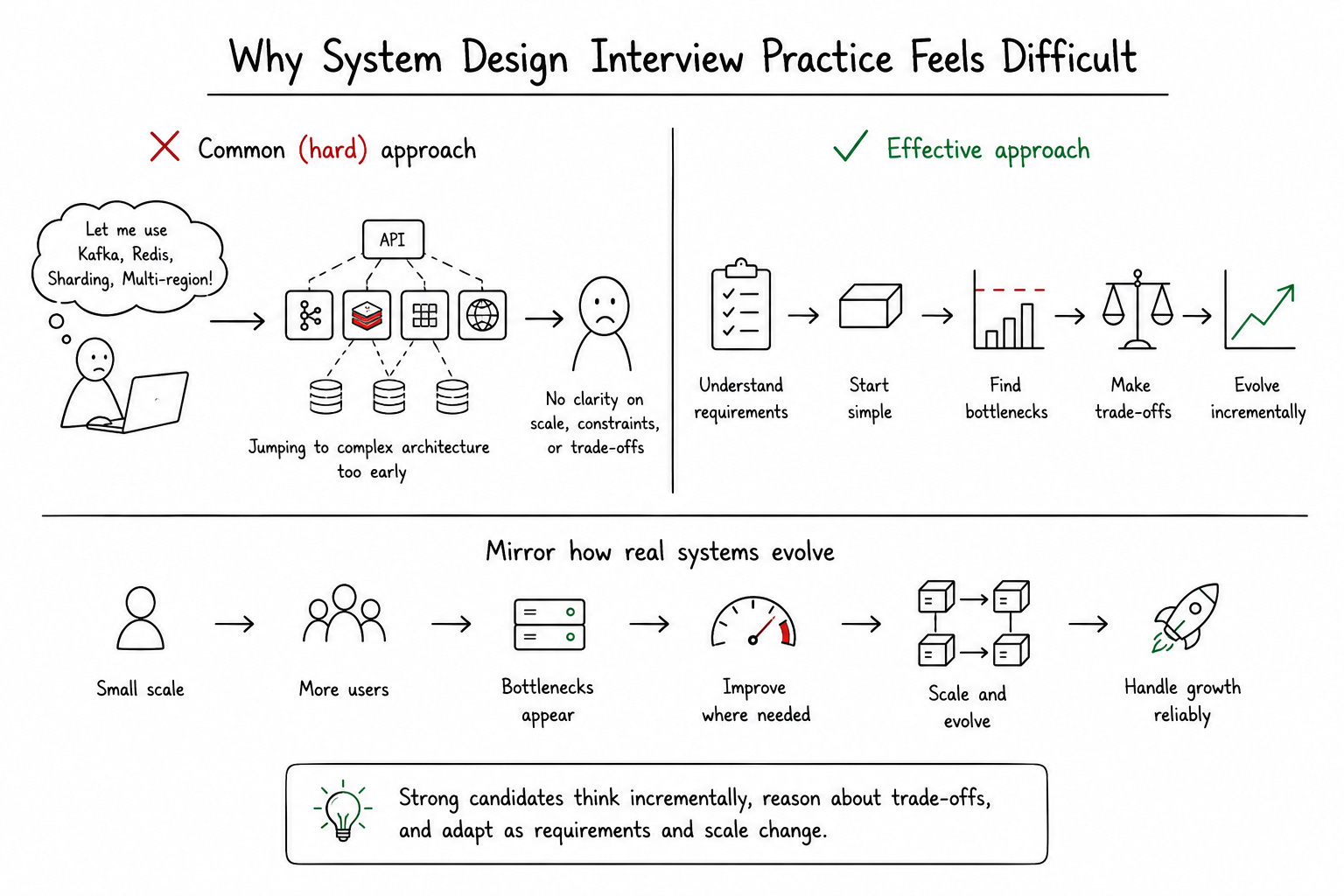
One of the biggest misconceptions about System Design interviews is that they are testing whether you can replicate the exact internal architecture used at companies like Netflix, Uber, or Instagram. That is not what experienced interviewers are evaluating. They are trying to understand how you reason through scaling constraints, operational bottlenecks, infrastructure trade-offs, and evolving product requirements when there is no single correct answer.
That distinction matters because many engineers prepare incorrectly from the beginning. They consume architecture diagrams passively, memorize generic “high-level design templates,” and attempt to imitate distributed systems patterns without understanding the operational pressures that made those patterns necessary in production. As a result, their answers often sound technically sophisticated on the surface while lacking engineering depth underneath.
I have seen candidates confidently recommend Kafka, Redis, sharding, WebSockets, and multi-region replication within the first ten minutes of an interview without first clarifying expected traffic patterns, consistency requirements, latency goals, or operational constraints. Those conversations usually collapse quickly because System Design interviews are fundamentally discussions about trade-offs rather than opportunities to showcase infrastructure vocabulary.
Strong candidates think incrementally. They begin with a simple architecture, identify measurable bottlenecks, and evolve the design gradually as scale increases. Weak candidates attempt to jump directly to “internet-scale architecture” before understanding the actual problem.
The learning process should mirror how real systems evolve in production.
What interviewers are actually evaluating during System Design interviews
Many engineers assume interviewers are grading System Design interviews using a secret architecture checklist. In reality, experienced interviewers are usually looking for signals that indicate whether you can reason effectively through ambiguity and make pragmatic engineering decisions under pressure.
The table below captures the areas that the strongest interviewers evaluate during modern System Design interviews.
One of the biggest differentiators during interviews is how candidates respond when assumptions change. A good interviewer intentionally increases complexity during the discussion because real production systems evolve unpredictably over time. Traffic increases unexpectedly. Latency targets tighten. Data consistency requirements change. Regional replication becomes necessary. Failures emerge in previously stable systems.
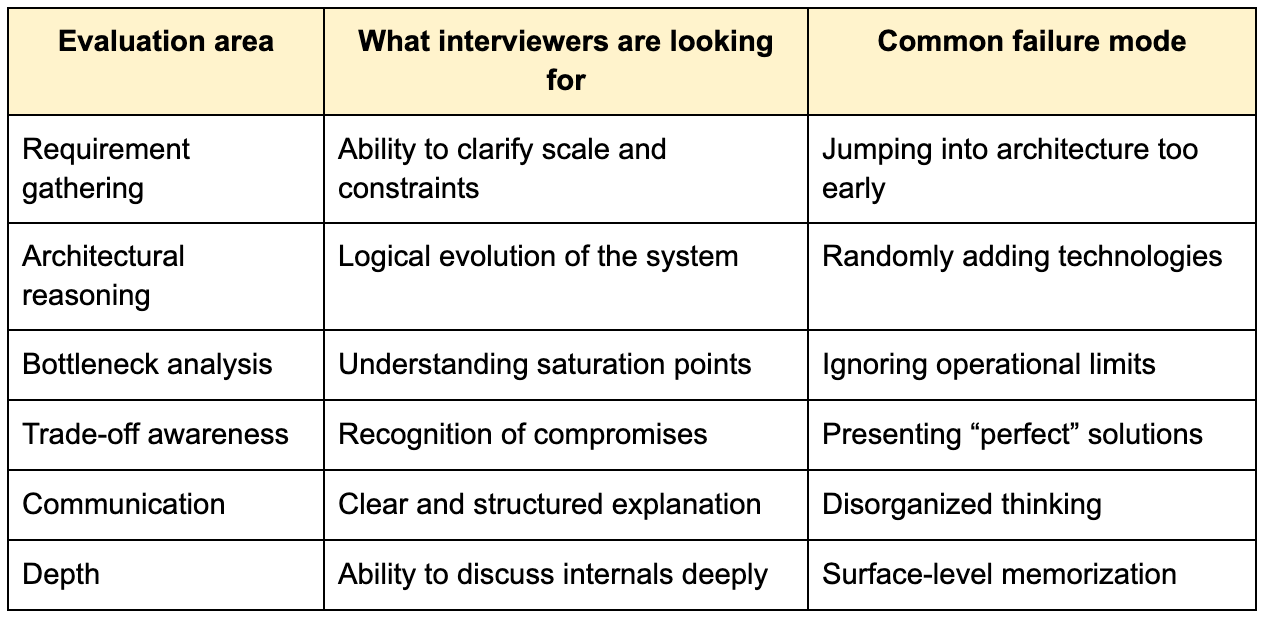
Strong candidates remain calm during these transitions because they understand that architecture is evolutionary. Weak candidates often panic because their preparation focused entirely on memorized templates instead of adaptive reasoning.
This is why passive studying rarely produces strong System Design performance. System Design interview practice must involve active reasoning under changing constraints.
Start your preparation by understanding real system behavior
Before practicing mock interviews, you need a strong mental model for how production systems behave under load. Without that foundation, System Design discussions quickly become abstract conversations filled with disconnected technologies.
The first thing I recommend studying is the request flow. Understand how a user request moves through DNS resolution, load balancers, reverse proxies, application servers, caches, databases, and asynchronous processing pipelines. Once you understand the lifecycle of a request, scalability discussions become dramatically easier because you can reason about where latency accumulates and where bottlenecks emerge.
Most beginner engineers focus too heavily on architecture diagrams without understanding the operational mechanics beneath them. They learn about caching before understanding database latency. They memorize queue systems before understanding asynchronous workflows. They study microservices before understanding why monoliths fail under scale.
That sequence creates fragmented architectural intuition.
The following progression reflects the order I usually recommend for serious System Design interview preparation.
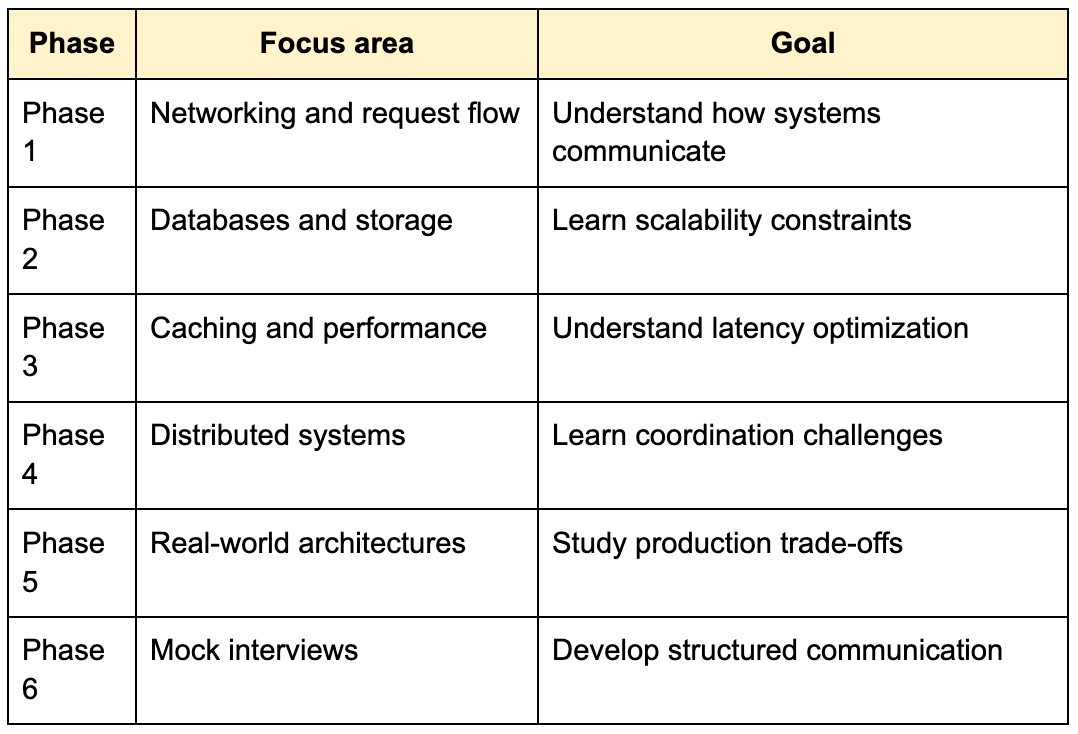
One important realization eventually changes how engineers approach System Design interviews: scalability problems are usually resource management problems. CPU saturation, memory pressure, database contention, network latency, queue backlogs, and inefficient I/O patterns drive most architectural decisions.
Once you begin thinking in bottlenecks rather than technologies, System Design interviews become significantly more manageable.
Learn how to structure your interview conversations
One of the most overlooked aspects of System Design interview practice is conversational structure. Many technically strong engineers fail interviews because their discussions become chaotic and difficult to follow.
Good System Design interviews feel organized. The interviewer should always understand what problem you are solving, why you are making certain trade-offs, and how the architecture evolves over time.
The strongest candidates typically follow a progression similar to this:
They begin by clarifying requirements and estimating scale. They define functional expectations, traffic assumptions, latency targets, consistency requirements, and storage needs before discussing architecture. Once constraints become clear, they propose a simple baseline system that works at a moderate scale. Only after establishing that baseline do they begin evolving the architecture to address bottlenecks.
That structure mirrors how real engineering systems evolve in production.
One of the most common mistakes I see is candidates prematurely optimizing for scale before establishing a working baseline. They introduce distributed queues, global replication, and aggressive caching layers before clarifying whether the system even needs them.
That approach creates operational complexity without demonstrating engineering maturity.
Interviewers generally trust candidates more when the architecture evolves gradually in response to measurable constraints.
Why mock interviews matter more than passive studying
There is a major difference between recognizing architectural concepts and communicating them effectively under time pressure.
Many engineers spend months watching System Design videos and reading engineering blogs, but still struggle during live interviews because they have never practiced articulating trade-offs verbally in real time. System Design interviews are communication-heavy engineering discussions. The ability to explain reasoning clearly matters almost as much as the technical decisions themselves.
This is why mock interviews are essential.
Mock interviews expose weaknesses that passive studying hides. You quickly discover whether your explanations are organized, whether you can estimate scale comfortably, whether you understand consistency trade-offs deeply enough, and whether you can adapt when assumptions change unexpectedly.
One thing I noticed repeatedly while interviewing candidates at Meta was that many engineers understood distributed systems conceptually but struggled to explain them coherently under pressure. Their thinking became fragmented once follow-up questions challenged their assumptions.
Mock interviews help solve that problem because they force architectural reasoning into a conversational format.
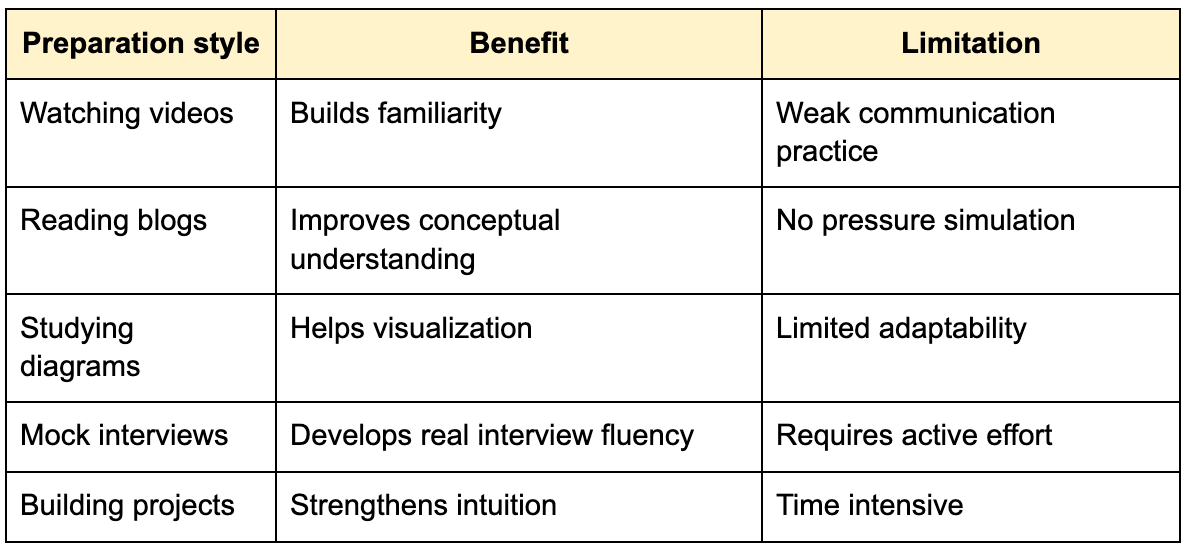
The table below summarizes the difference between passive preparation and active practice.
If I had limited preparation time, I would prioritize mock interviews much earlier than most engineers do.
Practice evolving systems instead of memorizing final architectures
One of the most important mindset shifts in System Design preparation is understanding that interviews are rarely about producing a perfect final architecture. They are about demonstrating how systems evolve under increasing load and changing requirements.
Strong candidates treat architecture as an iterative process.
For example, imagine designing a URL shortening service. At a small scale, a single database and application server may work perfectly well. As traffic increases, read-heavy workloads begin saturating the database. Caching layers emerge. Write contention eventually introduces partitioning requirements. Geographic latency may require replication strategies. Analytics pipelines introduce asynchronous event processing.
The architecture evolves because the bottlenecks evolve.
This incremental thinking is critical because interviewers are usually testing whether you understand how scaling pressures reshape systems over time.
I strongly recommend practicing systems at multiple scales rather than studying only “internet-scale” architectures. Learn how systems behave at 1,000 users, then 1 million users, then 100 million users. That progression teaches you when architectural decisions actually become necessary.
Without that context, engineers often introduce unnecessary complexity prematurely.
Understand the most common scalability bottlenecks
One of the fastest ways to improve at System Design interview practice is learning to recognize recurring bottleneck patterns.
Most large-scale systems eventually encounter similar categories of constraints. Database read throughput becomes insufficient. Write contention increases latency. Network communication amplifies tail latency. Queue backlogs grow under traffic spikes. Cache invalidation becomes difficult. Resource-heavy workloads saturate application servers.
Recognizing these patterns allows you to reason about architecture much more naturally during interviews.
The table below summarizes common bottlenecks and their typical mitigation strategies.
The key insight is that every mitigation introduces trade-offs.
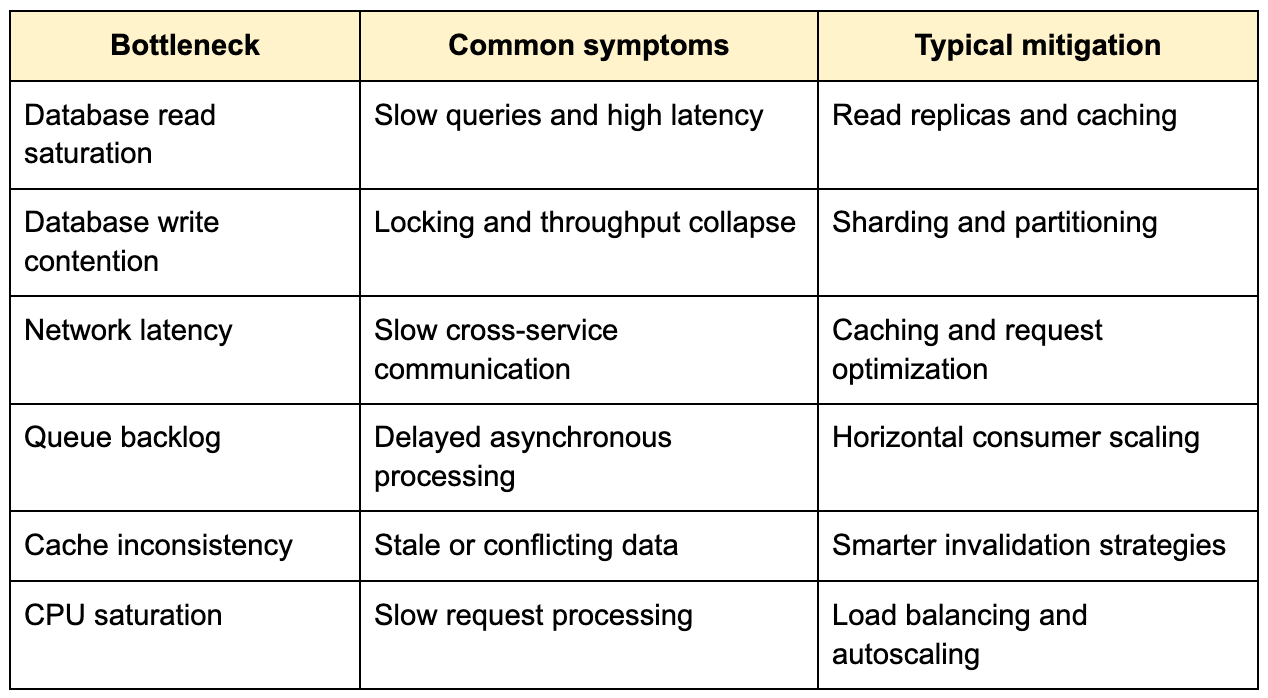
Caching improves performance but complicates invalidation. Sharding improves write scalability but makes querying harder. Replication improves availability but introduces consistency challenges.
Interviewers care deeply about whether you understand those trade-offs.
Build systems yourself instead of only studying theory
One of the best ways to accelerate System Design interview preparation is to build small distributed systems personally.
You do not need to build the next Instagram or Netflix. The objective is to develop operational intuition through implementation experience.
Build a chat application using WebSockets. Create a rate limiter using Redis. Build a notification system with asynchronous queues. Create a feed generation service. Build a file upload pipeline with chunked storage and retry behavior.
Implementation experience changes the way you discuss systems during interviews because architectural decisions stop feeling hypothetical.
You begin understanding why retries become dangerous during partial outages. You experience how cache invalidation complexity emerges. You see how queue depth increases under load spikes. You recognize why observability matters once debugging distributed failures becomes painful.
That intuition is difficult to replicate through passive studying alone.
This is also why candidates with strong backend engineering experience often perform well during System Design interviews, even if they studied less formally. Real production exposure teaches architectural trade-offs naturally.
Study production engineering blogs strategically
One of the most valuable habits for System Design interview practice is reading engineering blogs from large-scale technology companies.
However, the goal should not be memorizing architectures mechanically.
The real value comes from understanding why those systems evolved the way they did.
For example, Netflix engineering articles frequently discuss resiliency, distributed failure handling, and traffic isolation because those constraints become critical at their scale. Uber engineering posts often focus heavily on event-driven systems and real-time coordination challenges because their workloads demand low-latency global communication. Meta infrastructure blogs emphasize observability and data processing efficiency because operational visibility becomes essential under massive concurrency.
When you study these systems through the lens of constraints, you begin recognizing recurring architectural themes.
That recognition dramatically improves System Design interview performance because your reasoning becomes grounded in real engineering behavior rather than interview memorization.
Why communication quality matters so much
One thing many engineers underestimate is how heavily communication quality influences System Design interview outcomes.
A technically reasonable architecture can still perform poorly if the explanation feels disorganized or reactive. Conversely, a simpler architecture often performs well when the reasoning is structured clearly, and trade-offs are explained thoughtfully.
Strong communication during System Design interviews usually reflects strong architectural thinking.
The best candidates narrate their reasoning transparently. They explain assumptions explicitly, identify bottlenecks methodically, and evolve systems logically. Interviewers rarely need to “pull” information out of them because the conversation flows naturally.
This is another reason mock interviews matter so much. Communication improves through repetition.
What I would focus on if I had 30 days to prepare
If I had to prepare for System Design interviews from scratch in a limited timeframe, I would focus heavily on fundamentals, repetition, and structured practice instead of trying to memorize dozens of architectures.
I would begin by strengthening my understanding of networking, databases, caching, concurrency, and distributed systems fundamentals because those concepts underpin almost every interview discussion. Then I would study a relatively small set of core architectures deeply rather than skimming hundreds superficially.
I would practice systems such as chat applications, URL shorteners, news feeds, search systems, notification pipelines, and file storage platforms repeatedly until discussing them felt natural under pressure.
Most importantly, I would spend significant time practicing verbal explanations through mock interviews because communication fluency is one of the biggest differentiators during actual interviews.
The goal would not be memorizing answers.
The goal would be to develop architectural reasoning.
The strongest System Design candidates think like engineers, not students
One of the clearest differences between average candidates and outstanding candidates is mindset.
Average candidates often approach System Design interviews like academic exams. They search for “correct architectures,” memorize templates aggressively, and attempt to maximize technical sophistication.
Strong candidates think like engineers operating production systems.
They care about operational simplicity. They think about observability. They discuss failure modes naturally. They evolve architectures gradually instead of prematurely distributing systems. They understand that scalability introduces coordination costs. They recognize that simplicity is often a feature rather than a limitation.
That mindset creates calmer and more realistic interview discussions.
After conducting hundreds of interviews across Microsoft, Meta, and Educative, I can confidently say that interviewers are usually less impressed by architectural complexity than by thoughtful engineering judgment.
Practice systems the way real systems evolve
Most engineers struggle with System Design interviews because they try to learn architecture backward. They start with internet-scale diagrams before understanding how systems behave at a moderate scale. They memorize distributed systems patterns before learning why those patterns become necessary. They optimize for technical vocabulary instead of engineering clarity.
Real systems rarely begin as massively distributed architectures. They evolve gradually as measurable constraints emerge.
Your interview preparation should reflect that same progression.
If you focus on understanding request flow, scalability bottlenecks, data behavior, operational trade-offs, and incremental architectural evolution, System Design interviews become dramatically less intimidating. You stop viewing architecture as a collection of disconnected technologies and start viewing it as a sequence of engineering responses to changing constraints.
That is the point where System Design interview practice finally becomes useful instead of performative.