

The System Design patterns I saw repeatedly while interviewing engineers
The architectural patterns that appear repeatedly in System Design interviews

One of the biggest mistakes candidates make during System Design interview preparation is treating every interview question as a completely unique problem. They study designs for YouTube, Instagram, Uber, Dropbox, Netflix, and Twitter as if each system requires an entirely different way of thinking.
After interviewing hundreds of engineers at Microsoft and Meta, I noticed something very different. While the products themselves may vary dramatically, the architectural patterns behind them are surprisingly consistent. Most large-scale systems are built using a relatively small collection of design patterns that solve recurring engineering challenges.
Understanding these patterns is often more valuable than memorizing individual architectures because it allows you to recognize solutions regardless of the specific interview question. Once you understand the patterns, System Design interviews become less about remembering answers and more about identifying which architectural tools fit the problem in front of you.
Why System Design interviews are really pattern recognition exercises
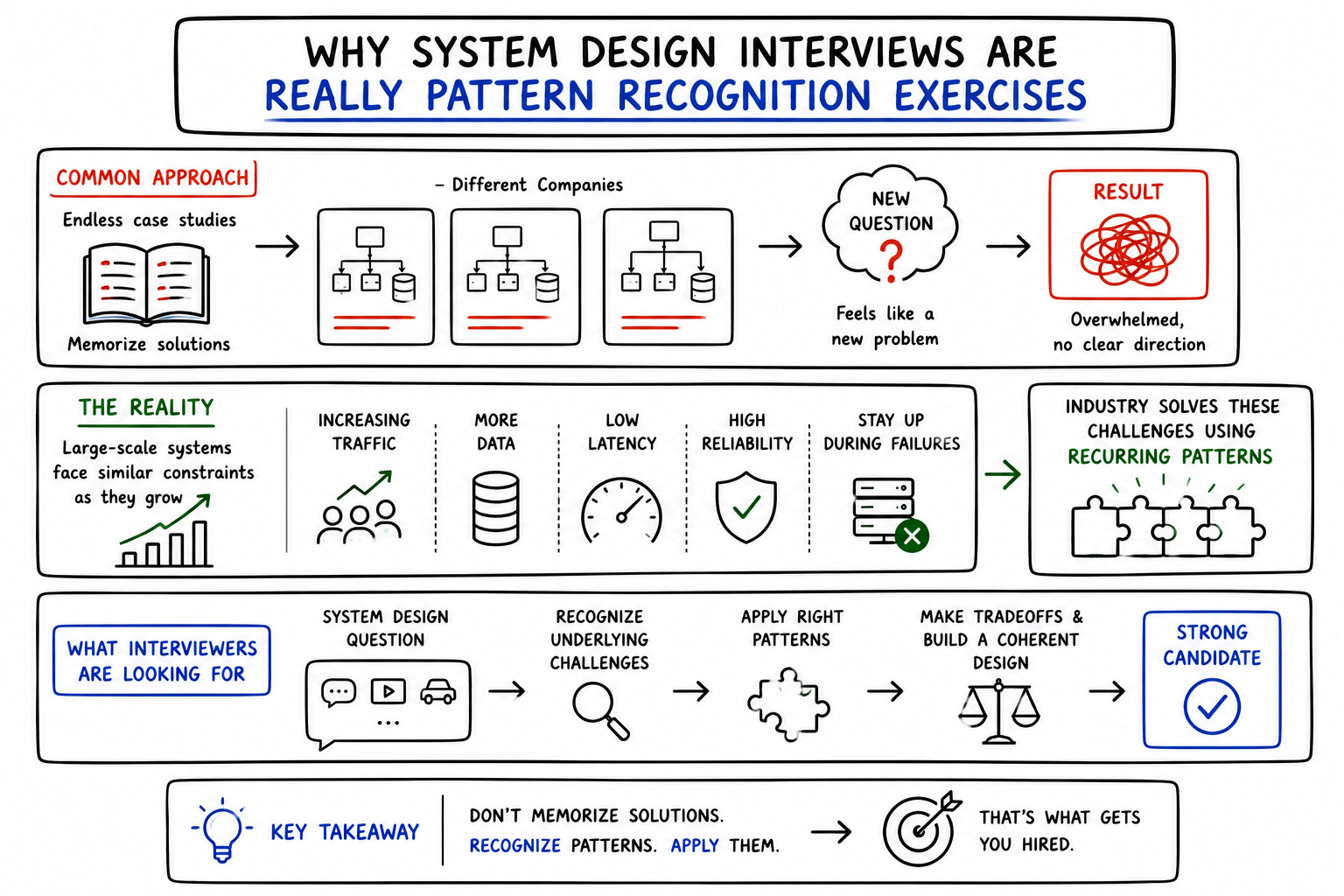
Many candidates approach System Design preparation as an endless collection of case studies. They spend hours reviewing architecture diagrams and trying to remember how different companies solve scalability challenges. While this can be useful, it often creates the impression that every new interview question requires learning an entirely new solution.
The reality is much simpler. Most large-scale systems face similar constraints as they grow. They need to handle increasing traffic, store larger amounts of data, maintain acceptable response times, improve reliability, and remain operational during failures. Because these challenges appear repeatedly, the industry has developed recurring architectural patterns that address them.
When interviewers ask you to design a messaging application, a video platform, or a ride-sharing service, they are not necessarily looking for a specific architecture. They are trying to determine whether you recognize the underlying challenges and know which patterns can be applied to address them. Strong candidates rarely memorize solutions. Instead, they develop familiarity with the architectural patterns that appear repeatedly across modern distributed systems.
The scaling pattern: horizontal scaling
One of the first patterns candidates encounter in System Design interview questions is horizontal scaling. As traffic grows, a single server eventually becomes a bottleneck. Adding more powerful hardware can help temporarily, but there is always a practical limit to vertical scaling. At some point, the system must distribute work across multiple machines.
Horizontal scaling addresses this challenge by allowing traffic to be spread across multiple servers. Instead of relying on a single application instance, requests are distributed among many instances that perform the same function. This pattern improves scalability while also increasing fault tolerance because the failure of a single server does not necessarily take down the entire system.
Interview questions involving social media platforms, e-commerce websites, streaming services, and SaaS applications frequently introduce scaling concerns. Strong candidates naturally discuss horizontal scaling because it provides a foundation for handling increasing traffic. More importantly, they understand why it is necessary. The goal is not to introduce multiple servers because interview diagrams often contain multiple servers. The goal is to recognize that increased traffic eventually requires distributing the workload across additional resources.
The load balancing pattern
Horizontal scaling becomes significantly more effective when combined with load balancing. Once multiple application servers exist, the system needs a mechanism for distributing incoming requests efficiently. This is where load balancers become one of the most common patterns in System Design interviews.
A load balancer sits between clients and backend services, directing requests to available servers based on predefined rules. This improves resource utilization while preventing individual servers from becoming overloaded. It also contributes to reliability because traffic can be redirected away from unhealthy instances during failures.
One reason load balancing appears so frequently in interviews is that it solves multiple problems simultaneously. It supports scalability, improves availability, and creates flexibility for future growth. Candidates who understand this pattern can apply it naturally across a wide variety of design problems. Whether the system involves media streaming, online marketplaces, or real-time communication platforms, load balancing often emerges as an essential part of the architecture.
Interviewers are usually less interested in specific load-balancing algorithms and more interested in whether candidates recognize when traffic distribution becomes necessary.
The caching pattern
Caching is arguably the most common optimization pattern in System Design interviews. Almost every large-scale system encounters situations where repeatedly retrieving data from the primary database becomes inefficient. As traffic increases, databases often become bottlenecks because they are responsible for storing and serving critical application data.
Caching addresses this challenge by storing frequently accessed information closer to users or application services. Instead of querying the database for every request, the system retrieves data from a faster storage layer. This reduces latency while significantly decreasing database load.
The reason caching appears so often in interviews is that many scalability problems can be traced back to excessive database access. Feed generation systems, product catalogs, user profiles, recommendation engines, and search systems frequently benefit from caching strategies. Strong candidates understand that caching is not a default solution for every problem. Instead, they recognize situations where read-heavy workloads justify introducing an additional layer between users and persistent storage.
The discussion becomes much stronger when candidates explain the tradeoffs involved, including cache invalidation, consistency concerns, and storage limitations.
The asynchronous processing pattern
Not every task needs to be completed immediately. This realization forms the foundation of another important System Design pattern: asynchronous processing. Many large-scale systems perform operations that are expensive, time-consuming, or unnecessary to complete within the user’s request cycle.
Message queues provide a common solution. Instead of performing every task synchronously, requests can be placed into a queue where background workers process them independently. This approach improves responsiveness while allowing the system to handle traffic spikes more effectively.
The pattern appears frequently in interview questions involving email delivery, notifications, media processing, recommendation generation, and analytics systems. These workloads often benefit from decoupling because immediate execution is not required. Strong candidates understand that queues are not simply architectural decorations. They exist because separating work improves scalability and resilience.
Interviewers often explore this pattern because it demonstrates a candidate’s understanding of throughput, reliability, and workload management. It also creates opportunities to discuss retry mechanisms, dead-letter queues, and fault tolerance strategies.
The database partitioning pattern
As systems grow, storing all data on a single database server eventually becomes difficult. Increasing traffic, storage requirements, and query volume can create bottlenecks that vertical scaling alone cannot solve. Database partitioning, often referred to as sharding, addresses this challenge by distributing data across multiple database instances.
This pattern frequently appears in System Design interviews because many large-scale applications eventually encounter data growth challenges. Social networks, messaging systems, e-commerce platforms, and content-sharing applications all generate large volumes of data that may require partitioning strategies.
Strong candidates understand that partitioning introduces both benefits and complexity. While it improves scalability and storage capacity, it also creates challenges involving cross-shard queries, data consistency, and operational management. Interviewers often use sharding discussions to evaluate whether candidates understand the tradeoffs associated with scaling databases.
The goal is not simply recognizing the term “sharding.” The goal is to understand why data distribution becomes necessary and what new challenges emerge after implementing it.
The replication pattern
Reliability becomes increasingly important as systems grow. Users expect applications to remain available even when individual servers fail. Database replication is one of the most common patterns used to improve fault tolerance and availability.
Replication involves maintaining copies of data across multiple servers. If one database instance becomes unavailable, another replica can continue serving requests. This approach improves resilience while often helping distribute read traffic across multiple nodes.
Many interview questions introduce availability requirements that naturally lead to replication discussions. Candidates who understand replication can explain how it improves fault tolerance while also discussing tradeoffs involving consistency and replication lag.
This pattern appears repeatedly because it reflects a fundamental reality of distributed systems. Hardware failures are inevitable. Well-designed systems assume failures will occur and build mechanisms for continuing operation when they do. Replication is one of the most widely used approaches for achieving that goal.
The event-driven architecture pattern
Modern distributed systems often consist of many independent services that need to communicate without becoming tightly coupled. Event-driven architecture provides a pattern for enabling that communication while preserving flexibility.
Instead of services directly invoking one another, events are published whenever significant actions occur. Other services subscribe to those events and react accordingly. This creates loose coupling because publishers do not need to know which consumers exist.
Event-driven patterns frequently appear in interviews involving e-commerce systems, analytics platforms, financial applications, and microservices architectures. They allow systems to evolve more easily because new consumers can be added without modifying existing producers.
Candidates who understand event-driven design often demonstrate stronger architectural reasoning because they recognize how communication patterns influence scalability and maintainability. The discussion naturally expands into topics such as message brokers, event ordering, and eventual consistency.
How to identify the right pattern during an interview
One reason some candidates struggle with System Design interviews is that they try to memorize where specific patterns should be used. A more effective approach is learning to recognize the problems that each pattern solves. Once you understand the underlying challenge, the appropriate pattern often becomes obvious.
If traffic is growing beyond the capacity of a single server, horizontal scaling becomes relevant. If database reads are overwhelming storage systems, caching may help. If workloads are expensive or time-consuming, asynchronous processing becomes attractive. If data volumes continue increasing, partitioning may be necessary. Every pattern exists because a particular constraint emerged somewhere in the system.
Strong candidates do not force patterns into their designs. They identify bottlenecks and then introduce patterns as solutions. This creates a much more natural conversation because every architectural decision is connected to a specific problem rather than to a memorized framework.
Final thoughts
The most important lesson candidates can learn about System Design interviews is that architectural patterns matter more than architecture diagrams. Specific products come and go, technology stacks evolve, and infrastructure tools change over time. The underlying challenges of scalability, reliability, performance, and maintainability remain remarkably consistent.
After interviewing hundreds of engineers at Microsoft and Meta, I found that the strongest candidates rarely relied on memorized solutions. They understood the patterns that appear repeatedly across distributed systems and knew how to apply them when constraints emerged. Their designs felt adaptable because their thinking was adaptable.
If you focus on learning System Design patterns for interviews rather than memorizing individual architectures, you will be better prepared for unfamiliar questions and more capable of reasoning through complex engineering problems. Ultimately, that ability to recognize patterns and apply them thoughtfully is what System Design interviews are trying to measure.