

What I Wish More Engineers Understood About End-to-End Machine Learning Systems
Why production ML is about building resilient systems, not just training better models

I’ve seen a lot of engineers describe an end-to-end machine learning system as a pipeline that starts with data and ends with predictions. That description is technically correct, but it hides the complexity that actually makes these systems hard to build and even harder to maintain. An end-to-end ML system is not just a pipeline. It is a continuously evolving system where data, models, infrastructure, and feedback loops all interact over time.
The difference becomes obvious when you work on a real production system. The first version often looks clean. You collect data, train a model, deploy it, and serve predictions. Then reality starts to intervene. Data arrives late. Features drift. Models degrade. Traffic patterns change. Business requirements evolve. What looked like a simple pipeline becomes a system that needs to adapt constantly.
Understanding what an end-to-end ML system looks like means understanding not just the components, but how they connect, how they fail, and how they evolve.
Start with the flow of data, not the model
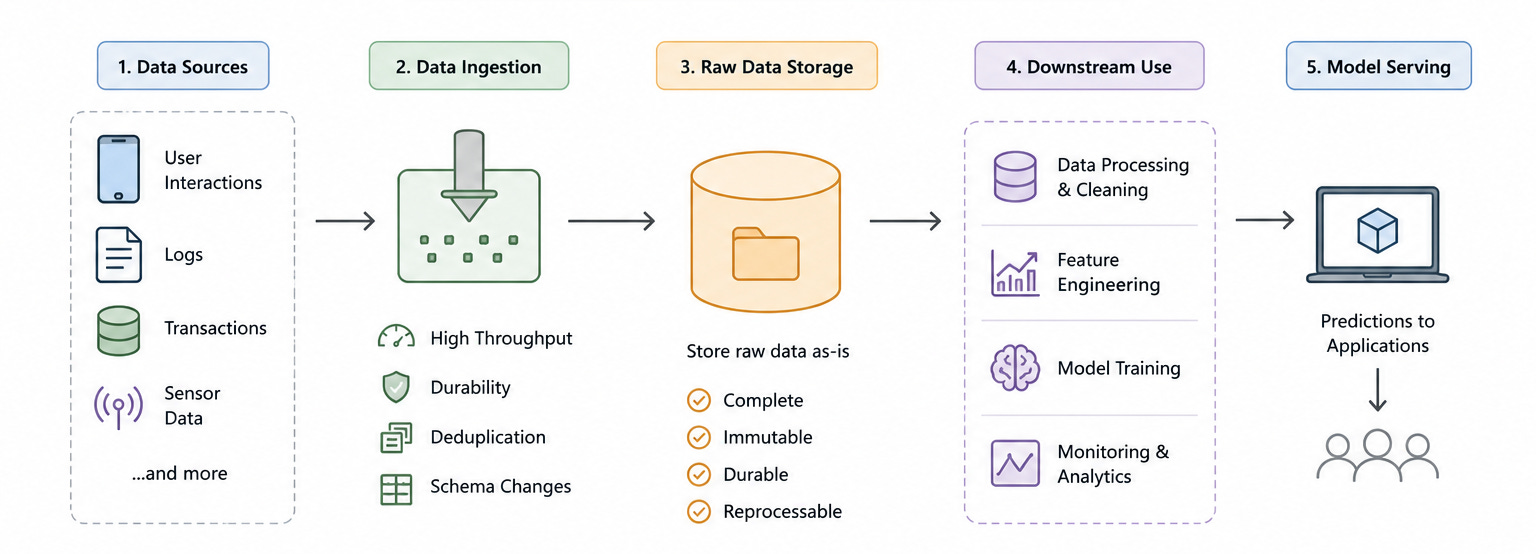
One of the biggest mindset shifts in machine learning System Design is realizing that the system is driven by data, not by the model. The model is just one component in a much larger system. If the data flow is broken, inconsistent, or delayed, the model becomes irrelevant.
An end-to-end ML system begins with data ingestion. This could include user interactions, logs, transactions, sensor data, or any signal relevant to the problem. These raw inputs are often messy, incomplete, and distributed across multiple sources.
The system must first collect this data reliably. That means handling high throughput, ensuring durability, dealing with duplicates, and managing schema changes. At a small scale, this step feels trivial. At a large scale, it becomes one of the most critical parts of the system.
Once data is ingested, it is stored in a raw format. This raw data becomes the foundation for everything that follows. If you lose it or corrupt it, you lose the ability to retrain models or debug issues later.
Transforming raw data into usable signals
Raw data is rarely useful in its original form. It needs to be cleaned, structured, and transformed into something that models can consume. This transformation layer is where much of the real work happens.
Data processing pipelines take raw inputs and apply filtering, aggregation, normalization, and enrichment. This step often involves distributed systems because the data volume can be massive. Batch processing is commonly used for historical data, while streaming systems handle real-time updates.
The goal is to create consistent, reliable datasets that can be used for feature engineering. This stage must handle edge cases such as missing data, out-of-order events, and inconsistent formats. If these issues are not addressed here, they propagate downstream and affect model performance.
At scale, the difference between a robust data pipeline and a fragile one becomes very clear. A well-designed pipeline can handle growth and change. A poorly designed one becomes a constant source of failures.
Feature engineering as the bridge between data and models
Once data is processed, it needs to be converted into features. Features are the signals that models use to make predictions. This step is often underestimated, but it has a significant impact on model performance.
Feature engineering involves creating meaningful representations of data. This might include aggregations, embeddings, or domain-specific transformations. The same feature may be used by multiple models, which introduces the need for consistency and reuse.
This is where feature stores often come into play. They provide a centralized way to define, compute, and serve features across both training and inference. Without this layer, feature logic can become fragmented, leading to inconsistencies between environments.
One of the key challenges here is maintaining training-serving consistency. The features used during training must match those used during inference. If they differ, the model’s behavior becomes unpredictable.
The training system and experimentation loop
With features in place, the system can move into model training. This is the part most people are familiar with, but in production systems, it is only one piece of the puzzle.
Training involves selecting algorithms, tuning hyperparameters, and evaluating performance on historical data. At scale, this process often requires distributed computing because datasets can be too large to fit on a single machine.
The training system also needs to support experimentation. Multiple models may be trained and compared to determine which one performs best. This requires tracking experiments, versioning datasets, and ensuring reproducibility.
Reproducibility is especially important. If a model performs well, you need to be able to recreate the exact conditions that produced it. This includes the data, features, and configuration used during training.
The output of this stage is not just a model. It is a versioned artifact that can be deployed and tracked.
Model validation and selection
Before a model is deployed, it needs to be validated. This step ensures that the model meets performance requirements and does not introduce regressions.
Validation typically involves offline evaluation using historical data. Metrics such as accuracy, precision, recall, or business-specific KPIs are used to assess performance. However, offline evaluation has limitations because it may not reflect current conditions.
This is why many systems include additional validation steps such as shadow testing or A/B testing. These methods allow the model to be evaluated using live data without fully committing to it.
Model selection is not just about choosing the highest-performing model. It also involves considering factors such as latency, resource usage, and stability. A slightly less accurate model may be preferred if it is significantly faster or more reliable.
Deployment and model serving
Once a model is validated, it is deployed to a serving environment. This is where the system starts interacting with real users.
Model serving systems are designed for low latency and high availability. They need to handle incoming requests, retrieve necessary features, run inference, and return predictions quickly. This often involves APIs, load balancers, and scalable infrastructure.
Serving introduces constraints that do not exist during training. Latency becomes critical, and resource usage must be controlled. This may require optimizing models, using caching, or precomputing certain results.
A key aspect of serving is version management. Multiple versions of a model may be deployed simultaneously, allowing for gradual rollouts and safe experimentation.
The role of feedback loops
An end-to-end machine learning system does not stop at serving predictions. It continues to evolve based on feedback.
Feedback comes from the outcomes of predictions. For example, a recommendation system may track clicks or purchases, while a fraud detection system may track confirmed fraud cases. This feedback is essential for evaluating model performance and improving future models.
The system must capture this feedback and link it to the original predictions. This requires careful logging and data management. Without this connection, it becomes difficult to measure performance accurately.
Feedback loops also introduce challenges. Data may be delayed, incomplete, or biased. The system needs to account for these factors when using feedback for retraining.
Monitoring and observability across the system
Monitoring is what keeps an end-to-end ML system reliable. It provides visibility into how the system is performing and helps detect issues early.
Monitoring should cover multiple aspects. Data pipelines should be monitored for delays and anomalies. Feature distributions should be tracked to detect drift. Model performance should be evaluated continuously. System metrics such as latency and error rates should also be tracked.
Observability goes beyond monitoring. It includes logging, tracing, and debugging capabilities that allow you to understand what is happening inside the system. When something goes wrong, you need to be able to trace it back to its source.
Without strong observability, the system becomes difficult to maintain. Issues take longer to diagnose, and failures become more costly.
Retraining and system evolution
Over time, models need to be updated. This may be due to new data, changing patterns, or improved techniques. Retraining is the process of updating models to keep them relevant.
Retraining can be scheduled or triggered by specific conditions such as data drift or performance degradation. The pipeline should support retraining without disrupting the rest of the system.
This is where the end-to-end nature of the system becomes clear. Data collected during serving feeds into training, which produces new models that are deployed back into serving. The system forms a continuous loop.
Managing this loop requires coordination. Changes in one part of the system can affect others. For example, updating a feature may require retraining models and updating serving systems.
Bringing all components together
When you look at all these components together, an end-to-end ML system starts to take shape as a connected system rather than a linear pipeline.
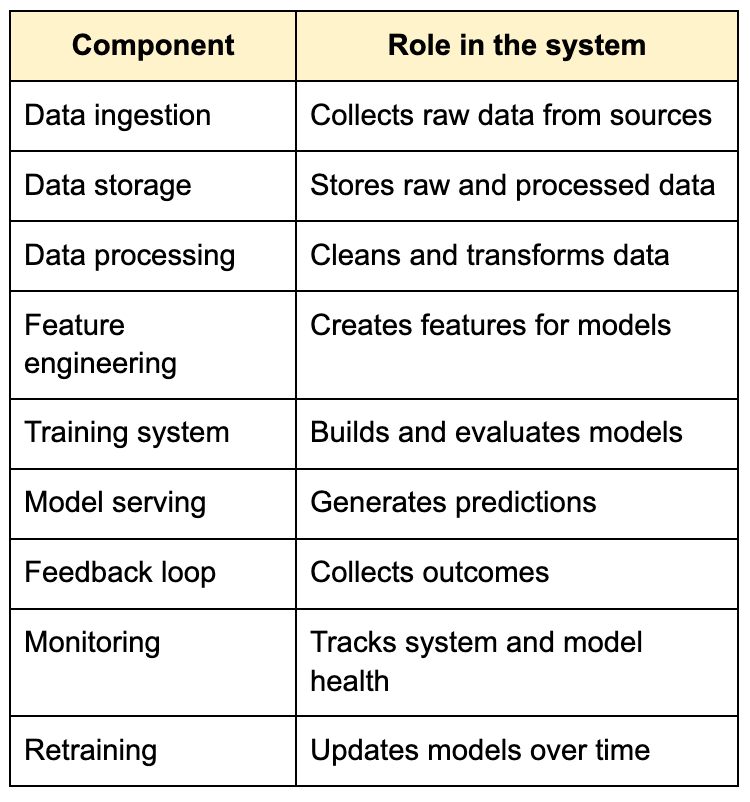
Each component has its own responsibilities, but they are all interconnected. The system’s behavior depends on how well these components work together.
Common failure modes in end-to-end systems
Understanding what an end-to-end system looks like also means understanding how it fails. Many failures are not obvious and do not cause immediate crashes.
One common failure is data inconsistency. If data pipelines produce inconsistent results, the model’s behavior becomes unpredictable. Another is feature drift, where feature distributions change over time, affecting model performance.
Latency issues can also arise in serving systems, especially when dependencies increase. Feedback loops can introduce bias if not handled carefully. Monitoring gaps can delay the detection of problems.
These failures highlight the importance of designing systems with observability, resilience, and adaptability in mind.
Final thoughts
An end-to-end machine learning system is not a static pipeline. It is a dynamic system that evolves over time. It starts with data, transforms that data into features, uses those features to train models, serves predictions, collects feedback, and continuously improves.
The model is only one part of this system. The real challenge lies in connecting all the pieces in a way that is consistent, scalable, and reliable.
In ML System Design interviews, understanding this holistic view is what sets strong candidates apart. It shows that you are not just thinking about models, but about systems that operate in real-world conditions.
And in practice, that is what matters. Because building a model is one thing. Building a system that keeps working as everything around it changes is something else entirely.