

What is high-level System Design? The foundation of every scalable software system
The architectural blueprint behind modern software systems

If you spend enough time learning about software architecture, preparing for System Design interviews, or working on large-scale applications, you will eventually encounter the term high-level System Design.
It is one of the most important concepts in software engineering, yet many engineers initially misunderstand what it actually means. Some assume it is simply drawing architecture diagrams. Others believe it is only relevant for senior engineers or software architects.
In reality, high-level System Design is the process of defining the major components of a system and how those components interact to achieve business goals. It provides the architectural blueprint that guides development, scalability, reliability, and future growth.
After spending years building large-scale systems at Microsoft and Meta, I found that strong high-level design skills often separate engineers who can build individual features from engineers who can design complete systems that survive real-world scale.
Understanding high-level System Design
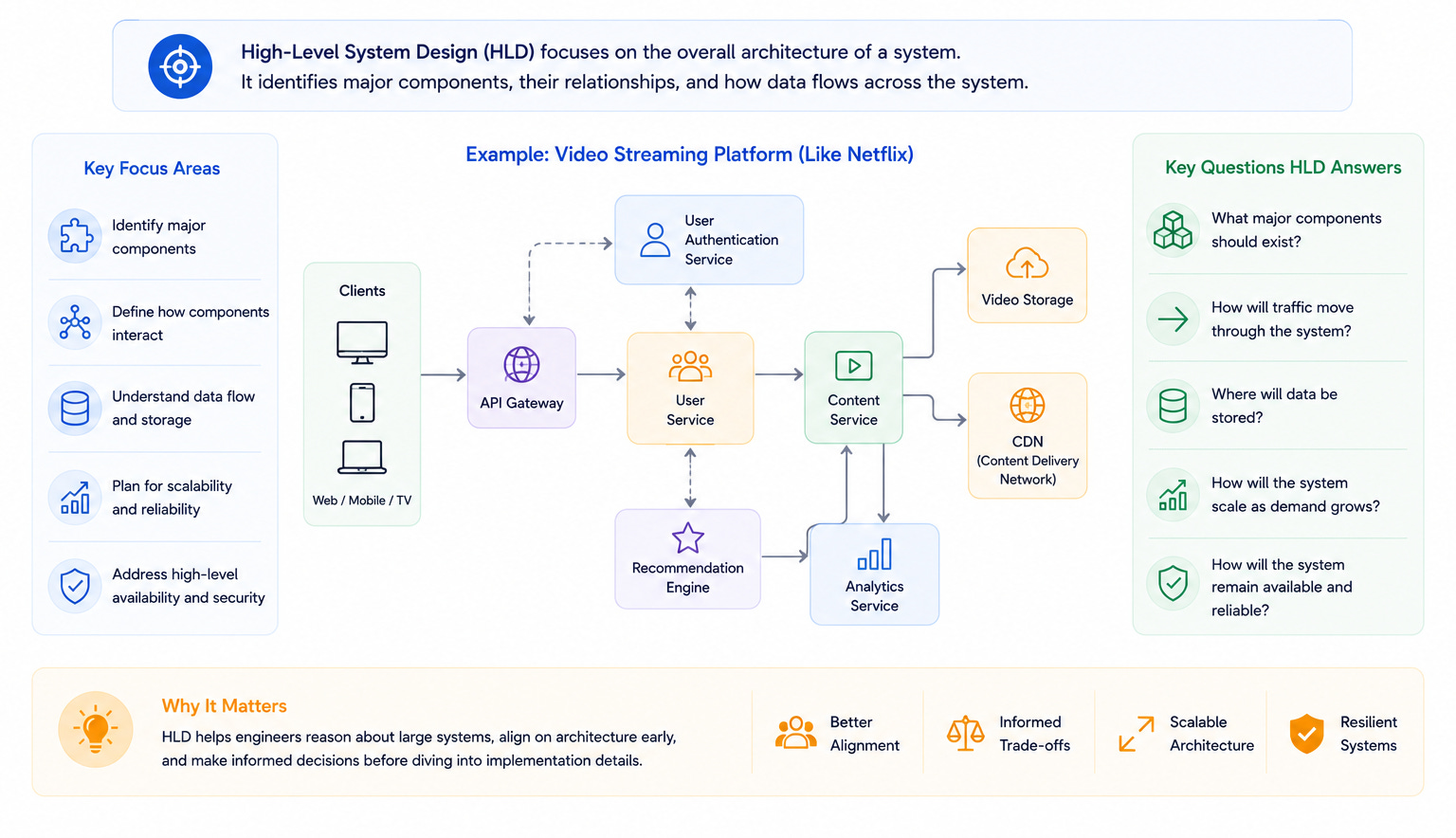
High-level System Design, often abbreviated as HLD, focuses on the overall architecture of a software system. Instead of discussing implementation details, classes, or code structure, it focuses on major system components and their relationships.
Imagine designing a video streaming platform similar to Netflix. A high-level design discussion during a System Design interview would identify major services such as user authentication, video storage, content delivery, recommendation engines, and analytics systems. It would also explain how these services communicate and how data flows through the system.
The emphasis is not on how individual classes are implemented. Instead, the focus is on answering broader architectural questions. What components should exist? How will traffic move through the system? Where will data be stored? How will the system scale as user demand grows?
This perspective allows engineers to reason about large systems without becoming distracted by implementation details too early in the design process.
Why high-level System Design matters
One of the biggest reasons high-level System Design matters when learning System Design fundamentals is that architectural decisions influence everything that follows. A poorly designed architecture can create scalability problems, reliability issues, operational complexity, and technical debt long before individual code decisions become relevant.
Consider a rapidly growing application. If the architecture does not account for scalability, even well-written code may struggle as traffic increases. If reliability is overlooked, outages become more frequent. If services are tightly coupled, future development becomes more difficult.
High-level design helps teams identify these challenges early. It allows engineers to evaluate different architectural approaches before significant implementation effort is invested. This often saves time, reduces costs, and prevents major redesigns later.
In large organizations, high-level design also improves communication. Architects, engineers, product managers, and stakeholders can discuss system behavior using a shared architectural view rather than focusing immediately on low-level technical details.
Key components of high-level System Design
Although every system is different, several components appear repeatedly in high-level designs because they solve common architectural challenges.
Client applications represent user-facing interfaces such as web applications and mobile apps. Application servers process requests and execute business logic. Databases store and retrieve data. Load balancers distribute traffic efficiently across multiple servers. Caching layers improve performance by reducing database load. Message queues support asynchronous processing. Monitoring systems provide operational visibility.
The specific combination of these components depends on the system being designed. A simple application may require only a few services, while a global platform may involve hundreds of interacting components.
The goal of high-level design is not to include every possible technology. The goal is to identify the components necessary to satisfy requirements while maintaining simplicity and scalability.
High-level design versus low-level design
One area that frequently causes confusion is the difference between high-level design and low-level design. While both are important, they address different aspects of software development.
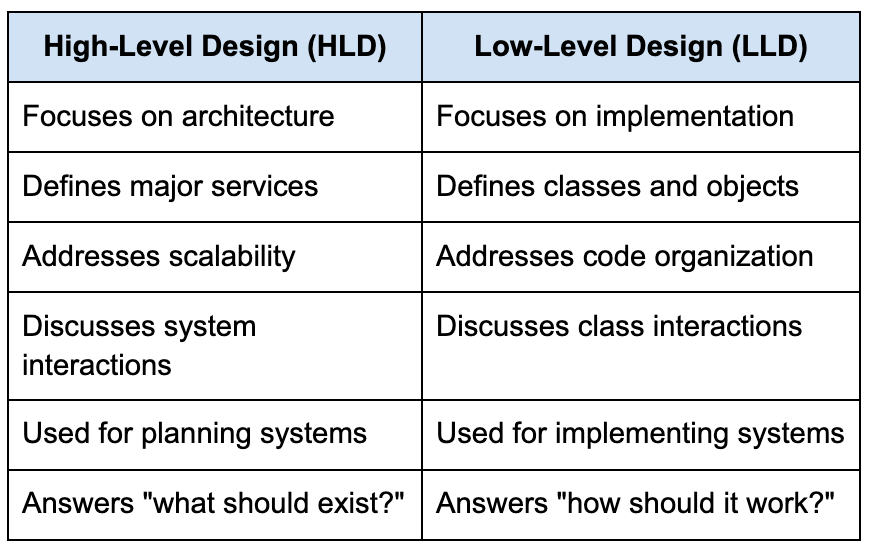
A useful way to think about the distinction is that high-level design creates the city map while low-level design creates the building blueprints. Both are necessary, but they operate at different levels of abstraction.
Strong engineers understand how these two perspectives connect because architecture ultimately influences implementation.
How scalability influences high-level design
Scalability is one of the most important considerations in high-level System Design because modern applications often experience significant growth over time. Systems that perform well with a thousand users may struggle dramatically with a million users.
This is why architects frequently discuss concepts such as horizontal scaling, load balancing, partitioning, replication, and content delivery networks during high-level design discussions. These mechanisms help systems handle increasing traffic while maintaining acceptable performance.
The challenge is balancing scalability with complexity. Introducing distributed databases, microservices, and advanced infrastructure too early can create unnecessary operational overhead. On the other hand, ignoring scalability entirely can lead to costly redesigns later.
Reliability and fault tolerance in high-level design
Reliability is another critical concern because large-scale systems must continue operating despite failures. Servers crash, networks experience outages, and databases become unavailable. High-level design must account for these realities.
Architects often introduce redundancy, replication, failover mechanisms, and disaster recovery strategies to improve reliability. These approaches help ensure that individual component failures do not bring down the entire system.
One reason reliability appears frequently in System Design interviews is that it reveals engineering maturity. Candidates who design only for normal operation often overlook real-world challenges. Strong candidates assume failures will occur and design systems capable of handling them gracefully.
High-level design provides the opportunity to identify reliability requirements early and build resilience into the architecture from the beginning.
A practical high-level design example
Consider designing an e-commerce platform. At a high-level, the architecture may include user services, product catalog services, inventory management systems, order processing services, payment systems, and recommendation engines.
Users interact with the platform through web or mobile applications. Requests pass through load balancers before reaching application services. Product information is stored in databases, while frequently accessed content is cached to improve performance. Order processing may use asynchronous messaging systems to coordinate inventory updates and payment workflows.
The architecture focuses on how these major components interact rather than how individual classes are implemented. Engineers can use this blueprint to guide future development while maintaining alignment across teams.
This example demonstrates why high-level design is often described as the architectural foundation of software systems.
High-level System Design interviews
Many technology companies include high-level design interviews because they evaluate an engineer’s ability to think beyond individual features. Interviewers want to understand how candidates approach scalability, reliability, data management, and architectural tradeoffs.
Common interview questions involve designing systems such as social media platforms, messaging applications, video streaming services, ride-sharing platforms, or e-commerce websites. Candidates are expected to clarify requirements, estimate scale, create architectures, identify bottlenecks, and discuss tradeoffs.
Strong candidates focus on reasoning rather than memorization. They explain why components exist and how those components address specific requirements. Interviewers are usually more interested in the decision-making process than in any particular architecture diagram.
This is why understanding high-level design concepts often provides value far beyond interview preparation.
Skills required to become good at high-level System Design
Several skills contribute directly to strong high-level design capabilities.
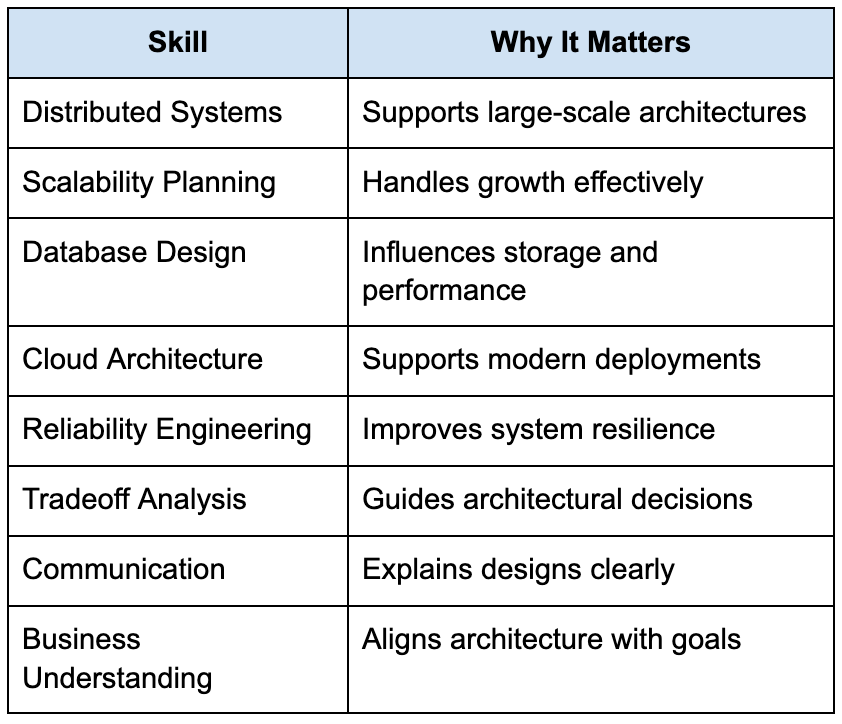
These skills develop over time through a combination of study, practical experience, and exposure to real-world systems.
The most effective way to improve is by designing systems regularly and reflecting on the tradeoffs behind architectural decisions.
Common mistakes in high-level System Design
One common mistake is introducing excessive complexity before it becomes necessary. Engineers sometimes assume that advanced architectures automatically create better systems. In reality, complexity should solve specific problems rather than exist for its own sake.
Another frequent issue involves focusing too heavily on technology choices. Strong high-level design starts with requirements and constraints. Technology selection follows naturally from those decisions.
Ignoring reliability, scalability, or operational concerns can also weaken a design significantly. Successful systems must function effectively under real-world conditions, not just ideal scenarios.
The strongest architects balance simplicity, scalability, reliability, and maintainability while remaining focused on business goals.
Final thoughts
High-level System Design is the process of defining a software system’s overall architecture and establishing how major components interact to meet business and technical requirements. It provides the blueprint that guides development, influences scalability, supports reliability, and shapes future growth. While low-level design focuses on implementation details, high-level design focuses on the bigger picture that makes those implementations possible.
After years of designing systems at Microsoft and Meta, I found that strong high-level design skills consistently distinguished engineers who could think beyond individual features and reason about complete systems. They understood how data moved through architectures, how bottlenecks emerged, and how tradeoffs influenced engineering decisions.
If you want to become a stronger software engineer, investing time in high-level System Design is one of the most valuable steps you can take. It improves not only your interview performance but also your ability to build software that remains scalable, reliable, and maintainable as it grows. Ultimately, every successful system begins with a strong architectural foundation, and high-level design is where that foundation is created.