

What programming language should you actually use for Machine Learning?
Why choosing a programming language for machine learning is really a System Design decision

A few years ago, I was reviewing a machine learning pipeline that had been built by a small team trying to move quickly. The model itself was reasonable, the data pipeline was functional, and the system was already in production. But there was one recurring issue that kept coming up in every discussion.
The team could not agree on the programming language they should be using going forward.
Some engineers wanted to standardize on Python because of its ecosystem. Others argued for using a compiled language for performance. A few suggested introducing multiple languages depending on the stage of the pipeline. Each argument had merit, but none of them addressed the underlying question clearly.
“What programming language should you use for machine learning?”
At first glance, it seems like a tooling decision. In practice, it is a System Design decision.
Because the language you choose does not just affect how you write models. It affects how you structure data pipelines, how you deploy systems, how you scale infrastructure, and how you reason about performance and reliability over time.
Understanding this choice requires stepping away from preferences and looking at how machine learning systems are actually built.
Why this question is often misunderstood
Most discussions around programming languages for machine learning focus on popularity or ecosystem size. Python is often presented as the default choice, while other languages are positioned as niche or specialized alternatives.
This framing is incomplete.
Machine learning System Designs are not built in a single layer. They consist of multiple components, each with different requirements. Data ingestion, feature engineering, model training, evaluation, deployment, and serving all introduce distinct constraints. A language that works well for one stage may not be optimal for another.
When beginners ask which language they should learn, they are often looking for a single answer that applies universally. In practice, the answer depends on what part of the system they are interacting with and what level of control they need over that component.
The difficulty comes from trying to reduce a multi-layered system into a single language decision.
The role of Python and why it dominates
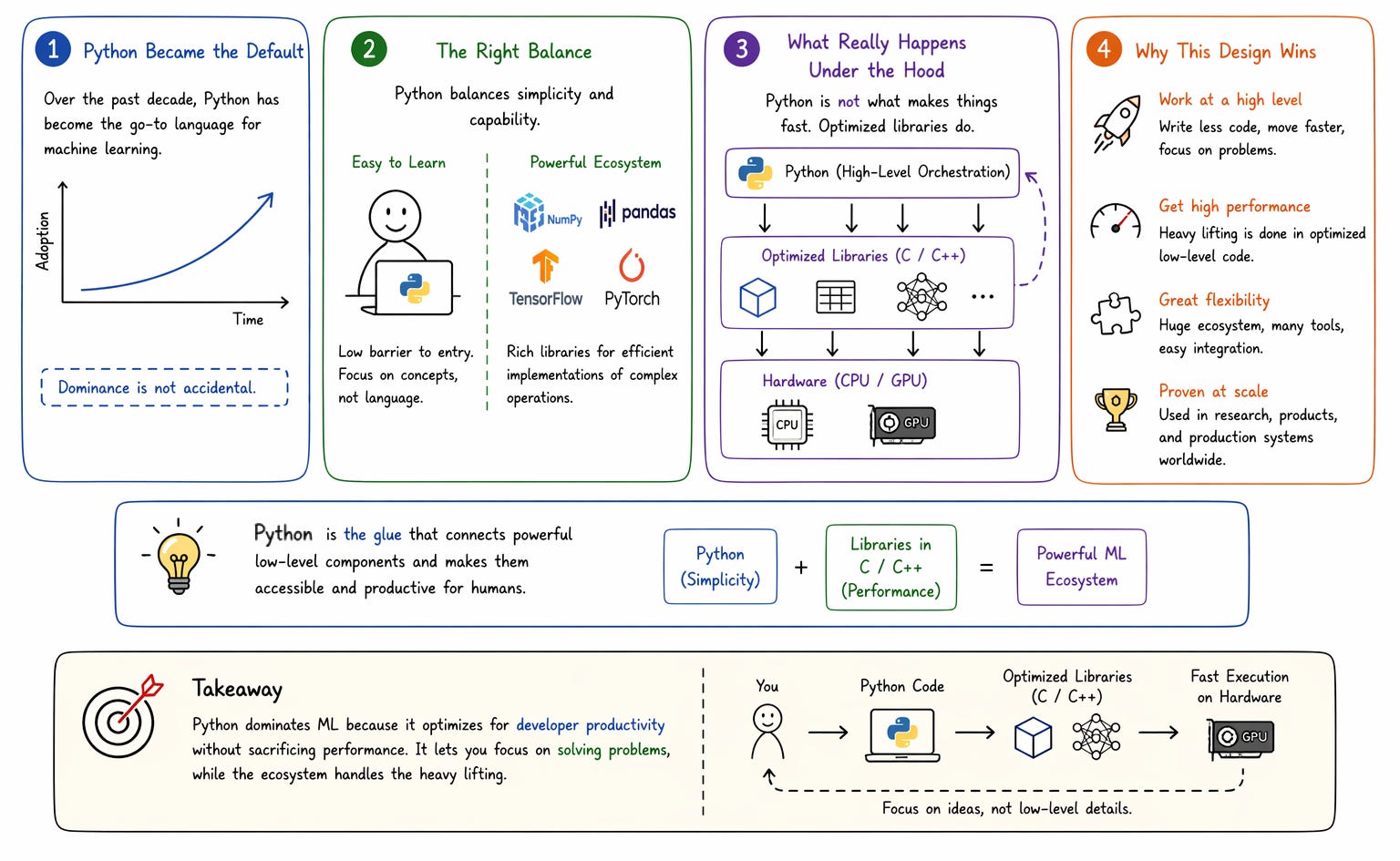
It is difficult to discuss machine learning without acknowledging the role Python plays in the ecosystem. Over the past decade, Python has become the default language for most machine learning workflows, and this dominance is not accidental.
Python provides a balance between simplicity and capability that aligns well with the needs of machine learning practitioners. Its syntax lowers the barrier to entry, allowing beginners to focus on concepts rather than language complexity. At the same time, its ecosystem includes libraries such as NumPy, pandas, TensorFlow, and PyTorch, which provide efficient implementations of complex operations.
The key detail that is often overlooked is that Python itself is not responsible for the performance of these systems. The heavy computation is handled by optimized libraries written in lower-level languages such as C and C++. Python acts as an orchestration layer that connects these components and provides a user-friendly interface.
This design allows developers to work at a high level while still benefiting from low-level performance optimizations. It also explains why Python remains dominant despite not being a high-performance language in the traditional sense.
What you are really choosing when you pick a language
Choosing a programming language for machine learning is not just about syntax or developer experience. It is about selecting an interface to a set of abstractions.
When you choose Python, you are choosing an ecosystem that prioritizes rapid experimentation, flexibility, and access to a wide range of tools. When you choose a language like C++ or Rust, you are prioritizing control over memory, performance, and system-level behavior.
These choices reflect different stages of system development.
In the early stages of building a machine learning system, the ability to iterate quickly is often more valuable than raw performance. You need to experiment with different models, test hypotheses, and refine your approach based on data. In this context, a language that enables rapid development is a better fit.
As systems mature and move into production, performance and reliability become more important. At this stage, you may need to optimize specific components, reduce latency, or handle large-scale data processing. This is where lower-level languages or specialized frameworks may come into play.
The language choice evolves with the system.
Data processing and the role of high-level languages
One of the first stages in any machine learning pipeline is data processing. This involves cleaning data, transforming it into usable formats, and extracting features that can be used by models.
High-level languages like Python are particularly well-suited for this stage because they provide libraries that simplify working with structured and unstructured data. Tools like pandas allow developers to manipulate datasets with operations that would be significantly more complex to implement from scratch in lower-level languages.
This abstraction reduces the cognitive load associated with data manipulation and allows developers to focus on understanding the data itself rather than the mechanics of processing it.
However, this convenience comes with trade-offs. High-level abstractions can hide performance bottlenecks, especially when dealing with large datasets. In such cases, developers may need to optimize specific operations or offload processing to distributed systems that are implemented in more performant languages.
Model training and the abstraction of complexity
Training machine learning models involves computationally intensive operations, particularly when working with large datasets or complex architectures such as deep neural networks.
In practice, these operations are not implemented directly in the high-level language used by the developer. Instead, they are handled by specialized libraries that leverage optimized numerical routines and hardware acceleration.
For example, frameworks like TensorFlow and PyTorch use backend implementations written in C++ and CUDA to perform matrix operations efficiently on CPUs and GPUs. The developer interacts with these frameworks through Python, which acts as a layer of abstraction.
This separation of concerns allows developers to work with complex models without needing to manage low-level details such as memory allocation or parallel computation. It also means that the choice of programming language at this stage is less about performance and more about usability and ecosystem support.
Deployment and the need for different constraints
Once a model is trained, it needs to be deployed in a way that allows it to serve predictions in real time or batch processes. This stage introduces a different set of constraints that influence language choice.
In a production environment, factors such as latency, throughput, and reliability become critical. A model that performs well during training may not be suitable for deployment if it cannot meet these requirements.
This is where the limitations of high-level languages can become more apparent. While Python is widely used for deployment, it may not always provide the level of performance required for certain applications, particularly those with strict latency constraints.
In such cases, developers may choose to implement parts of the system in languages like Java, Go, or C++, which offer better performance characteristics and integration with existing infrastructure.
The model itself may still be trained in Python, but the serving layer may use a different language to meet operational requirements.
Multi-language systems are the norm, not the exception
One of the most important insights when working with machine learning systems is that they are rarely built using a single programming language.
A typical production system might use Python for data processing and model training, SQL for data storage and querying, Java or Go for serving APIs, and C++ for performance-critical components. Each language is chosen based on the specific requirements of the component it supports.
This multi-language approach reflects the complexity of real-world systems. It allows teams to leverage the strengths of different languages while mitigating their weaknesses.
For beginners, this can feel overwhelming because it suggests that there is no single language that covers all aspects of machine learning. However, it also means that you do not need to learn everything at once. Starting with a language that provides the most flexibility and ecosystem support is often the most practical approach.
How System Design influences language decisions
As machine learning systems scale, language choices become more closely tied to System Design considerations.
For example, a system that processes large volumes of streaming data may require a language that integrates well with distributed processing frameworks. A system that serves real-time predictions may prioritize low-latency languages for its inference layer. A system that relies on heavy numerical computation may benefit from optimized libraries written in lower-level languages.
These decisions are not made in isolation. They are influenced by factors such as team expertise, existing infrastructure, and long-term maintenance considerations.
In many cases, the choice of language is less about finding the “best” option and more about finding the one that aligns with the constraints of the system and the organization.
What beginners should focus on first
For someone starting from scratch, the goal is not to optimize for every possible use case. It is to build a strong foundation that allows you to understand how machine learning systems work and how different components interact.
In this context, Python remains the most practical choice for beginners. It provides access to a rich ecosystem of tools and resources that simplify the learning process. More importantly, it allows you to focus on concepts such as data representation, model behavior, and evaluation without being distracted by low-level implementation details.
As you gain experience, you can begin to explore other languages and understand where they fit within the broader system. This progression mirrors how machine learning systems are built in practice, where different components are optimized based on their specific requirements.
A more accurate way to think about the question
Instead of asking which programming language you should use for machine learning, it is more useful to ask how different languages contribute to the system as a whole.
Machine learning is not a monolithic activity. It is a collection of processes that operate across different layers of abstraction. Each layer has its own requirements, and the choice of language reflects those requirements.
By understanding this, you can make more informed decisions about which languages to learn and when to use them. You can also avoid the trap of treating language choice as a binary decision rather than as part of a broader System Design.
Closing perspective
The question of which programming language to use for machine learning does not have a single answer because it depends on the context in which the system operates.
Python has become the default choice because it provides a balance between ease of use and access to powerful tools. However, it is not the only language involved in building machine learning systems, nor is it always the best choice for every component.
What matters more than the language itself is your ability to understand how machine learning systems are structured and how different components interact. Once you have that understanding, the choice of language becomes a matter of aligning tools with the requirements of the problem you are solving.
In practice, the most effective engineers are not those who commit to a single language, but those who understand where each language fits within the system and how to use it to solve specific challenges.