

Why Every ML Engineer Should Understand MLOps and System Design
How MLOps turns machine learning systems into reliable, scalable production software

I’ve seen teams build impressive machine learning models that never made it to production, and I’ve also seen simple models quietly drive millions in business impact because they were embedded in well-designed systems. The difference between those two outcomes is rarely the model itself. It usually comes down to how the system around the model is designed, operated, and maintained over time.
That gap is exactly where MLOps comes in.
MLOps is often introduced as “DevOps for machine learning,” but that description is incomplete. It captures the idea of automation and pipelines, but it misses the deeper connection to System Design. MLOps is not just about tooling or workflows. It is about building ML systems that can operate reliably in production, evolve over time, and handle real-world complexity.
If you think of machine learning System Design as the blueprint of how a system should work, MLOps is how that blueprint is implemented, maintained, and continuously improved. You cannot separate the two. A System Design that ignores operational realities will fail, and MLOps practices without a strong design foundation will become fragile and hard to scale.
Understanding what MLOps actually is
At its core, MLOps is a set of practices that bring discipline to the lifecycle of machine learning systems. It covers everything from data ingestion and feature engineering to model training, deployment, monitoring, and retraining. The goal is to make this lifecycle repeatable, reliable, and scalable.
What makes MLOps different from traditional DevOps is that it has to deal with data and models as first-class citizens. In a typical software system, the code defines behavior. In an ML system, behavior is influenced by both code and data, and data changes over time.

This introduces a new dimension of complexity. You are not just deploying code. You are deploying models trained on specific datasets, with specific feature transformations, and those assumptions can become invalid as data evolves.
MLOps exists to manage that complexity.
Why traditional software practices are not enough
If you approach ML systems using only traditional software engineering practices, you will quickly run into limitations. Code versioning, CI/CD pipelines, and monitoring are necessary, but they are not sufficient.
In ML systems, data is constantly changing. New data arrives, distributions shift, and patterns evolve. A model that worked yesterday may not work tomorrow, even if the code remains unchanged. This is fundamentally different from most software systems, where behavior is deterministic.
This means you need to version not just code, but also data, features, and models. You need to track how models were trained, what data they used, and how they perform over time. You need to monitor not just system metrics, but also model performance and data quality.
Traditional DevOps practices do not account for these requirements. MLOps extends those practices to handle the unique challenges of machine learning.
The ML lifecycle and where MLOps fits
To understand how MLOps relates to System Design, it helps to look at the ML lifecycle as a whole. An ML system typically goes through several stages, each of which introduces its own challenges.
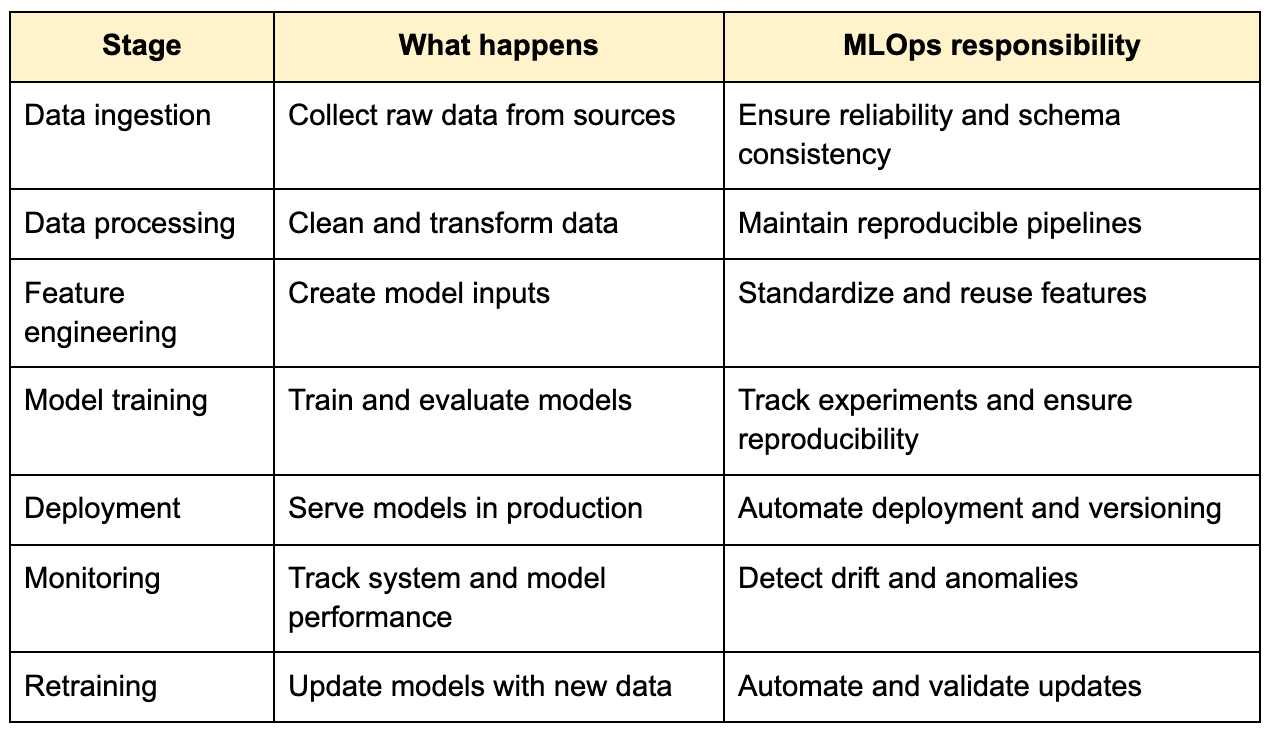
MLOps connects all these stages into a cohesive system. It ensures that each stage is not only functional but also integrated with the others in a way that supports continuous operation.
This is where the relationship with System Design becomes clear. System Design defines the structure of these stages, while MLOps ensures they work together reliably.
Reproducibility as a core principle
One of the most important aspects of MLOps is reproducibility. In traditional systems, if something breaks, you can often reproduce the issue by running the same code. In ML systems, reproducing behavior requires more than just code.
You need the same data, the same feature transformations, and the same model configuration. Without this, debugging becomes extremely difficult. A model may behave differently simply because the data has changed or a feature was computed differently.
MLOps practices enforce reproducibility by tracking experiments, versioning datasets, and maintaining consistent pipelines. This allows teams to understand how a model was created and how it can be recreated if needed.
From a System Design perspective, this means designing pipelines and storage systems that support versioning and traceability from the beginning.
Automation and pipeline orchestration
As ML systems grow, manual processes become unsustainable. Training models, validating them, and deploying them manually introduces delays and increases the risk of errors. Automation becomes essential.
MLOps introduces automated pipelines that handle tasks such as data processing, model training, evaluation, and deployment. These pipelines are orchestrated to run in the correct order and handle failures gracefully.
Automation is not just about efficiency. It is about consistency. When processes are automated, they are executed the same way every time, reducing variability and improving reliability.
From a System Design perspective, this means building systems with clear boundaries and interfaces that can be automated effectively. Pipelines should be modular, with well-defined inputs and outputs.
Model deployment as an engineering problem
Deploying a model is not just about exposing it through an API. It involves managing versions, ensuring compatibility with features, handling scaling, and minimizing latency.
MLOps practices treat model deployment as an engineering problem. Models are versioned, tested, and deployed using controlled processes. Techniques like canary releases, shadow deployments, and A/B testing are used to validate models in production.
This is where System Design and MLOps intersect strongly. The design must support safe deployment strategies, while MLOps ensures those strategies are executed correctly.
For example, a System Design might include a model registry and a serving layer that supports multiple model versions. MLOps practices ensure that models move through this system in a controlled and observable way.
Monitoring and drift detection
One of the defining characteristics of ML systems is that they change over time. Data distributions shift, user behavior evolves, and models degrade. Monitoring is essential to detect these changes.
MLOps extends monitoring beyond system metrics to include model and data metrics. This includes tracking feature distributions, prediction outputs, and business outcomes.
Drift detection is a key part of this process. It involves identifying when data or model behavior changes in a way that affects performance. This requires comparing current data with historical baselines and monitoring performance metrics over time.
From a System Design perspective, this means building systems that capture and store the necessary data for monitoring. It also means designing alerting mechanisms that trigger when thresholds are exceeded.
Feedback loops and continuous improvement
An ML system does not stop after deployment. It continues to learn from new data and improve over time. Feedback loops are what make this possible.
MLOps ensures that predictions and outcomes are captured and fed back into the system. This data is used to evaluate model performance and retrain models when necessary.
Handling feedback is not trivial. Data may be delayed, incomplete, or biased. The system needs to account for these challenges to ensure that retraining improves performance rather than degrading it.
This is another area where System Design and MLOps are closely linked. The design must include mechanisms for capturing and linking feedback, while MLOps ensures that this data is used effectively.
Scaling ML systems with MLOps
As systems scale, the complexity of managing them increases significantly. More data, more features, more models, and more users all introduce new challenges.
MLOps provides the structure needed to handle this complexity. It standardizes processes, enforces best practices, and ensures that systems remain manageable as they grow.
For example, feature stores enable consistent feature usage across models. Model registries track versions and metadata. Automated pipelines handle training and deployment. Monitoring systems provide visibility into system behavior.
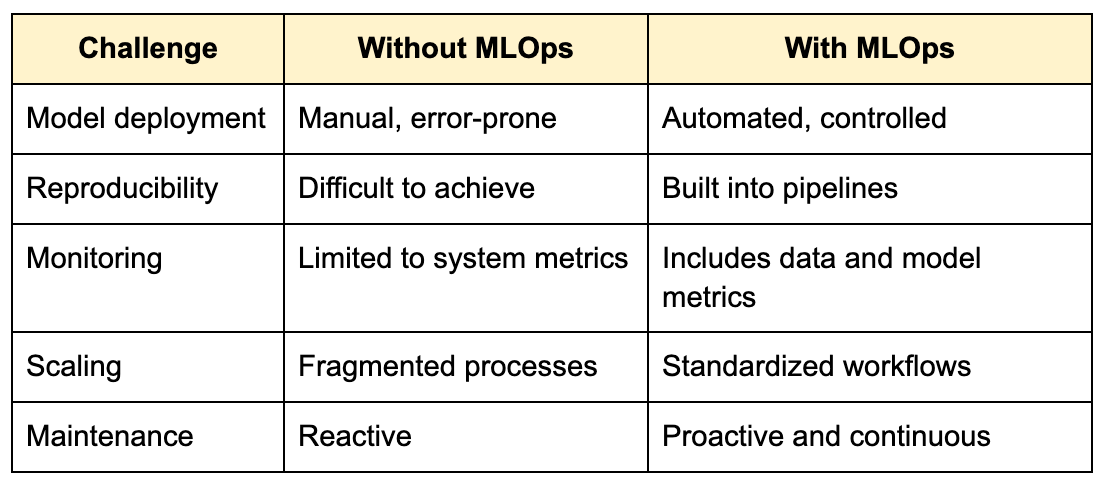
This comparison highlights how MLOps transforms ML systems from experimental setups into production-ready systems.
Common misconceptions about MLOps
One common misconception is that MLOps is just about tools. While tools are important, they are only part of the solution. MLOps is fundamentally about practices and processes.
Another misconception is that MLOps is only needed for large systems. In reality, even small systems benefit from MLOps principles. Starting with good practices early makes it easier to scale later.
A third misconception is that MLOps replaces System Design. In reality, it complements it. A well-designed system provides the structure, and MLOps ensures that the structure is maintained and evolved over time.
How to think about MLOps in interviews
In ML System Design interviews, mentioning MLOps is not about listing tools or frameworks. It is about demonstrating that you understand how systems operate in production.
You should be able to explain how models are versioned, how deployments are managed, how monitoring is implemented, and how retraining is handled. You should connect these practices to the overall System Design.
For example, when designing a recommendation system, you might discuss how new models are trained and deployed, how performance is monitored, and how feedback is used for improvement. This shows that you are thinking beyond the initial design.
The relationship between MLOps and System Design
The relationship between MLOps and ML System Design is not hierarchical. One does not replace the other. They are complementary.
System Design defines what the system should look like. It outlines components, data flows, and interactions. MLOps defines how that system is built, operated, and maintained.
A good System Design without MLOps is theoretical. It may look correct on paper but fail in practice. MLOps without good System Design becomes chaotic, with processes that are difficult to manage and scale.
The strongest systems combine both. They have clear architectures and disciplined operational practices.
Final thoughts
MLOps is what turns machine learning from an experimental activity into an engineering discipline. It brings structure, reliability, and scalability to systems that would otherwise be fragile and difficult to maintain.
Understanding MLOps means understanding how ML systems behave over time. It means thinking about data, models, pipelines, and feedback as interconnected parts of a larger system.
In the context of ML System Design, MLOps is not an optional layer. It is a fundamental part of building systems that work in real-world conditions.
If you can explain how MLOps supports System Design, you demonstrate that you are not just thinking about models, but about systems that continue to operate and improve long after they are deployed. And that is exactly what production ML is all about.